
Protecting their students from ICE, the other job for some teachers in the US: ‘They can’t take any of our children’
At the start of the school year in the country’s second-largest school district, dozens of educators and volunteers patrol the streets of LA to warn families about possible immigration sweeps
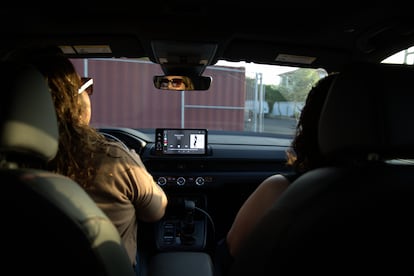

One hour before classes start at hundreds of Los Angeles schools, elementary teachers Ingrid Villeda and Olga drive through the southside neighborhoods of the city, where Hispanic residents are the majority. It is 6.58 am and many in this neighborhood are still asleep. As they approach two black pickup trucks, they slow down and watch them closely. They suspect the vehicles could belong to agents from the U.S. Immigration and Customs Enforcement (ICE), possibly stationed there awaiting the start of a raid. Ingrid takes out her cellphone and photographs the license plates of one of the vehicles. A few blocks later, Ingrid sums up the purpose of their volunteer work in one sentence: ‘They can’t take any of our children.’
Both educators say they did not miss a single day last school year of what they call ‘community patrols,’ in which they monitor the surroundings of various schools to detect possible ICE activity. They are part of a network made up of teachers, school staff, activists and community members carrying out similar work across L.A. Their goal is to prevent students and parents from being detained by immigration officers, a threat that has become constant since the administration of Donald Trump intensified its controversial plan of mass arrests and deportations last summer.
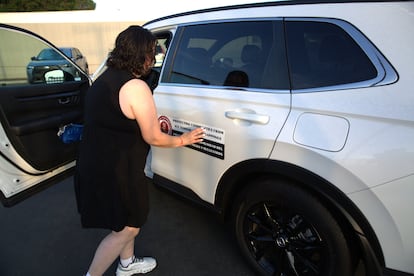
‘We do it because this affects our families, our children. Their parents are afraid to go out. But if we know something is happening in the community, we can warn them,’ says teacher Olga, who prefers to keep her name and the school where she works anonymous. She spent the early morning driving through south Los Angeles. Her colleague Ingrid guides her as a passenger. To identify themselves as part of the volunteer watchers, they have placed two magnets on the sides of the vehicle reading: ‘Protecting communities from ICE terror and kidnappings.’ The morning seems calm, but they remain on alert. ‘Twice they’ve been a few blocks from here and they picked someone up,’ Olga says.
ICE tension with LAUSD
ICE already has a contentious history with the Los Angeles Unified School District (LAUSD), which serves more than 370,000 students, about 70% of them Hispanic. Since last year, its agents have detained at least two students and, according to activists, several parents who were on their way to or returning from dropping off their children at public schools.
One of the affected students, a 15-year-old Hispanic teen with special needs, was held at gunpoint by federal agents in August 2025 outside Arleta High School. The youth was handcuffed after he was mistaken for a person they were seeking, according to authorities. He remained in detention until agents spoke with family members, school officials and local police, after which he was released.
A few days later, Benjamin Marcelo Guerrero Cruz, 18, a student at Reseda Charter High School, was intercepted by masked agents while walking his dog. ICE had targeted him because his tourist visa had expired in 2023. The young man was initially taken to the detention center in Adelanto, in California’s high desert, and was later transferred, without his parents’ knowledge, to another immigration facility in Arizona, more than 400 miles (nearly 670 km) from his home. At one point, authorities considered sending him to a detention center in Louisiana as a step toward deportation to Chile. Three months after his arrest, he was released and reunited with his family.
These incidents led LAUSD, the country’s second-largest school district, to reinforce security measures across its more than 1,500 schools. Those measures include ‘a visible presence in affected communities and rapid-response protocols for any possible actions by authorities,’ the district said in a statement sent to EL PAÍS. ‘All children must be in school and we will do everything in our power to keep our schools safe, welcoming and conducive for everyone,’ it added.
At the start of the current school year, dozens of volunteers organized by the group Unión del Barrio were deployed to monitor the areas around schools in Koreatown, Downtown, South Central, Filipino Town, Boyle Heights and other neighborhoods. About 60 people, including educators, received training for this specific task last Saturday at the United Teachers Los Angeles (UTLA) offices. They were told they have the right to document ICE activity with their cellphones, but were also warned about the risks of doing so: they too could end up detained. ‘There can still be violence, there can be arrests by ICE agents, even if we do nothing illegal,’ says Ron Gochez, a teacher at Maya Angelou High School and a leader of Unión del Barrio.
The return to classes was marked by a poignant image the principal of Maya Angelou posted publicly as a symbol of this new reality: a photo of a graduate with her mother watching the ceremony from a cellphone screen. ‘The mother was deported and was watching her daughter’s graduation from Tijuana, Mexico. It’s a reality for many students who have been directly affected by these raids or who live in fear of being affected,’ Gochez says.
This educator says several of his students have been separated from their parents since Trump returned to the White House. This Wednesday he drove through some city streets, as he has done for several years, looking for immigration agents. ‘We’ve seen an increase in operations in recent months. We know activity dipped for a while, but now it has increased again,’ he says.
A secret code in case agents arrive
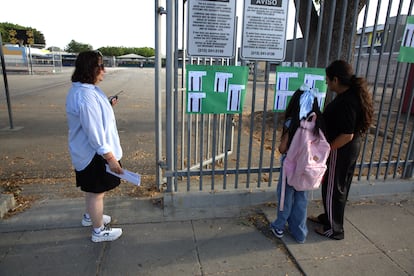
At 93rd Street Elementary in south Los Angeles, where teacher Ingrid Villeda works, the ‘community patrols’ are only the first line of monitoring. A second phase is activated with the support of four volunteers stationed at the corners closest to the school. They wear reflective vests and stay in contact via civilian-band radios.
During the first two days of the return to classes for nearly 700 students, from kindergarten through sixth grade, mostly Hispanic, school leaders also adopted another measure: allowing parents to accompany their children onto the schoolyard. ‘It’s safer because we can close the doors and keep parents inside if ICE comes,’ explains Ingrid, who greets students at the entrance. She greets one boy and his mother with particular warmth, in Spanish. ‘We take great care of them; they are a vulnerable family,’ she says.
For this teacher, it is personal. She came to Los Angeles from Guatemala when she was 10 and was undocumented for many years. In 1986, when she was in her first semesters of college, she was able to regularize her status thanks to the amnesty promulgated by President Ronald Reagan. ‘It makes me very sad. I never thought we would live through what we are living now,’ she laments.
Ingrid, who has taught sixth grade, joined the ‘community patrols’ in 2020, at the end of Trump’s first term, and over the years has become an observer of ICE operations. She knows the main streets where, she says, agents usually travel; she can identify movements she interprets as surveillance activity preceding a raid and says she has detected vehicles with switched plates. She even knows, she says, a southside gas station where agents often gather before taking action.
At 93rd Street Elementary they also have a secret code to alert staff to a possible ICE presence and immediately trigger the closure of doors and the sheltering of students. Staff are also prepared to notify families via emails and text messages. ‘We alert them so they don’t come or so they can be careful,’ Ingrid says.
The teacher also runs courses for families on how to act during a raid and what to do if they are detained. ‘We end up exhausted,’ Ingrid says as she finishes her morning watch and prepares to begin her workday. ‘But we also feel satisfied because parents tell us they feel protected.’
Sign up for our weekly newsletter to get more English-language news coverage from EL PAÍS USA Edition









































