
Fuad Gaši, coordinator of the Svalbard Global Seed Vault: ‘We have more than 1.4 million samples and the door is only opened three times a year’
The professor of genetics and plant breeding heads the institution that safeguards the biodiversity of our planet’s crops: ‘We are preserving the history of agriculture’
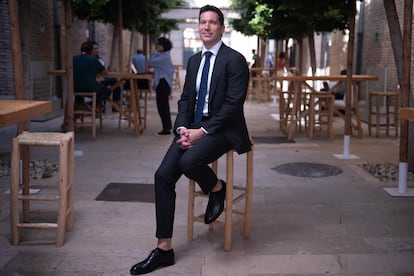

It has been referred to as the “Doomsday Vault” or the “End of the World Vault.” But Fuad Gaši, who has been in charge of the Svalbard Global Seed Vault’s coordination since June of this year, prefers to speak about this seed bank in a somewhat more poetic and hopeful way. He sees the institution — which is located in the Norwegian archipelago of Svalbard — as a repository of knowledge that ensures the biodiversity of our planet’s crops.
This 46-year-old professor of genetics and plant breeding was born in Bosnia-Herzegovina. In the 1990s, during the Bosnian War, he emigrated to Sweden as a refugee. He eventually returned to his home country, studying agriculture sciences and genetics, before taking up a teaching post at the University of Sarajevo.
While studying, Gaši became interested in the work of seed banks, which preserve different varieties of plant species. He came into contact with the SEEDnet project (South East European Development Network on Plant Genetic Resources), which is dedicated to developing gene banks in Eastern European countries.
In 2008, he launched the first plant gene bank in Bosnia and Herzegovina. However, during the COVID-19 pandemic, the bank ran into financial difficulties. Åsmund Asdal, then-coordinator of the Svalbard Global Seed Vault, encouraged Gaši to send duplicates of the seeds stored in Sarajevo to the BOLD project (Biodiversity for Opportunities, Livelihoods and Development) and invited him to deposit a second set in the renowned Norwegian vault.
At the time, this professor couldn’t have imagined that, just a few years later, he would succeed Asdal as the head of Svalbard. Today, the “Noah’s Ark of Seeds,” which has been operating since 2008, holds more than 6,500 varieties from over 100 countries.
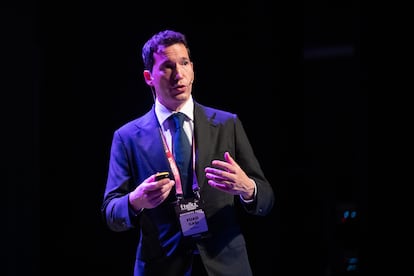
Fuad Gaši was recently in the Spanish city of Valencia, participating in the 8th ftalks Food Summit, a gathering of experts, companies, investors and startups, focused on the future of food. In his presentation, he warned about how the loss of crop diversity makes food production systems vulnerable. This, in turn, reduces our dietary diversity. He also spoke about the opportunity that Svalbard represents when it comes to adapting the crops of the future to new climatic conditions.
Question. How have your first few months been as coordinator of the Svalbard Global Seed Vault?
Answer. Exciting! The most interesting thing about this job is how varied it is. Every week, I add something new to my list. I’m still learning, but I had already managed a gene bank before taking charge of Svalbard. So, I’ve been “on the other side.” I had a great transition into this role, because I’ve known my predecessor for 20 years. And, since this project is a collaboration between the Norwegian Ministry of Agriculture and Food, the Global Crop Diversity Trust and the Nordic Genetic Resource Center (NordGen), I always feel that there’s someone around to support me if a new challenge arises.
Q. How did you end up coordinating a project like this?
A. In 2024, I took a sabbatical from my teaching position and I realized that I wanted to do something completely different. So I started working for the pharmaceutical company Novo Nordisk on projects related to the raw materials used in medicine. I was happy there. But then, Åsmund Asdal, my predecessor at Svalbard, told me that he was retiring. He’d been working there for 12 years, and his predecessor had also worked at the Vault until retirement. I thought that a job where everyone seems to want to stay until retirement must be special.
Q. What did you feel the first time you saw the Global Seed Vault?
A. From the inside, or from outside?
Q. Didn’t you see both on the same day?
A. No, back in 2024 I went there as a guest, to deposit seeds from our gene bank in Sarajevo, and I saw it from the outside. When I arrived, I thought I should pay close attention to everything because, realistically, that was going to be my only chance to visit Svalbard.
It wasn’t until June of 2026 that I was able to see the inside, because no one goes into the vault unless they have something specific to do. It was an incredible experience. [And] not just getting in there: the actual work of storing the seed boxes, which we don’t do very often, because the door only opens three times a year, was incredible.
If you stop for a second to think about what you’re doing, about these seeds, which are the result of careful selection and generations of farmers who have been doing this for thousands of years — [or] about being under a mountain very close to the North Pole, it’s all pretty impressive.
Q. Why is the Global Seed Vault important for the entire planet?
A. It’s not a seed bank in the traditional sense. Instead, we serve as a backup for other seed banks around the world. Our most important function is to help gene banks protect their material, because they’re the ones maintaining biodiversity, which helps us develop new crop varieties that could feed the population. This biodiversity is one of the answers to all the challenges we face, in agriculture and in the food supply.
Q. What does a country have to do to deposit a “backup” of its seeds in the Svalbard Global Seed Vault?
A. We sign a deposit agreement with each country. There are certain requirements for storing seeds in the Vault. Above all, we want to ensure that this is a backup repository, so each country’s seed bank must duplicate the seeds they wish to store and send them to another gene bank. Why? Well, because despite how secure Svalbard is, we don’t want to put all the seeds “in one basket.” And we encourage gene banks to collaborate with each other and maintain this community.
Furthermore, we want the material they send to be available to researchers, educators and, of course, to anyone who wants to reproduce the plant. We want it to remain in the public domain and be used, because conservation isn’t possible without use.
Q. Once the seeds are in the vault, do they require any kind of maintenance?
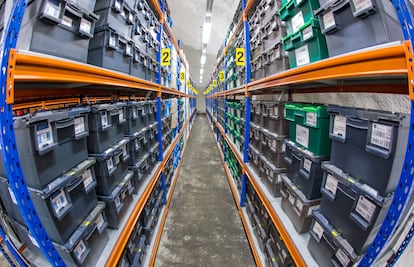
A. We’re like a black box. We don’t touch the seeds; we only store them at a temperature of -18°C (-0.4 °F), which allows them to last for a very long time. The seed banks in each country are responsible for planting them and making sure that they’re still viable.
Q. How many seed samples are currently stored in Svalbard?
A. More than 1.4 million. Each of the three seed storage chambers in Svalbard has a capacity of 1.5 million. We’ve already filled one chamber and we’ve started filling the second.
We ask seed banks not to deposit anything that isn’t unique. This is in order to avoid duplicates; we want to be efficient, even though we’ve still got plenty of space. [At Svalbard], we’re preserving the history of agriculture.
Q. What do we lose when we lose a seed?
A. We lose potential. We might lose a variety that could help develop a new one, which could then be resistant to a disease that threatens the food supply, or be really good at adapting to climate change. Who knows? Each seed is precious because it has taken generations to develop. It’s a living organism that has adapted to certain conditions and contains all the genetic material; [it has tons of] information.
Q. And what about all the knowledge associated with its cultivation? How can we preserve that?
A. That’s the wonderful work that seed banks do. They preserve something called “traditional knowledge,” linked to the cultivation of each variety of seed. And, when they regenerate the seeds, which is something that they occasionally have to do, they trace the phenotype of that particular variety and store it in their databases.
I often say that the richest seed bank isn’t the one with the most diverse material; rather, it’s the one that best understands what it preserves. Because that knowledge might help some farmer develop another crop that could prove essential tomorrow.
Q. Is the Svalbard Global Seed Vault prepared for climate change?
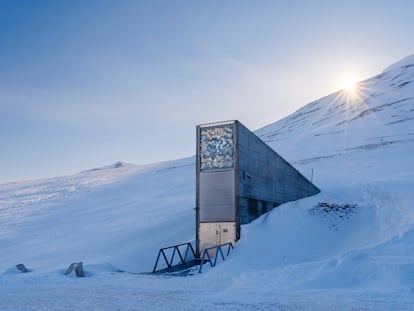
A. A good example of our long-term thinking — which, I believe, is lacking in agriculture — is that our entrance is located 130 meters above sea level (426 feet). Even if the ice caps melt and sea levels rise significantly, the entrance would still be above sea level. As for the material we store, it’s appalling that we’re losing biodiversity. Even though we can preserve it in the Vault, it shouldn’t be confined to this space — it should be out in the fields.
We’re here to provide a service in case of a catastrophe, even if it’s not a massive one. But, in any case, if we want resilient crops, we need to ensure that they reproduce. And, for that to happen, we need a broad genetic base. We need that diversity.
Q. In recent weeks, around the world, concern has erupted over the possibility that artificial intelligence (AI) could wipe out humanity before the end of this decade. Why don’t the warnings issued about the threat posed by climate change cause the same panic?
A. Looking at it logically: would a human being from a couple of thousand years ago have worried about their immediate needs? Or would they have made plans for the next 50 years? Evolutionarily, it makes sense that we aren’t long-term thinkers. [But] we’re now at a stage in our civilization where we can do a lot of damage to our habitat, so we have to be better at thinking long-term.
Sign up for our weekly newsletter to get more English-language news coverage from EL PAÍS USA Edition









































