
Global warming slowly brought about the catastrophic collapse of the Nepalese glacier
A study points to the role of climate change in the melt that set the stage for the catastrophic August avalanche
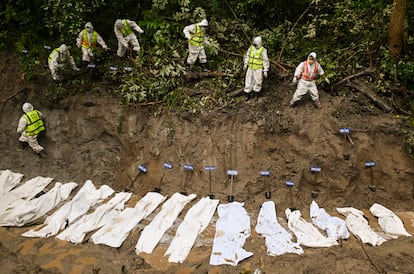

The catastrophic avalanche of rock and ice on Langtang Lirung mountain, on Nepal’s northern border — which caused 1,300 deaths and as a result of which, 22 days later, more than 5,000 people remain missing — was the result of a combination of factors that simmered until they triggered an unprecedented disaster in the Himalayas. A report published on September 17 by World Weather Attribution (WWA), the group of scientists that specializes in calculating the influence of climate change on extreme weather events, sheds light on the catastrophe. Among the factors, the authors note “unusually warm conditions before the failure, supporting enhanced snow and ice melt and more precipitation falling as rain rather than snow” around the site where the collapse occurred.
But this story has other protagonists, because “it was not a single triggering event,” explains Professor Walter Immerzeel of Utrecht University, referring to the factors that contributed to the collapse on the mountainside at an altitude of 5,150 meters on August 26. This hydrology expert, who has worked in the area for years and is one of the WWA report’s authors, says those factors “acted together over” years and decades. To global warming he adds an earthquake that struck the region in April 2015 and “may have preconditioned the slope” for failure. “The earthquake had a magnitude of 7.8 and also caused widespread devastation in Nepal, triggering numerous landslides in the country’s central region,” he adds. Scientists suspect that quake “may have weakened the rock mass” beneath the glacier.
The collapse unleashed a massive flood of water, ice and debris that swept downstream, causing catastrophic damage. Immerzeel says it was “an unprecedented disaster in the Himalayas”: “The mechanism behind this disaster is comparable to the one in India’s Uttarakhand, known as the Chamoli disaster [a glacier collapse that occurred in February 2021]. But the mass that fell there was roughly one-fifth of the mass that fell this time, and the impact was also much smaller.”
In the recent Nepal disaster, the glacier’s failure triggered a rock-and-ice avalanche that grew as it descended the river channel. “A wall of water, ice, rock and sediment reached the Rasuwagadhi border, 22 km downstream, within seven minutes, moving at an average speed of 188 km per hour, and wiped out the border facilities, the town of Timure and the Syabrubesi market town within the next quarter of an hour, catching pilgrims, border staff and hydropower workers,” the WWA report recounts.
“The resulting debris flood was therefore likely caused by several sources of water, including melting glacier ice, water stored beneath the glacier and in permafrost, ice and water carried within the debris, and river water pushed ahead of the flow,” the analysis summarizes. That water volume was augmented by heavy precipitation that fell in the area in October and November 2025 as snow. When temperatures rose in the following months, that snow turned to water, fueling the disaster.
Climate change
The heat that arrived with summer was also abnormal. July and August temperatures were “substantially warmer” than the local average, the study says. The fingerprint of climate change is visible there, but also in the year‑by‑year glacier melt. “Glaciers across this region have thinned by roughly half a meter a year since 2000, and the glacier next to the slope that collapsed retreated more than 300 meters between 2010 and 2026,” Immerzeel explains. “The presence of that glacier is very important because it basically buttresses the rock face,” he adds.
Moreover, warming has “shifted to higher elevations consistent with global warming,” which can “contribute to the degradation of high-elevation permafrost, glacial thinning and retreat, the snowfall-rainfall transition, and associated slope instability,” the report warns. The researchers estimate the freezing threshold is rising about 100 meters per decade. In other words, during the monsoon and post‑monsoon seasons, the zero degrees Celsius line climbs roughly 100 meters up the mountain each decade.
The problem is that this threshold is not exceeded year‑round but varies with the seasons. That increases “the number of freeze‑thaw cycles.” “Water becomes liquid and then refreezes, which exerts all kinds of stress on fractures” in the rock, Immerzeel notes.
“There is no doubt that climate change is one of the factors that drove the disaster,” says Friederike Otto, professor of climate science at Imperial College London and co‑founder of WWA. In her view, this link must “be discussed in the context of losses and damages” related to climate change.
For years, the countries most vulnerable to climate impacts — which are also often the least responsible for the problem — have been urging the UN to set up a compensation mechanism that would require the wealthiest and highest fossil fuel‑consuming states to pay. In May, the UN General Assembly took a symbolic step in that direction by approving a resolution sponsored by Vanuatu, a small Pacific island republic, calling on states that fail to meet their climate obligations to offer restitution to nations hardest hit by warming. The measure passed with the support of 141 countries despite active opposition from the United States and a group of oil‑producing states led by Saudi Arabia. But the resolution was nonbinding, and that commitment needs to be carried into climate treaties.
Sign up for our weekly newsletter to get more English-language news coverage from EL PAÍS USA Edition









































