
Fears of a second flood grow in Nepal and Tibet as more than 1,500 remain missing
Rain is feeding several natural dams after the disaster, which has killed over 540 people

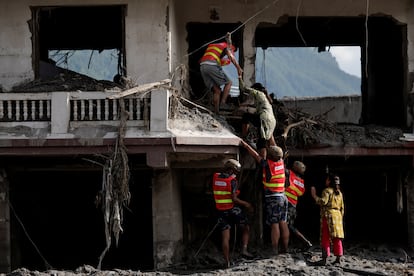
The emergency in the Himalayas entered a particularly critical phase on Friday, with China and Nepal locked in a race against rising waters. The massive landslide that triggered a devastating flash flood on Wednesday left behind huge quantities of mud and sediment that became lodged in river channels on both sides of the border. Those natural blockages have created a large landslide-dammed lake whose evolution is being closely monitored by authorities in Beijing and Kathmandu.
Chinese state media reported early Friday afternoon that the reservoir had filled and begun to overflow, but later said the water had stopped spilling over the barrier. The danger, however, has shifted upstream. Rain forecast for the coming hours and days is increasing pressure on the natural dam and raising fears of fresh flooding in areas already devastated by the disaster, which has claimed at least 543 lives and left 1,535 people missing, including 977 in Nepal and 558 in Tibet.
According to figures released Friday by Nepal police, the death toll in Nepal has risen to 538. Authorities there also said 3,742 people have been rescued alive. China has so far reported five deaths in Tibet.
The emergence of a new risk forced search-and-rescue operations on the Tibetan side to pause for nearly three hours before resuming. China Central Television (CCTV) said teams advancing toward the main search area temporarily halted near the village of Laojiang, relocating to a safer zone. Later, the state broadcaster reported that water was no longer overtopping the barrier and that rescue operations were continuing as normal. Authorities are installing cameras around the lake to monitor its development over the coming hours.
The lake, located about 2,950 meters (9,680 feet) above sea level and more than 10 kilometers upstream from the Gyirong border crossing, is full, although there is no indication that the natural dam has collapsed. Officials in Nepal’s Rasuwa district, which borders Tibet, received warnings that the lake was overflowing and observed rising river levels. Nepal suspended air rescue operations for 90 minutes and urged residents to move to higher ground.
The landslide-dammed lake being monitored by China is, for now, the only one whose dimensions are known. Drone measurements indicate it is about 150 meters long and between 40 and 50 meters deep.
By midday Friday, CCTV estimated that more than 2.5 million cubic meters of water had accumulated behind the barrier, up 25% from the 2 million cubic meters reported on Thursday morning, roughly the equivalent of 1,000 Olympic-size swimming pools. The lake continues to expand, while unstable masses of earth remain visible on the surrounding slopes. China’s Ministry of Water Resources estimates that another 3 million cubic meters of water could enter the lake over the next three days and considers the risk of a breach high, with peak flows expected around September 1.
A team of specialists from China Aneng has produced a three-dimensional terrain model, but on Thursday they could only observe the lake from about six kilometers away. Isolated cliffs, rain-softened slopes and ongoing landslides have prevented both personnel and heavy machinery from reaching the natural dam. The team planned to approach on foot Friday to measure the lake’s depth and the rate at which water levels are rising.
New data have also provided a clearer picture of the force of the initial flash flooding. According to CCTV, the torrent reached speeds of up to 200 kilometers per hour and generated a wall of water, mud and rocks as high as 15 meters when it struck the border post. Satellite images released by the state news agency Xinhua show the Gyirong border facility and nearby residential areas buried under sediment. The flood swept away the Friendship Bridge linking Nepal and China and damaged customs housing, private homes, a parking area, police facilities and the immigration control building. Xinhua reported Friday that firefighters had finally reached the hardest-hit section of Gyirong.
Despite the scale of the destruction shown in images released by Chinese state media, Beijing had not updated Tibet casualty figures since Thursday morning. That changed on Friday, when authorities confirmed five deaths, while the number of missing remained unchanged at 558, including 260 foreign nationals. Chinese authorities said 555 people were evacuated on Friday.
Meanwhile, Nepal’s National Disaster Risk Reduction and Management Authority reports 977 people still missing, including 517 foreign nationals, 127 Nepalese citizens living abroad who were visiting the country, 85 members of the security and customs services, and dozens of residents of the affected communities.
Sign up for our weekly newsletter to get more English-language news coverage from EL PAÍS USA Edition









































