
How California became the birthplace and refuge for the children of Mexico’s most feared narcos
Two sons of El Mayo Zambada, El Chapo’s twin daughters, his wife Emma Coronel, three of El Mencho’s children and his stepson were born in the US state
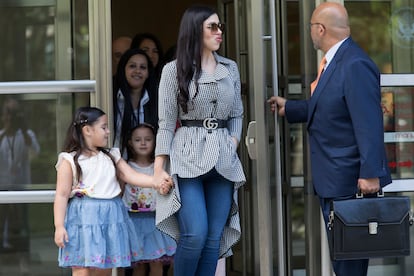

In July 2011, a 22-year-old woman arrived at the Calexico checkpoint on the Mexico–California border carrying a U.S. passport with a navy-blue cover. Her eight-month pregnancy and Sinaloa accent were hard to hide. A customs agent asked routine questions: where she had come from, where she was headed, and what she was carrying. Despite her answers and the document she presented, he sent her for a secondary, more thorough inspection. Other federal officers meticulously searched her belongings and the contents of her cellphones. Minutes later, once the rigorous procedure was complete, they allowed her into the country.
The young woman, Emma Coronel Aispuro, was on the U.S. Department of Homeland Security’s (DHS) watchlist. A few years earlier, around 2007, when she was still a teenager wearing the crown she won in a small-town beauty pageant in Durango, she had married Joaquín “El Chapo” Guzmán, co-founder of the Sinaloa Cartel and at the time the world’s most-wanted drug trafficker. The daughter of Inés Coronel Barreras, a mid-ranking member of the criminal organization, Emma Coronel was returning to the United States with a specific purpose: to give birth in Los Angeles to El Chapo’s twin daughters.
Nothing and no one could stop her. On August 15, 2011, Coronel entered the maternity wing of Antelope Valley Hospital in Lancaster, a suburb in northern Los Angeles County. That day, Emaly Guadalupe and María Joaquina Guzmán Coronel were born one minute apart: at 3.50 p.m. and 3.51 p.m., according to public records. On the birth certificates, the space for the father’s name was left blank.
Coronel’s choice was not unusual among the partners of Mexican cartel bosses. They seek hospitals equipped with advanced medical technology and, critically, U.S. citizenship for their children — a safeguard that could make it easier to seek refuge if they must flee a turf war between criminal organizations or the constant threats that stalk the drug trade. Moreover, if the children become involved in the cartel, having a legal immigration status is no longer something to negotiate with the government.
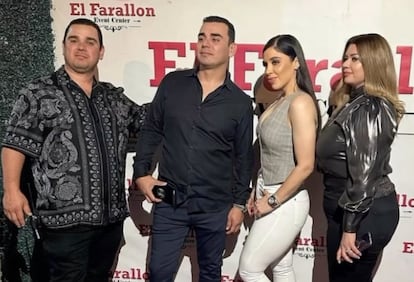
“Some have operated in California, they know the territory, they have contacts there and that’s why they send their wives to have the children in that state, where, furthermore, there are better doctors,” explains Mike Vigil, former director of international operations at the Drug Enforcement Administration (DEA), in a telephone interview with EL PAÍS. “For many of them it is a badge of honor for their children to have U.S. citizenship, and they get it very easily: by being born in the United States,” he added.
The narcos’ US-born children
There is a long list of children of cartel bosses who were born, have lived, or currently live in California. They are mostly descendants of leaders from the Sinaloa Cartel and the Jalisco New Generation Cartel (CJNG), two organizations that have established distribution hubs in the state’s major cities, from San Diego to San Francisco. Both groups have spent years fighting for control of Tijuana, the gateway to the most lucrative drug-trafficking corridor into the U.S.
Two sons of Ismael “El Mayo” Zambada, the long-standing leader of the Sinaloa Cartel who is now serving a life sentence in a New York prison, are also California-born: Serafín Zambada Ortiz was born in San Diego and his half brother, Ismael Zambada Sicairos, in Anaheim. The former served five-and-a-half years in prison for drug trafficking; the latter, nicknamed “Mayito Flaco,” today heads the criminal organization known as Los Mayos.
Nemesio Oseguera Cervantes, “El Mencho,” also had family ties to California. In the 1980s and 1990s, when he was still a heroin seller far from becoming the CJNG boss, his two eldest children were born in Northern California. His wife, Rosalinda González Valencia, gave birth in San Francisco to Jessica Johanna and Rubén Oseguera González. In 2001 she returned to the city via the Golden Gate Bridge to give birth to a third daughter, Laisha Michelle, whose last known address was in Riverside.
Earlier, in 1984, Rubén Oseguera González’s half-brother Juan Carlos Valencia González was born in a Santa Ana hospital. Known as “El Pelón,” “03″ and “R3,” he took control of the CJNG after his stepfather, El Mencho, was killed during a military operation in Tapalpa, Jalisco, in February. He is now the world’s most-wanted drug trafficker. A ranch he bought in his youth, which the government is now seeking to seize, remains as evidence of a time when he crossed the border freely in both directions thanks to his dual nationality.
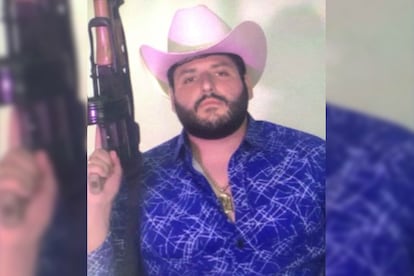
The tally includes three children of Abigael González Valencia, “El Cuini,” El Mencho’s brother-in-law and one of the CJNG’s main financial operators. Marlyne, Jasmine and Alexis González Lara have lived for years in Southern California. They have chosen to stay out of the public eye but have not escaped government scrutiny. For a time Marlyne was associated with her uncle, José María González Valencia, in the lucrative horse-racing business. The two pooled resources in Balgo Racing Team, a Hemet-based company east of Los Angeles that has accumulated $1.6 million in prize winnings, according to equestrian competition records.
The Zambadas of California
Ismael Zambada Sicairos, heir to the throne of Los Mayos — the faction that broke from the Sinaloa Cartel — was born in March 1982 at Martin Luther King Medical Center, a hospital in Anaheim located a few miles from Disneyland. At the time his father, El Mayo, was building one of the bases of his international drug empire in the Los Angeles metropolitan area.
Eight years later, in May 1990, another of El Mayo’s sons was born: Serafín Zambada Ortiz, in the border city of San Diego. Like his older siblings, Serafín became involved in the family’s shady businesses and became a figure in narcocorridos. “If you want to know my name, I’m Serafín, I’m El Mayo’s son / I’m the first out here and I’m waiting for my brothers,” goes a song performed by Ernesto Barajas, Enigma Norteño’s vocalist, who was shot dead in Zapopan, Jalisco, in August 2025.
From childhood Serafín moved among the narco elite. His godfather at baptism was Benjamín Arellano Félix, head of the Tijuana Cartel, and his confirmation sponsor was Amado Carrillo Fuentes, “The Lord of the Skies.” But that bond, sealed by two religious sacraments, was broken when his father and El Chapo unleashed a war over control of Tijuana. Serafín and his family had to flee the city before falling into the hands of Arellano Félix’s hitmen.
They did not even find safe refuge in Culiacán, El Mayo’s stronghold. A bomb placed in a car exploded in front of the house where a party was being held for Serafín’s second birthday.
“From that day, our lives were never the same,” his mother, Leticia Ortiz Hernández, wrote in a letter sent to a federal court in San Diego to ask for clemency for her son, then awaiting sentencing on drug charges. “The same men who not long before had stood as godfathers to our children in church and promised to raise them as good Catholics now tried to kill them,” she added. She also said that her parents and siblings had been gunned down in a Mazatlán hotel shortly after she and Serafín, then nine, left the establishment.
Leticia Ortiz recounted that she met El Mayo as a child in a mountain town in Sinaloa and that they began a relationship in Mexicali in 1988. She also crossed the border so her son could obtain U.S. citizenship and, perhaps, a chance at a different life. But Serafín ended up involved in the family business.
The U.S. government charged him with running a cell dedicated to trafficking cocaine and marijuana. His name surfaced in three federal investigations, including that of José Rodrigo Aréchiga Gamboa, “El Chino Ántrax,” the infamous cartel hitman leader who was killed in Culiacán after escaping from the final stage of his incarceration in San Diego.
Luxury cars, a gold-plated rifle and exotic felines were among the extravagances Serafín Zambada displayed on social media. “I lived in a gilded cage with useless luxuries,” he wrote in a letter to Judge Dana Sabraw, who oversaw his case in a San Diego court. “From 1992 to 2000, the days were difficult and bloody, and there was a stupid, senseless war in which many families were destroyed,” recalled El Mayo’s son.
On the day of his sentencing, in March 2018, Serafín Zambada expressed remorse for his past, apologized for his crimes and said he wanted to rebuild his life to raise his children “in the best possible way.” Judge Sabraw found his remorse credible and took into account, among other factors, his youth, his relative lack of experience in drug trafficking, and the absence of violent offenses in his record. He imposed the minimum possible sentence: five and a half years in prison. That allowed Serafín to regain his freedom a few months later.
Vigil, the former DEA agent, argues that U.S. citizenship has helped cartel bosses’ children avoid harsher sentences. “Judges take into account that they are citizens of this country, because the cases they review are mostly of Mexicans who belong to the cartels. It’s a stigma,” he says.
The ‘Chapo’ family in Los Angeles
When Emma Coronel went to Los Angeles to give birth to her twin daughters she was following her mother, Blanca Estela Aispuro’s, example. She “vacationed” in San Francisco despite being several months pregnant when, she said, she was suddenly struck by labor pains. That is how El Chapo’s wife recounted it in a 2016 interview with Univision.
Coronel was born in San Francisco on July 3, 1989. More than three decades later she has settled in Los Angeles, far from the violence that has bled Culiacán and other northern Mexican cities dry amid the Sinaloa Cartel’s internal war. One of the opposing factions is led by her stepsons, Iván Archivaldo and Jesús Alfredo Guzmán Salazar, heirs to the criminal faction known as Los Chapitos.
“Narcos are always afraid that if they clash with another cartel, their enemies will go after their families. But if they have U.S. citizenship, they can cross [the U.S. border] easily,” Vigil explains, pointing to another reason cartel bosses’ children are born on the U.S. side of the border.
For more than a decade, Coronel had been preparing to settle in Los Angeles. She took English classes and traveled to California whenever she could to shop and visit relatives. In an interview with Univision she said she liked the order and cleanliness of the United States. Those were some of the reasons, she explained, that she chose to give birth to her twins in Lancaster.
In February 2016, when El Chapo had been recaptured and was being held at the Altiplano prison in central Mexico, his daughters had still not returned to California. Coronel then came back “for their birth certificates, because I arrived before they issued them,” she told journalist Anabel Hernández.
Living in Los Angeles, the nation’s second-largest city, also makes it easier for her daughters, now 15, to visit their father at the ADX maximum-security prison in Colorado. “They see him, they talk to him, they have a very beautiful communication with him,” Coronel recently said during a live social media broadcast.
Alejandrina Guzmán Salazar, one of El Chapo’s daughters and sister to those who remain in charge of his cartel faction, tried to follow the wives-of-narcos’ path but failed. In October 2012, when she was about five months pregnant, she showed up at the San Ysidro checkpoint in San Diego with a tourist visa that did not belong to her. She was detained there, pleaded guilty to possession of a false document, and was sentenced to 65 days in prison.
She was released in December of that year, by then eight months pregnant, and deported to Tijuana. Her attorney, Guadalupe Valencia, told CNN about her client’s failed objective: “She wanted to come and have her baby here.”
Sign up for our weekly newsletter to get more English-language news coverage from EL PAÍS USA Edition









































