
The enigmas of Ismael ‘El Mayo’ Zambada
The former leader of the Sinaloa Cartel, for decades one of the world’s biggest drug traffickers, awaits a life sentence in the United States amid unresolved questions that have political repercussions in Mexico
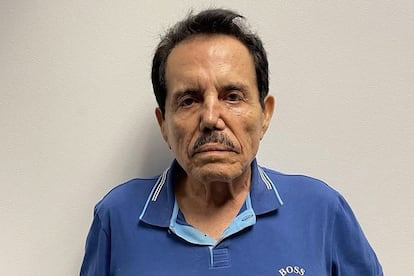

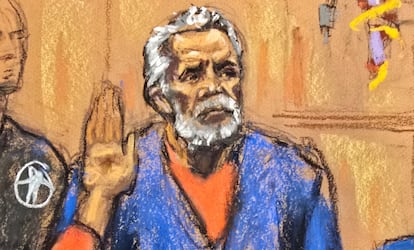
Mexico only knows what 76-year-old Ismael Zambada García, known as “El Mayo,” looks like today from illustrations made by a U.S. court artist when he appeared there a year ago. The portrait shows a wrinkled man with a white mustache and beard, wearing a blue prison jumpsuit and a solemn expression. In fact, only a few photographs of him have been published: a couple taken when he was arrested two years ago, thin and with black hair; a blurry, old U.S. wanted-card photo; and another of him wearing a cap and mustache. He is the man the U.S. attorney for the Eastern District of New York calls “one of the largest and most powerful drug traffickers in the world, if not the most” — but unlike the flamboyant style of his former partner Joaquín “El Chapo” Guzmán, also imprisoned in the United States, El Mayo always chose to hide, to be an enigma.
For decades he led the powerful Sinaloa Cartel in the country’s northwest and organized the logistics to send thousands of tons of cocaine, heroin and, in recent years, fentanyl to the United States. To do that, he drenched Sinaloa in blood with hitmen who killed anyone who stood in the way, and he bribed officials — from police and military officers to politicians. That is the description the U.S. prosecutors give of Mayo’s criminal activity in their sentencing submission, contained in an eight-page letter to Judge Brian M. Cogan, who is scheduled to announce his sentence this Monday, July 20. Zambada has pleaded guilty to all charges. Prosecutors are seeking life imprisonment and a $15 billion fine.
The United States had had him on the radar since the early 1990s, although El Mayo entered the drug trade much earlier, at 16, according to the late Mexican journalist Julio Scherer in the first interview the trafficker ever gave — one of only a handful in his life — to the magazine Proceso in 2010. Asked how he began in the drug business, he said it simply happened: he “just came in.” Fifteen years later, last August before the New York judge, he said he started at 19 by planting marijuana.
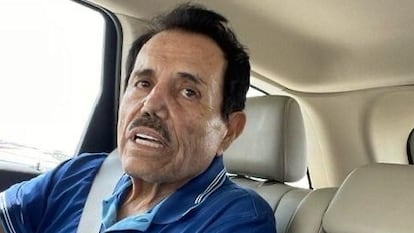
Among the flashes of himself shown in the conversation with Scherer, he attempts to portray himself as austere, a country man with social support, always ready to flee, always aware he was being pursued. “I have my wife, five women, fifteen grandchildren and one great-grandchild. They, the six of them, are here on the ranches, daughters of the land, like me. The land is my home, my family, my protection, my earth, the water I drink,” he said.
The prosecutors’ account runs in parallel with the history of the Sinaloa Cartel, now designated a terrorist organization by the United States. It was “a pioneer in the use of new distribution techniques [for drugs], including trains and tunnels across the Mexico–U.S. border,” allied with Colombian cartels to distribute its cocaine at an “astonishing speed,” and at one point reportedly received nightly “15 or 20 flights each carrying between 1,000 and 1,500 kilos of cocaine.”
By the 1990s, El Mayo had formed an alliance with El Chapo to run the Sinaloa Cartel and clashed in gun battles with rival cartels over control of trafficking routes. When El Chapo was imprisoned for the first time, El Mayo ran the business, and when El Chapo escaped, El Mayo helped him flee. He did so again on his second escape, until El Chapo was captured in 2016 and deported to the United States, where he is serving life and from where he cultivates an epistolary habit of writing to the judge. In those letters he complains about the isolation conditions at the maximum-security prison in Colorado: “I have drunk unclean water, I do not breathe clean air, the air is dry, my throat hurts, my nose hurts, my ears hurt, my head hurts. I have been denied the right to breathe clean air,” he says in one, frequently invoking God.

In a way, El Mayo’s story can be told in opposition to that of his former partner. Against El Chapo’s spectacular prison escapes — his last one involved a tunnel connected to a shower — his desire to be recognized as the world’s top trafficker and his eagerness to speak — he gave an interview to actor Sean Penn and sought a biography — El Mayo remained almost entirely in the shadows. From 2017, when he became the cartel’s sole leader, until 2024, U.S. prosecutors attribute to him “systematic murders of other cartel members” and rivals. He commanded an arsenal of military-style weapons and an army to protect his interests.
When the U.S. judge announces El Mayo’s sentence this Monday, the man who evaded justice for decades will spend the rest of his life in prison. He accepted a life term to try to avoid a supermax prison like the one holding El Chapo, and he has requested placement in a medical facility because of his health problems. There will also be no trial, which leaves some unanswered questions that, two years after his transfer to the United States, still influence politics in Mexico today.
One mystery concerns how he arrived at an airport in New Mexico, on the U.S. side of the border. In a letter distributed by his lawyer, El Mayo claimed he was deceived and kidnapped by one of El Chapo’s sons, who subsequently surrendered to U.S. authorities. He had gone to a meeting where he was told the then-governor of Sinaloa, Rubén Rocha Moya, and the former mayor of Culiacán, Héctor Cuén — who was murdered that same day — would be present.
Rocha Moya, of the ruling party Morena, said he was in Los Angeles on July 25, 2024, and that he knew nothing about the meeting. He is currently suspended from office and accused by the United States of having ties to the Sinaloa Cartel. His case has generated major friction with Washington, which seeks his extradition — something Mexico refuses unless solid evidence is provided. El Mayo ended up on a plane, after being beaten, bound for prison.
The Mexican government says it was not involved in the surreal transfer of the capo to the United States and now wants to know whether any U.S. agency took part in handing over El Mayo — an act that would violate Mexican sovereignty — in a new controversy in the fraught relationship with Washington. In 2024, Ken Salazar, then the U.S. ambassador to Mexico, said his country had nothing to do with it: “It was not our plane, nor our pilot, nor our agents in Mexico.” The controversy has reemerged now that the Mexican government learned the FBI claims credit for capturing El Mayo and that it donated to a museum in New Mexico the plane on which the trafficker crossed the border.
A second unknown emerged in the prosecutors’ filing to the judge, where paragraphs are redacted in the section about El Mayo’s arrest, which mention the cartel’s corruption of Mexican authorities. “[El Mayo] increased bribes to police, military chiefs and politicians,” the text reads, specifying that the cartel paid “millions of dollars a year” in payoffs. What it does not say is who received them.
El Mayo’s arrest unleashed a true war in Sinaloa over control of the cartel between the successors of the former partners, Los Chapitos and Los Mayos, in a wave of violence that left thousands dead and forced the Mexican government to deploy 1,600 soldiers in January to quell the outbreak; roughly 14,000 troops are now stationed there. The sentence to be announced this Monday will leave El Mayo in prison for life. But as Ernesto López Portillo, coordinator of the Public Safety Program at Universidad Iberoamericana, points out, that sentence “does not mean the symbiotic relationship between criminal groups and the state will end, nor that the macro-criminal networks involving the state, companies, and organizations will be dismantled.”
The information that captured kingpins can provide may be valuable for pursuing others, “but the fall of Mayo is not the fall of the narco; leaders have been taken down for decades,” López Portillo says. For now, the prosecutors’ letter to the judge cites testimony obtained in trials against El Chapo and Genaro García Luna to support the thesis that “corruption at all levels was necessary for the cartel to operate so effectively and on such a large scale.”
For López Portillo, the sentence only indicates “levels of total impunity”: “Why are there no trials that dismantle criminal networks in Mexico? The Mexican state has not built a criminal narrative, with judicial documents on criminal structures, that prove what they do, who runs the financing, logistics and technical circuits...” He warns: “In the 1980s there were five or seven cartels. Today people talk about 500 criminal organizations in the country that operate locally, in only some states or with a national presence.”
El Mayo seemed to understand well the reproductive logic of his violent business. In that first interview with Julio Scherer in 2010, when he was still a fugitive, he said something that proved prophetic: “The problem of the narco involves millions. How to control them? As for the bosses, locked up, dead or extradited, their replacements are already out there.” Locked up for life with the secrets he may hold from decades of criminal activity, El Mayo remains shrouded in unanswered questions.
Sign up for our weekly newsletter to get more English-language news coverage from EL PAÍS USA Edition









































