
Former ambassador to Mexico Ken Salazar says in his memoir that no US agent traveled on the plane that transported ‘El Mayo’ Zambada
The diplomat is at the center of criticism from the Mexican government for allegedly lying about the circumstances surrounding the transfer of the Sinaloa Cartel leader to the United States
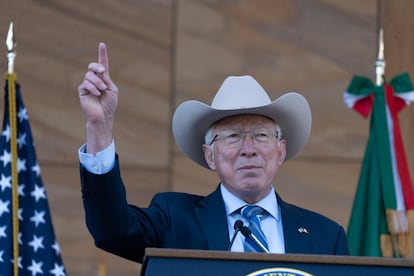

Former U.S. ambassador Ken Salazar could not have picked a better moment to promote his memoir, Borderlands, which is about to be published later this month by BenBella Books. This week Salazar has been in the Mexican government’s crosshairs over the murky capture of Ismael El Mayo Zambada, leader of the Sinaloa Cartel, and his subsequent transfer to U.S. authorities two years ago. President Claudia Sheinbaum’s government accuses the man who served as ambassador during Joe Biden’s presidency (2021–2025) of lying about the circumstances of that arrest, which took place without the knowledge of Mexican authorities.
The matter resurfaced after it was revealed that the FBI had possession of the plane used to transport the drug lord and even claimed credit for the operation. At the time, Salazar denied that his government had been involved in the case, which has ignited suspicions in Mexico that Washington runs covert operations on its soil without authorization.
In his memoir, of which EL PAÍS has obtained a copy, the former official provides details of El Mayo’s capture and how it ultimately led to a diplomatic rupture with then- president Andrés Manuel López Obrador. Salazar insists that the United States did not provide resources to carry out the operation; instead, he attributes Zambada’s fate entirely to the “betrayal” — in exchange for judicial benefits — of his own godson, Joaquín Guzmán López, a blood relative of Joaquín El Chapo Guzmán, who was an old associate of El Mayo. Suddenly the United States had two very valuable targets in custody, not thanks to the Mexican government, but rather because of what appeared to be a hostile action taken by one cartel member against another, writes Salazar.
Salazar also writes he did not learn of Zambada’s transfer until after it had been completed, and that it was a complete surprise. According to his account, he hurried to inform then-president López Obrador that his country had nothing to do with it, as he knew that these arrests could deeply upset Mexico’s outgoing president: “I suspected he would find it hard to accept that the U.S. government had not been directly involved in any way.” Salazar indicates that Washington was aware the issue of interference would be sensitive for the president, and insists in his memoir that the United States had no prior knowledge of this abduction and that under no circumstances did it carry out an unauthorized operation on Mexican soil, “which would have been a serious violation of its sovereignty.”
Salazar’s explanations at the time did not soften López Obrador, and they have now put the former ambassador squarely in the spotlight again. Last week it emerged that the FBI had donated to a New Mexico museum the Beechcraft King Air 200 in which El Mayo Zambada and Guzmán López, known as El Güero, arrived on July 25, 2024. Several outlets released previously unseen images of the plane’s arrival that day showing the two kingpins disembarking the aircraft, apparently surrounded by U.S. officials. The question is whether those officials, or some of them, also traveled on the plane that took off from Culiacán, the capital of Sinaloa — which would confirm Mexico’s suspicions of alleged violations of Mexican sovereignty.
According to Salazar, there were only three people on board: the two traffickers and the pilot, whose identity remains unknown to this day (the ambassador told Mexican authorities the pilot was not American and had not been hired by his government). The memoir adds that after takeoff the plane turned off its tracking systems and reappeared near the border. Only then were U.S. authorities notified. This account matches what U.S. officials told their Mexican counterparts. After the notification, Salazar recounts, the FBI office in El Paso, Texas, hurried to send an arrest team and SWAT [special weapons and tactics] to the runway, which received the Beechcraft on landing. The plane taxied a short distance to the waiting team and, after the pilot shut down the engines, the door opened.”
First out was El Güero “with his hands up.” While agents pointed guns at him, he identified himself by name and was then handcuffed. Zambada did not come down; rather, Salazar says, authorities had to enter the plane to get him out. According to his account, agents boarded the aircraft and found a figure heavily sedated, plastic restraints securing him to his seat. To their surprise it was Ismael El Mayo Zambada,” he explains. Salazar then recounts details of the meeting to which the kingpin was lured by deception by his own godson, how he was subdued and forced onto the plane. He also describes efforts he made to clear Washington of any responsibility, including a new private message he sent to López Obrador, this time co-signed by the then U.S. attorney general, Merrick Garland: “It was not our plane, nor our pilot, nor our operation,” they wrote to the president, who again did not respond.
The El Mayo case, coupled with Salazar’s criticisms of the judicial reform promoted by López Obrador, shattered the bilateral relationship. The Mexican president at the time feared the operation in Sinaloa could trigger a wave of violence, as ultimately happened.
The former ambassador says one of his sources, a prominent businessman who “was a friend and confidant” of the president, told him that López Obrador was “very worried” about what information the United States might obtain from Zambada — that he might “reveal secrets” about Mexican officials. President Sheinbaum stepped in and clarified that if her predecessor was worried about anything, it was about U.S. interference in Mexico. She has again demanded explanations from Washington to clear the lingering clouds over the El Mayo case.
Sign up for our weekly newsletter to get more English-language news coverage from EL PAÍS USA Edition









































