
Dutch university reserves 30% of aerospace engineering places for women to tackle gender stereotypes
Delft University of Technology aims to increase female enrollment in the program and ultimately boost the number of women in teaching and research roles
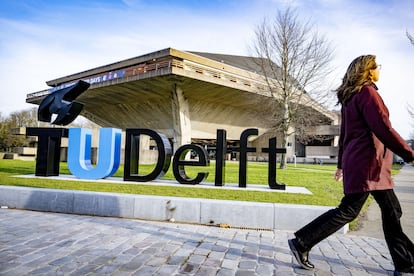

The Netherlands Institute for Human Rights, an independent public body, has given Delft University of Technology the green light to reserve 30% of places for female students in its aerospace engineering program starting in the 2027–2028 academic year. Currently, about 22% of enrolled students in the bachelor’s degree (BA) are women, and faculty say this underrepresentation feeds gender stereotypes and also hinders a balanced composition of academic and research staff.
The plan requires final approval from the Ministry of Education. Officials in Delft say the policy will have a limited effect on male applicants because everyone must pass the same entrance exams. In Spain, 29.2% of students enrolled in the first year of aeronautical engineering were women in the 2024/2025 academic year.
Of the faculty’s 3,000 students in the School of Aerospace Engineering, about 1,500 are undergraduates, and 1,500 are master’s students. Each year the program admits roughly 440 students, “and to give you an idea that we can choose the best without discriminating, last year we received 4,300 applications for 440 places,” Henri Werij, dean of the faculty and a doctor in atomic physics, explains by phone.
Around 24% of those applicants were women. Werij says: “That’s very good, but it’s not the 30% we propose, which would be 132 female students — a threshold we hope will be a turning point.” “We lack role models, and the problem may start with the education boys and girls receive at earlier ages,” the dean adds.
He offers a striking example: in the final year of the BA, students work in teams for 10 weeks on a design project. If a group included only one female student, “she was often assigned the role of project secretary.” “She could be the systems engineer, the program manager — anything,” he says. To prevent this, the faculty ensures there are at least two or three women per team, “but this means there are also teams made up only of male students,” he says.
Werij, who has been dean for nine years, explains that this branch of engineering is an international program that is taught in English and accepts applications from abroad: “Many universities offer aerospace as part of mechanical engineering, but at Delft, aerospace is an independent program from the start, and we receive applications from 100 different nationalities.” Among applicants, 16% of Dutch applicants are women, a figure that rises to 25% among applicants from other countries. “So we also need to ensure greater visibility at the national level,” says Werij.
That is one of the tasks of Lyssia van der Kooi, president of the faculty’s student association, who has paused studying her master’s in flight performance to focus on the role. In her view, “the energy is different in a male-dominated field, so it would be beneficial for the atmosphere to have more women.”
She confirms that in team projects “female students tend to be assigned the more secretarial tasks.” “If you don’t speak up, you can end up doing things you might not want to do,” adds Van der Kooi. At the same time, she believes some men “aren’t aware of what they’re doing, and that becomes a major bias.”
Her fellow students, she says, support the initiative: “They may fear that men will say they deserve to be here less, when that’s not true. We all have to pass the same exams, and the door doesn’t open just because you are a woman.”
Under Dutch equal-treatment legislation, universities may give preference to female applicants for a portion of available places only if a number of conditions are met to prevent discrimination. In the case of aerospace engineering, the faculty has demonstrated that the policy serves a legitimate aim, namely addressing gender stereotypes in a degree program that has a clear male majority.
The Netherlands Institute for Human Rights also accepted that women face a demonstrable disadvantage, as they do not fill a proportionate share of the available places. It further found that the university had adequately publicized the preference policy; that female applicants would be admitted only in cases where candidates had equal examination results; and that the reserved places were directly linked to the objective of attracting more women to the program.
The institute has also recommended that the Ministry of Education “facilitate this type of preferential measure in order to achieve substantive equality between men and women,” in line with the principles set out in the United Nations Convention on the Elimination of All Forms of Discrimination against Women.
Sign up for our weekly newsletter to get more English-language news coverage from EL PAÍS USA Edition









































