
Egypt searches the desert for mineral treasures
The African country has large reserves, but the sector is underdeveloped. The government has made it a priority amid global demand for minerals critical to the energy transition
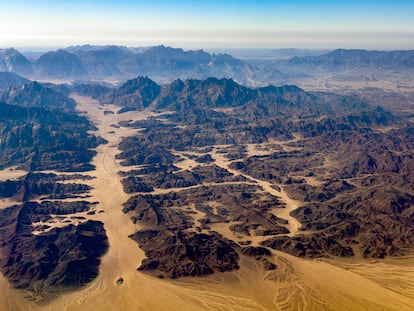

Deep in Egypt’s eastern desert, just a few miles from the Red Sea town of Marsa Alam, a team of archaeologists has in recent years uncovered an extraordinary gold extraction and processing complex dating to about 3,000 years ago. The unearthed facilities include crushing and grinding workshops, settling ponds and clay furnaces, as well as residences, temples and administrative buildings.
Archaeologists have determined that mining activity at the site was concentrated in the Third Intermediate Period of Ancient Egypt, between the 21st and 25th dynasties, roughly 300 years after a regional gold rush prompted the pharaohs Thutmose III and Amenhotep IV to send expeditions that located more than two hundred gold deposits. Although the earliest evidence of deposits in the region predates those reigns, some of the most emblematic missions to these inhospitable lands were organized under those pharaohs.
Taking up the mantle of those early prospectors, Egypt announced in May its first national geological survey in more than four decades, covering the eastern desert as well as the areas west of the Nile and in the Sinai. For the project it will join forces with the Spanish company Xcalibur, a world leader in the use of airborne geophysical technologies and artificial intelligence to map underground resources from the air, identify promising mining zones and thus lower the risk for future investments.
Despite a long extractive tradition and being considered a country with significant mineral wealth, mining currently contributes barely 1% of GDP; the Egyptian government has set a goal of raising that to 6%. To reach that target, Cairo has adopted reforms to make the sector more attractive and competitive, including changes to licensing and revenue-sharing. But giving the industry a real boost depends on first mapping the country’s extensive subsurface thoroughly.
Beyond the gold coveted by the pharaohs, Egypt is believed to host a notable variety of minerals, including vast black sand deposits along its Mediterranean coast that could contain large quantities of heavy minerals such as titanium, zirconium and the valuable rare earths. The country also has promising phosphate and quartz reserves, and the eastern desert holds copper and zinc deposits.
Spanish assistance
To locate these resources with precision, Xcalibur operates a fleet of 45 aircraft, including planes and helicopters, equipped with geophysical systems to scan large areas and identify surface and subsurface properties. Using cutting-edge technologies in these flying laboratories, the company can map a terrain’s electrical conductivity, measure density and detect geothermal structures. For Cairo, locating areas with mining potential and beginning raw extraction is a first step. Since the real value lies in processing and refining, the country is also betting on developing an emerging industry around those activities, currently focused on treating black sands and phosphate — essential feedstock for one of Egypt’s major export industries: fertilizers.
Moreover, Egypt does not want to miss the opportunity to benefit from global demand for minerals critical to technologies expected to drive the energy transition. As if that were not enough, exercising greater control over its mineral resources, especially in the eastern desert, is a matter of national security. Over the past decade, the rise of informal gold mining, the emergence of militias around it, and state attempts to reclaim control have sparked a low-intensity conflict in the region. The success of the government’s effort will therefore also depend on Cairo’s ability to defuse that conflict.
Sign up for our weekly newsletter to get more English-language news coverage from EL PAÍS USA Edition









































