
Venezuela approves new mining law to open its subsoil to foreign capital
The Chavista-controlled parliament unanimously passes legislation that removes the State’s exclusive control over mineral exploitation
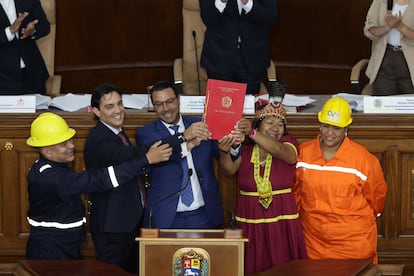

The Venezuelan parliament, controlled by the Chavista regime, on Thursday approved a new mining law that—just as with the hydrocarbons law—opens Venezuela’s mineral-rich subsoil to foreign capital. The approval of this 131-article law, which repeals the one enacted by former Venezuelan leader Hugo Chávez in 2013, took several sessions and had been under debate for weeks. It finally passed unanimously on the same day that the new Attorney General and Ombudsman were elected.
The law authorizes national, foreign, state-owned and private companies or consortia to exploit gold and “strategic minerals.” The licenses will have a maximum duration of 30 years, but may be extended for up to two 10-year periods. Representative Orlando Camacho, one of the main proponents of the bill, has stated that one of the objectives of this legislation is to “attract national and foreign capital with legal stability” and “update the legal framework to meet the country’s current challenges.”
Regarding the objectives of the law, Venezuela’s interim president, Delcy Rodríguez, has been generating expectations for several weeks. During meetings with private investors, both domestic and foreign, she has offered business opportunities in a country that has been under the tutelage of the United States, the prime interested party in Venezuela’s natural resources, since the military intervention of January 3.
The law incorporates the possibility of international mediation and arbitration for conflict resolution, a precaution that companies have requested as a guarantee against expropriations and confiscations like those carried out by Chavismo in the past.
The law crosses some of the red lines imposed by Chávez when he nationalized the oil and mining industries, granting the State exclusive control over exploitation rights—a matter of honor for Chavismo. However, as was also the case with the new hydrocarbons law, approved on January 30, the legal framework maintains the principle that ownership of the deposits belongs to the Republic.
This law began to be discussed immediately after the early March visit by the United States Secretary of the Interior, Doug Burgum, which was followed by the lifting of the sanctions that were in place on Venezuelan gold.
President Trump has repeatedly expressed interest in Venezuelan minerals, especially rare earth elements, which are globally controlled by China, his trade rival. Therefore, following the restoration of relations between Washington and Caracas, barrels of oil and shipments of gold have begun to flow north from the South American country. The largest deposits of gold and other minerals are located in the south of the country, in a strategic area of 112,000 square kilometers known as the Orinoco Mining Arc.
Mining activity in this vast territory has been voracious and has proceeded with great opacity on the part of the government. Environmental organizations have denounced enormous devastation encompassing environmentally protected areas, and the extracted product can be considered “blood gold.” United Nations reports have documented serious human rights violations, slavery, and murders in the mines, where control is shared by military and criminal groups, including the Colombian guerrilla group National Liberation Army (ELN). Journalistic investigations have also revealed that the illegal gold extracted from the Orinoco Mining Arc is smuggled through criminal networks to conceal its origin before reaching Europe and other markets.
Regarding gold, the new law establishes that the Central Bank of Venezuela “has the preferential right to purchase the mineral obtained as a result of any mining activity carried out within the national territory.” A cap of 13% is set on royalties paid to the State, calculated on the gross production of the mineral, based on the final product’s market value. The parameters for these payments will be established by the executive branch, but the law stipulates that the State may demand them “in cash or in kind.”
Sign up for our weekly newsletter to get more English-language news coverage from EL PAÍS USA Edition









































