
The ELN shows no sign of letting up on the Venezuelan border, with its rearguard in jeapordy following Maduro’s downfall
The humanitarian crisis caused by the guerrilla offensive in the Catatumbo border region is still far from being resolved

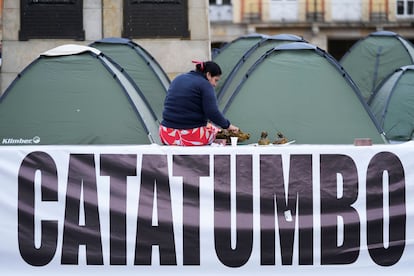
Gustavo Petro’s rise to power once again sparked hopes that the elusive goal of peace with the ELN, pursued by nearly every Colombian government this century, was finally attainable. The leftist president even signed an unprecedented six-month ceasefire with guerrilla commander Antonio García in mid-2023, the first milestone in the now-weary policy of total peace. But the winds have shifted. A year ago, Petro had no choice but to suspend talks with the ELN in the face of a ferocious offensive in the Catatumbo region, bordering Venezuela, where they have since clashed with dissident factions of the now-defunct FARC, resulting in over 80,000 displaced people. This enormous humanitarian catastrophe remains far from over.
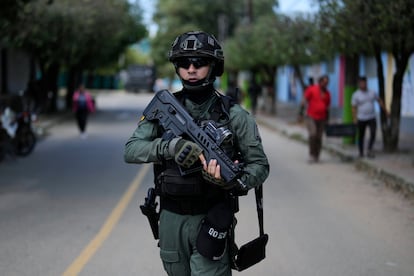
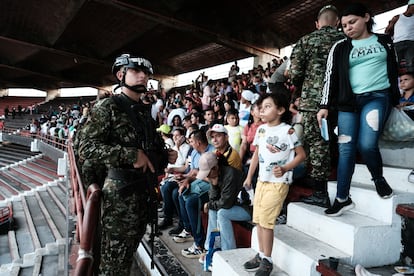
The war in Catatumbo, where five police officers were kidnapped early Tuesday morning on the highway between Cúcuta and Tibú, continues unabated. Colombia’s Ombudsman Iris Marín reported Tuesday that 130 families, comprising approximately 300 people, had arrived in Cúcuta, the capital of the troubled department of Norte de Santander, in recent days. They were fleeing clashes between the ELN and the so-called 33rd Front of the dissident groups. Between December 29 and January 2, at least 500 people were displaced, according to a report by the organization Vivamos Humanos, which also warns that another 6,000 people are at risk of confinement. The promised deployment of 30,000 soldiers along the border has failed to extinguish this conflagration. “The ELN has chosen the path of war, and war it will have,” President Petro declared.
The fighting also demonstrates that the self-proclaimed National Liberation Army (ELN) has become a binational guerrilla group, operating on both sides of a porous border stretching over 1,370 miles, as documented by various investigations. The offensive a year ago began with the transfer of fighters from Arauca, another department bordering Venezuela, presumably through its territory. The ELN is seeking to consolidate its control over the entire border region. The permissiveness of the regime of ousted Nicolás Maduro, a constant source of debate, now raises new questions.
The Bolivarian Republic of Venezuela even hosted — and was one of the guarantor countries of — the frozen negotiations with the ELN, which all observers consider a failure. This was the first round of talks established as part of the comprehensive peace process, through which Petro intended to engage in simultaneous dialogue with all armed groups. With only six months left in office, it is widely assumed that if the talks resume, it will be with the next government. Leftist Senator Iván Cepeda, the ruling party’s candidate and frontrunner in the polls, was part of the government’s negotiating team and has consistently expressed support for launching new peace processes.
Analysts agree that the future of the ELN is closely tied to Venezuela. As long as the Caracas government continues to support the Colombian insurgent group, it cannot be completely defeated, nor is it likely to sign a peace agreement, notes Jeremy McDermott, co-director of InSight Crime, in a recent investigation into the border wars, published before Maduro’s capture in a U.S. military operation early Saturday morning. For the time being, Vice President Delcy Rodríguez has been sworn in as acting president.
“While the ELN is currently a pro-regime paramilitary force in Venezuela, in the event of a regime change, could it become an insurgent force there, as it is in Colombia?” the report asked. The answer is complex. Any new government in Caracas, especially one that cannot count on the cooperation of formerly Chavista sectors, would face enormous difficulties, if not impossibilities, in expelling the ELN, at least in the short term, McDermott points out. The possibility of a U.S.-backed regime change could even favor the ELN, he warned. “Any new government, especially an opposition one, will find it hard to govern after more than two decades excluded from power. Its only tools to fight against the ELN will be the same military that today works alongside, and profits from, the Colombian rebels.”
The ELN, which emerged under the influence of the Cuban Revolution more than half a century ago, has been present on the other side of the border since at least the 1970s. In recent years, however, its expansion has become increasingly evident. Organizations such as Human Rights Watch have denounced the complicity of Venezuelan security forces, even going so far as to carry out joint operations. The independent UN international mission on Venezuela has also documented collaborative links between the rebels and the Chavista regime. The ELN has even reached agreements with Venezuelan authorities to participate in the exploitation of gold, diamonds, and coltan.
The guerrilla group, considered a foreign terrorist organization by the United States, has already incorporated the defense of the Bolivarian Revolution into its narrative, confirms Gerson Arias, a researcher at the Ideas for Peace Foundation, although he clarifies that they are concerned about the possibility of becoming a bargaining chip for the Venezuelan regime in the current situation. The combined strength of the ELN’s three war fronts operating in the border region represents 60% of its armed capacity, he points out. According to the most recent estimates from Colombian intelligence, the ELN has 6,500 fighters, the second-largest armed group after the Gulf Clan, which has almost 9,000.
Although this is a time of uncertainty, for the ELN it also represents the platform it has long awaited to become a continental guerrilla force, a long-held ambition that hinges on being able to confront the United States directly or indirectly, warns political scientist Jorge Mantilla, an organized crime researcher. “Given the archipelago of power that the Bolivarian National Armed Forces represents in practical terms, the ELN has opportunities to seize Venezuelan military assets if there is a collapse, or if the regime begins to crumble,” from weapons depots to anti-aircraft equipment, he points out. For more than a decade, Chavismo has incorporated Colombian armed groups into its national defense strategies, as a kind of first line of defense against a potential invasion. This logic remains in place and is even more relevant today, he concludes.
Sign up for our weekly newsletter to get more English-language news coverage from EL PAÍS USA Edition









































