
Gulf Clan negotiates peace while fighting the ELN over one of the largest coca and gold reserves in Colombia
The armed group, which concluded its first round of talks with the government this week, seeks to wrest control of southern Bolívar from the guerrillas
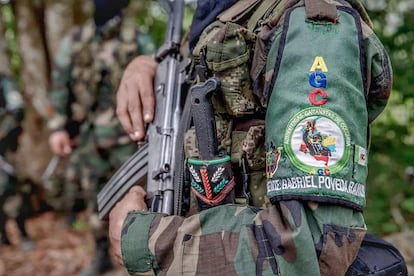
The peremptory order caught him out of the house. When he returned, his family and most of his neighbors had already fled. He hurried to pack two changes of clothes in the first bag he found and, before setting off on his motorcycle, he tied a white cloth to a long pole: “It was a flag as a sign of peace, to avoid any attacks on the three-hour journey,” says the social leader, who requests anonymity. He sped down the track along which cocoa crops and gold from the mines are transported. Further ahead, on the road leading to the urban center of Arenal, in the south of the department of Bolívar, he caught up with the convoy: 500 families fleeing the war between the National Liberation Army (ELN) — the oldest active guerrilla group in the world — and the Gulf Clan, the most powerful armed group in Colombia, which this week concluded its first round of peace talks with the government of Gustavo Petro.
The exile has so far lasted 12 days. It is the latest consequence of a dispute that has been ongoing for three years, but has intensified recently. Far from what happens in touristy Cartagena de Indias, the capital of Bolívar, located about 250 kilometers (155 miles) to the north, the south of the department is a prize fought over by illegal armed organizations. The incentive to control it is no less significant: according to the United Nations Office on Drugs and Crime, it is the region of Colombia with the fourth-highest coca production (37,524 hectares planted in 2023) and the third-most open-pit gold mining. Seventy-five percent of these operations lack technical or environmental permits and, according to estimates by the Colombian military, produce more than four tons of gold per year, which can fetch around $420 million (1.64 trillion pesos).
Furthermore, its location is privileged. Straddling the San Lucas mountain range, one of the northernmost foothills of the Andes, and on the banks of the Magdalena River, the country’s main waterway, the region’s 16 municipalities are part of a corridor that connects the border with Venezuela, in Catatumbo, with the ports on the Caribbean Sea and Panama, key to drug trafficking and other illegal economies.
“We had been hearing the fighting for several weeks. We tried to resist, but when they told us ‘either you leave or we won’t be responsible for anyone,’ there was no choice but to abandon the territory. It was a decision made by the entire community,” adds the social leader in a call he receives from a makeshift shelter in the Arenal coliseum.
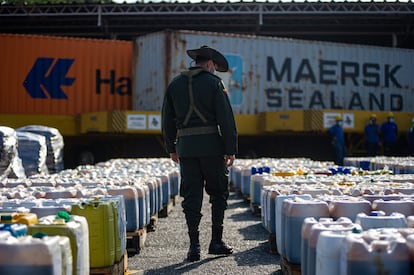
With or without a peace process, expansion will continue
The Gulf Clan — which calls itself the Gaitanista Army of Colombia — is the illegal organization that carries the greatest military, economic, and expansionist capacity in the country: it has nearly 10,000 members, grouped into six blocs and 40 fronts, with influence in more than 300 of the country’s 1,123 municipalities. On August 8, after three years of failed attempts, President Gustavo Petro officially reopened peace negotiations with the group, this time in Qatar. But that does not mean the group will halt its offensive.
Gerson Arias, a researcher at the Ideas for Peace Foundation (FIP), explains that the attack in southern Bolívar is part of an expansion plan that began to become more evident at the end of 2022, but is also related to the upcoming talks: “There are two wings of the Gulf Clan, one led by ”Chiquito Malo" and the other by “Gonzalito.” The latter, which operates in the region, would be more hesitant about negotiations and is continuing its expansion as a way to arrive at the table in a strong position.” Elizabeth Dickinson, an analyst with the International Crisis Group, agrees. “The Clan’s priority is to remain strong because, whether or not it reaches an agreement, it guarantees more room for negotiation and, at the same time, control of a territory crucial for its financing and mobility.”
The Gulf Clan has clashed with the ELN — a guerrilla group that arrived in southern Bolívar more than 40 years ago — and, taking advantage of the state’s absence, it has forged a rearguard that it now defends in an escalating dispute: an intensification of fighting has been documented since June. Between July and August of this year, more than 7,000 residents of small rural towns in the municipalities of Santa Rosa and Montecristo were confined for 20 days due to an armed strike ordered by the Darío Ramírez guerrilla front. This was an ELN response to the Gulf Clan’s new onslaught, similar to the one it has deployed in the department of Chocó, another of the two groups’ battlefronts.
“Farmers are worried about the fighting, the landmines, and the accusations. All the groups want to co-opt the leaders and authorities. They set the rules in the villages, recruit young people, issue fines, threaten, and kill those who don’t comply,” says a humanitarian worker in the Marizosa district, one of the areas hardest hit by the recent clashes. “You can’t even file a complaint anymore because they check cell phones to see if anyone has shared videos or messages about what’s happening. The communities’ plea is to be left out of this conflict.”
Between June 15 and August 7 alone, when the most recent armed shutdown was lifted, the International Institute of Caribbean Studies recorded 29 homicides, 22 combat incidents, four kidnappings, two accidents involving antipersonnel mines, and four drone attacks in seven municipalities in southern Bolívar. The use of these devices, which is only beginning to be documented in this territory, is a fresh concern for the authorities: on Tuesday, September 9, two soldiers died and four were injured in Santa Rosa after an attack with explosives sent from a drone. “I had never seen a situation of this gravity in southern Bolívar. In the midst of that war, the state left the communities adrift,” says Amaranto Daniels, director of the institute, who has more than 30 years of fieldwork in the area under his belt.
The war is not limited to the ELN and the Gulf Clan. Dissidents from the defunct FARC known as the 37th Front are also participating at a lesser intensity. They present themselves as part of the group commanded by Calarcá Córdoba and were accused a month or two ago of murdering 13 police officers after shooting down a helicopter in Amalfi, Antioquia, less than 150 kilometers (93 miles) from Santa Rosa. Precisely, one of the reasons for fear of an escalation is the alleged breach of the 2023 agreement between this dissident group and the ELN to jointly confront the advance of the Gulf Clan. “This year, several dissident units mobilized to Catatumbo to support the 33rd Front in confronting the ELN’s onslaught. When they began to return, there were tensions and accusations. The fear is that the three groups will receive reinforcements and fight with more vigor,” says a university researcher who, like the residents, requests anonymity.
As the war escalates in the region, this week, from Doha, Qatar, peace delegations published a statement in which the Gulf Clan — now officially recognized by the Colombian government as an Organized Armed Group called the Gaitanista Army of Colombia — pledges to establish a pilot plan for coca crop substitution and to respect international humanitarian law, among other things. What’s happening in southern Bolívar calls these commitments into question.
Sign up for our weekly newsletter to get more English-language news coverage from EL PAÍS USA Edition









































