
Cocaine trafficking in Colombia moves as much money as the construction industry
A new academic paper reveals that the drug trade generates annual revenues of $15.3 billion, equivalent to 4.2% of the country’s GDP
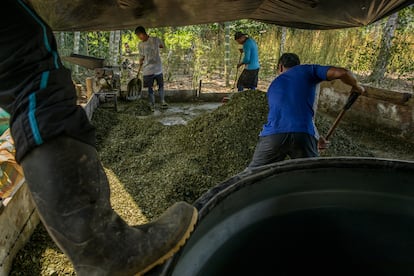

Between the fatigue caused by the news of the U.S. government’s decertification of Colombia — Washington has removed the country from its list of preferred allies in the war against drugs — and the confirmed significant increase in coca leaf cultivation, society is in a state of stupor. No formula seems to work in this chronic battle against drug trafficking. Neither the military-police approach of the traditional right nor the disorganized voluntarism initiated by Gustavo Petro’s left have yielded results.
Amid this dizzying boom, economist Daniel Mejía is about to publish a revealing study concluding that cocaine trafficking generates an average annual revenue of $15.3 billion in Colombia. This figure is equivalent to 4.2% of the national GDP and the equivalent of the value of legal sectors of the economy such as construction. From this perspective, the concern of several analysts in a country where wealth generation and private demand have been intertwined in one way or another with the specter of illegality is understandable.
Data from the 2025 UN Drug Report, compiled by a specialized UN division, show that the area planted with coca leaf increased from 230,000 hectares in 2022 to 253,000 in 2023. According to the results, Colombia is the world’s leading producer of this plant — the main raw material of cocaine — accounting for 67.3% of the total existing crop.
Despite decades of control policies, aerial spraying of illicit crops, manual eradication, prohibition and seizure, and the extradition of drug lords, the area devoted to this plant has continued to expand unchecked year after year. The same has happened with the production of the alkaloid. And, despite the fact that the paralysis in global trade due to the pandemic represented an unprecedented pause, rates have soared again.
This is the only way to understand President Petro’s recent shift in anti-drug policy: initially, he proposed an approach based on harm reduction, with less emphasis on eradication and military action. However, a few days ago, with the shadow of Washington’s decertification looming, he announced the reactivation of aerial spraying with glyphosate, a measure unlikely to be implemented due to the Constitutional Court’s firm rejection of its potential negative impacts on the health of rural populations and the environment.
Mejía’s research reflects the rapid increase in potential production: “The results are based on the measurement of cocaine that manages to leave the country. And they are also supported by the prices that organized criminal groups obtain in the Pacific, the border with Ecuador, and the Caribbean,” notes the economist at the University of the Andes.
His work allows him to conclude that the number of drug seizures — which Petro displayed like a badge of honor this Wednesday in his response to the Trump administration — has lagged behind the power of illegal networks. In the face of the government’s limping total peace strategy, focused on negotiating a peaceful and simultaneous solution with various armed groups, voices like Mejía’s have pointed out that the result has been counterproductive. Violent organizations have re-emerged and seized more and more space in various municipalities across the map. They have taken advantage of the military withdrawal to strangle the civilian population with more extortion, kidnappings, and armed actions.
The presence of criminal gangs like the powerful Gulf Clan, with which the government announced the start of a first round of negotiations in Qatar this Thursday, has expanded by 82% in the last five years, according to projections from academic work. Others, such as the Castro-inspired guerrilla group the National Liberation Army (ELN) or the fragmented dissidents of the defunct Revolutionary Armed Forces of Colombia (FARC), have increased their shadow of terror by 65% and 141%, respectively. For this reason, various analysts have expressed their criticism of a focus on anti-drug policies that — 10 months before the end of the presidential term — have strengthened these violent organizations.
In which economic sectors are cocaine-derived flows channeled? “These resources come in and stimulate aggregate demand. They are known to boost all kinds of goods and services, such as tourism and the construction sector. In mid-sized cities, one already sees consumption patterns, with luxury vehicles and restaurants, among people with a lot of money and little education,” says Mejía. The scent of money laundering from the past is pervasive. But, at the same time, he emphasizes that it is not possible to conclude that the country’s GDP has grown thanks to drug trafficking.
“These are incomes that do not generate productive capacity, like those generated by coffee or the textile industry. They do not create formal jobs, pay taxes, or contribute to the social safety net. On the contrary, they generate huge costs in security, public health, and infrastructure delays,” the economist explains. Drug trafficking also creates a framework of collective impoverishment among rural sectors, who capture a mere 8% of the income pie in the drug trafficking chain. According to the author’s calculations, in 2013, cocaine income accounted for 1.4% of GDP. By 2008, it had risen to 2.3%. Only in this way can we understand the asymmetry between the social hardships of coca-growing areas and the prosperity of a business that continues to expand like a monster, leaving bloodshed and hardship in its wake.
Sign up for our weekly newsletter to get more English-language news coverage from EL PAÍS USA Edition









































