
Mexico extradites 26 cartel members to the US under the promise they will not face death penalty
The transfer follows the same pattern as last February, when Mexico handed over 29 drug lords, including Rafael Caro Quintero, the ‘Narco of Narcos’
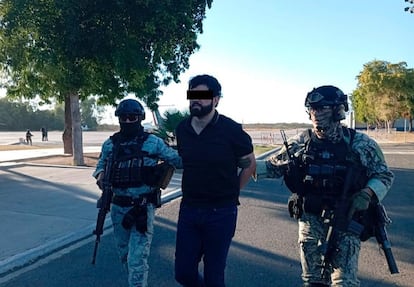

The Mexican government has handed another 26 criminals linked to drug trafficking over to Washington, including members of the Sinaloa Cartel, the Jalisco New Generation Cartel (CJNG), and Los Zetas. The handover — a kind of atypical extradition, as it is not formally such — is the second that Claudia Sheinbaum’s government has granted to its northern neighbor, after delivering another 29 drug lords in February, including Rafael Caro Quintero, who had been sought by the U.S. justice system for decades. As before, the handover of these 26 cartel members was carried out with the utmost discretion and, once again, it came amid heightened tensions between the two countries and days after it was revealed that Donald Trump had ordered the U.S. military to combat foreign cartels.
Mexican authorities have emphasized that the handover of the 26 drug traffickers was carried out in accordance with the National Security Law and following the United States’ commitment not to seek the death penalty for them, something that the 29 criminals handed over in February also escaped. The names of the prisoners handed over to the Trump administration were released by the U.S. Department of Justice, in contrast to the Mexican authorities, who remained silent about the identity of the drug lords pending a press conference scheduled for Wednesday. The list includes Abigael González Valencia, “El Cuini,” right-hand man and brother-in-law of the founder of the Jalisco New Generation Cartel, Nemesio Oseguera Cervantes, “El Mencho.” Also included is Servando Gómez, “La Tuta,” who was the leader of the once powerful Knights Templar cartel, as well as Juan Carlos Félix Gastélum, “El Chavo Félix,” son-in-law of Ismael “El Mayo” Zambada, the founder of the Sinaloa Cartel who is also in Washington’s custody.
The Mexican Attorney General’s Office and the Secretariat of Security stated in a press release that the drug lords, who were being held in various prisons, had extradition orders against them and “posed a permanent threat to public safety.” In February, the Mexican government handed over the previous 29 drug traffickers to the U.S. through an ingenious legal framework that allowed it to circumvent the complicated extradition process. That maneuver set a precedent. Everything points to the fact that this time the scheme has been replicated, just days after Mexico and Washington reached an agreement to ease Trump’s tariff war. In addition, a week ago it was revealed that Trump has ordered the Pentagon to use the military to enforce the law against foreign drug cartels. The order allows direct military operations to be carried out on foreign territory, and in the corresponding territorial waters, against these organized criminal groups. Since then, Claudia Sheinbaum has tried to emphasize that the United States will not operate on Mexican soil.
The Sheinbaum administration has stated that the individuals sent to the United States “were wanted for their links to criminal organizations involved in drug trafficking and other crimes.” The U.S. embassy, for its part, added that the drug lords “face serious criminal charges in U.S. federal courts, including drug trafficking, organized crime, money laundering, and violent crimes.” The Mexican authorities have specified that the U.S. Department of Justice “has agreed not to seek the death penalty for the prisoners in its country,” in line with the shift in Trump’s hardline policy against Mexican drug traffickers, whom his administration has shown leniency toward in order to pressure them into accepting plea bargains.
The Mexican agencies explained that “the custody, transfer, and formal handover” of the drug lords was carried out in accordance with the Constitution and the National Security Law, and at the express request of the U.S. Department of Justice, the same legal argument on which the February operation was based. The heads of the Attorney General’s Office and the Secretariat of Security, Alejandro Gertz and Omar García Harfuch, will hold a press conference on August 13 to report on this new operation.
Legendary and infamous drug lords such as Rafael Caro Quintero, leader of the Guadalajara Cartel and murderer of DEA agent Enrique “Kiki” Camarena; the former leaders of the Los Zetas cartel, Miguel Ángel and Omar Treviño Morales, known as Z-40 and Z-42, and Antonio Oseguera Cervantes, “Tony Montana,” the CJNG’s chief financial operator and El Mencho’s brother, were among the drug traffickers sent to Washington last February. At the time, the Mexican government became entangled in explaining the legal basis for the operation. There was talk of transfer, expulsion, extradition, and shipment.
The truth is that it was not a typical extradition, that is, one carried out in accordance with the law. Many of the drug lords had managed to bribe judges to delay their appearance before U.S. courts for years, and this reality led Mexican authorities to seek an alternative. After that unprecedented operation, Prosecutor Gertz explained that it had been carried out based on the National Security Law and the constitutional article that empowers the head of the executive branch, Claudia Sheinbaum, to preserve it.
The U.S. Embassy in Mexico has emphasized that this new transfer of criminals “represents another significant milestone in the collaboration between U.S. and Mexican law enforcement agencies, as well as in the alliance between Presidents Trump and Sheinbaum.” “We are deeply grateful to President Sheinbaum and her administration for demonstrating determination in the fight against organized crime,” said Ambassador Ronald Johnson. “This transfer is yet another example of what is possible when two governments unite against violence and impunity,” he added.
Sign up for our weekly newsletter to get more English-language news coverage from EL PAÍS USA Edition









































