
Extortion: Mexico’s new battle against a deeply rooted crime
García Harfuch has presented a police and intelligence initiative targeting the criminal charges imposed on both large and small businesses

Mexico — where there are 65 violent deaths a day — is plagued by another crime hiding in plain sight: extortion. Millions of people are victims of threats that force them to pay fees to criminals. It’s a problem that affects businesses and services, transportation and the distribution of goods, medium and large companies, and increasingly, poor people trying to get by with a street vending stall or a humble tortilla shop.
The fear of failing to meet these criminal demands has driven hundreds of businesses to ruin, while few have dared to speak up: only 0.2% of extortion cases are reported. What’s more, it has become the fastest-growing crime in Mexico.
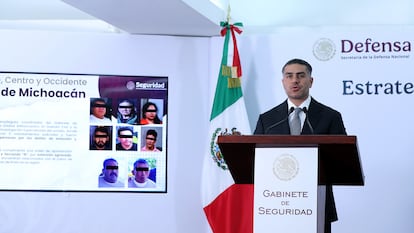
Mexico’s Secretary of Public Security, Omar García Harfuch, has presented a plan to combat this epidemic, offering police and financial intelligence support to a handful of Mexican states, including the capital, as well as campaigns to encourage people to report the crime.
Mexican President Claudia Sheinbaum is entering the fight against a crime “under state jurisdiction, which no previous president has wanted to talk about because of the risk of making it more public and ending up with counterproductive statistics once victims start reporting,” says security expert Carlos Pérez Ricart. “It’s a brave move,” he adds. Extortion only falls under federal jurisdiction if it’s tied to organized crime — and it often is. But with so many local gangs operating under similar tactics, the line between street-level extortion and organized crime is increasingly blurred, forcing the federal government to take an active role.
President Sheinbaum’s most trusted ally — and one of the country’s most popular figures — is now leading the charge against this scourge: García Harfuch, whose approval ratings continue to climb ahead of the 2030 elections.
Pérez Ricart sees this as a political strategy: Sheinbaum is betting that reducing crime and insecurity will become the defining success of her presidency — a sharp contrast to her predecessor.
“Homicidal violence is decreasing, but extortion is not, and that is clearly perceived by ordinary citizens,” Pérez Ricart explains. “The project will focus on defeating this crime, and the new security and intelligence laws are moving in that direction.”
But that’s not the only reason behind the push. Next year, Mexico will be one of the three host countries of the FIFA World Cup, alongside Canada and the United States. Some experts see the anti-extortion campaign as part of preparations for this event.
“This is reminiscent of the strategy Brazil used during its World Cup, where eight cities were shielded from crime — and it worked,” says security expert Raúl Benítez Manaut. He adds more context to complete the picture: “When García Harfuch was Security Secretary in the capital, he carried out many joint operations with his counterpart in the State of Mexico, Rodrigo Martínez. They’re close friends, and Martínez is now FIFA’s security liaison in Mexico — a contract in which I bet Harfuch was involved,” the analyst says.
The economic challenges Sheinbaum encountered upon taking office — driven in part by Donald Trump’s tariff threats — prompted her administration to refocus on strengthening the domestic market. She has held numerous meetings with business leaders, who have rallied around her in the face of external threats. To all of them, she has presented the “Plan Mexico,” asking for collaboration to boost the internal market and reduce Mexico’s heavy economic dependence on the United States — its main trading partner and the destination of most of its massive exports.
From this perspective, fighting extortion is critically important. On one hand, it offers foreign investors the security needed to set up operations in Mexico — even though large companies are not the most vulnerable to this crime, they do suffer from it and are demanding action. On the other hand, the small Mexican business owner and the even smaller entrepreneur — those truly suffocated by criminal extortion — would benefit greatly from a crackdown on those demanding a cut of their earnings.

Extortion has surged, driven both by powerful crime bosses and by opportunistic criminals acting on their own. The former suffocate rural areas, livestock farming, wholesale markets, and certain merchants in high-conflict zones; the latter prey on nearly anyone, sometimes staging bogus kidnappings by phone to demand ransom — schemes that tend to exploit the poorest and most vulnerable.
García Harfuch’s announcement emphasized the use of intelligence to apprehend criminals, the creation of local anti-extortion units, and victim support protocols for those paralyzed by fear. He also promoted the use of the 089 hotline to properly receive and process complaints. Additionally, the Financial Intelligence Unit will play a greater role, freezing bank accounts tied to criminal activities, and court orders will be requested to block phone numbers and cell phone lines — many of which are operated from within prisons.
“Renting out cell phones in prisons is a thriving business, and signal jammers don’t work because they disrupt the surrounding communities, so they’ve failed. But those kinds of extortions are the least common; they mostly target unsuspecting citizens,” says Manaut.
This cell phone monitoring strategy has a political subtext: it aligns with the telecommunications law introduced by Sheinbaum as part of her anti-crime efforts. The legislation has faced strong criticism over concerns it might enable government spying, but the president has repeatedly insisted: “A judge’s order will be required — this isn’t espionage.”
Now, García Harfuch, the man at the center of government power — the one who has gained the most political capital in Sheinbaum’s first 10 months — is taking on the extortion crisis. He has been delivering results against crime almost daily, targeting the countless offenses that have been cripling the country. The drop in crime statistics isn’t driven only by Trump’s pressure on drug and fentanyl trafficking — it’s shaping up to become the hallmark of this administration, which urgently needs to outperform its predecessor’s poor track record on security.
“It’s clear that this government wants to show a firm hand with a soft voice — not to be seen as another [Nayib] Bukele, but to ‘Bukelize’ things a little. And a lot of people would welcome that, no doubt,” says Benítez Manaut, referring to the president of El Salvador.
Without directly referencing Bukele — whose image contrasts sharply with Sheinbaum’s — Pérez Ricart also believes the Mexican president will be judged by her handling of insecurity in the country: “Because in other areas, I think she’ll come up short: the economy will struggle to grow, and we’ll have to see whether the major infrastructure promises materialize. But security could be the area where results are achieved.”
Sign up for our weekly newsletter to get more English-language news coverage from EL PAÍS USA Edition









































