
Colombian government confirms 34 soldiers kidnapped after clashes with FARC dissidents
The Defense Ministry said that the troops have been held since Sunday, following an operation against Iván Mordisco’s faction
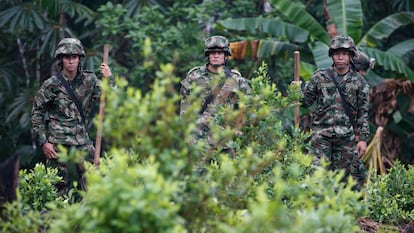

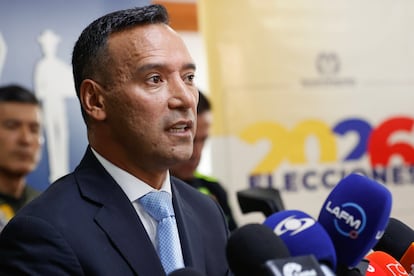
Colombia’s Defense Minister Pedro Sánchez confirmed on Tuesday that 34 soldiers have been held hostage for two days in the rural area of El Retorno, in the Amazonian department of Guaviare. “People dressed in civilian clothes claim to be holding a group of soldiers. But this is not a detention, it is a kidnapping, because they are being held against their will,” he told reporters.
Admiral Francisco Cubides, commander of the Armed Forces, said the kidnapping took place on Monday after clashes with one of the FARC dissident structures led by Iván Mordisco. “As a result of these military operations, ten suspected members of that structure were killed […] When the troops attempted to leave the area, they were blocked by members of the community.”
The fighting also led to the capture of 10 members of the armed group, known as the Estado Mayor Central (EMC), including a minor, as well as the death of Willington “Dumar” Vanegas Leyva, a close ally of Mordisco in the region. It was then that members of the community surrounded the soldiers and prevented them from leaving.
“The people say it is a humanitarian corridor. What they are really doing is blocking the protection of other Colombians,” said Cubides. He called on the Ombudsman’s Office and the Organization of American States Mission to Support the Peace Process to help secure the soldiers’ release.
It is not the first time the military has accused civilians of detaining soldiers under pressure from dissidents. In June, in the municipality of El Tambo, in the conflict-ridden department of Cauca, 57 soldiers were held against their will during another operation against the EMC. At the time, Minister Sánchez described it as a violation of international humanitarian law.
“Using civilians as human shields is a crime intended to block the advance of the security forces and state institutions in bringing social investment and justice to one of the regions most affected by violence,” he said in June. The soldiers were released the following day.
In the first months of 2025, security in the department of Guaviare deteriorated sharply amid fighting between the dissident FARC faction led by Iván Mordisco and another headed by his former lieutenant, Calarcá Córdoba. Both groups are seeking to control the region with such violence that, between late May and June, the Ombudsman’s Office reported more than 10,000 people were confined in rural areas of the northern part of the department.
The crisis reached a breaking point in July, when a mass grave was discovered in the municipality of Calamar. It contained the bodies of eight religious and community leaders who had gone missing weeks earlier while taking part in a humanitarian mission. They were kidnapped and killed, allegedly by the Armando Ríos front, which is part of Mordisco’s faction. The impact was profound: Colombian President Gustavo Petro condemned the killings as a serious violation of fundamental rights, while the U.N. and the Catholic Church issued an urgent call for stronger protection of community leaders.
Last Thursday, the Jaime Martínez front, another unit of the same dissident group, drove two trucks loaded with explosives from the department of Cauca to the vicinity of the Marco Fidel Suárez air base, in the heart of Cali, Colombia’s third-largest city. They detonated one of them in an attack that killed seven civilians and injured more than 79 people.
Although the group has not claimed responsibility, authorities have unanimously blamed it, and the defense minister reiterated that the government will step up its offensive against Mordisco — a drug trafficker with a bounty of more than 4 billion pesos ($1 million) on his head, who has put the Colombian state under significant pressure.
Sign up for our weekly newsletter to get more English-language news coverage from EL PAÍS USA Edition









































