
The shadow of Jeffrey Epstein tarnishes Costa Rica’s picture-postcard image
Judicial authorities are investigating a case linked to the abuse of a minor after it was leaked that the sex offender’s accomplices visited the Central American country
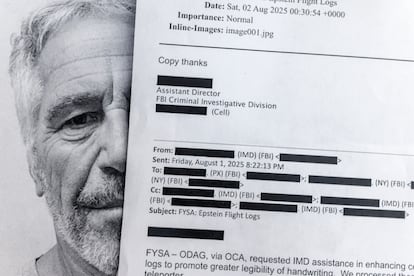

The picture-postcard image that Costa Rica projects to the world has a dark side. The Central American country is also a destination for foreigners in search of minors who are sexually exploited by criminal groups. This has been a known problem for decades, but now, the case involving Jeffrey Epstein and the trail he left in Costa Rica have drawn the attention of authorities, who are beginning to shed light on the extent of the networks involved in the trafficking and sexual exploitation of minors.
On January 30, the U.S. Department of Justice released more than three million pages of the so-called Epstein Files, which reveal the scale of the child trafficking operation run by the financier, who died in 2019. Among the thousands of documents, there are 324 mentions of Costa Rica in emails, phone conversations and court records, prompting the Costa Rica Attorney General’s Office to open an investigation.
Last week, Attorney General Carlo Díaz confirmed to the news outlet Teletica.com the opening of an investigation into the sexual abuse of a minor, linked to Epstein’s connections in Costa Rica. At this time, however, the investigation is proceeding without any individuals being formally charged. In other words, no suspects have yet been identified.
Among the hundreds of mentions of Costa Rica are details of an undercover operation by the Federal Bureau of Investigation (FBI) that used a fake agency they called Costa Rica Taboo Vacations to track suspects looking for organizations that sexually trafficked girls between the ages of 14 and 16.
“The FBI identified a couple of U.S. citizens who came to Costa Rica to negotiate the possibility of having sex with minors and whom they managed to arrest during a meeting,” says Karen Jiménez, president of the College of Professionals in Criminology of Costa Rica.
The expert points out that the documents also mention two people closely linked to Jeffrey Epstein’s criminal organization: Jean-Luc Brunel — a French modeling agent accused of child rape, who died in prison in 2022 — and Daniel Siad, another close associate of Epstein also linked to the modeling world.
“Jean-Luc Brunel was a well-known modeling agent who recruited these victims. The documents mention his visits to Costa Rica, but there are no specific references to his activities here,” Jiménez explains.
Regarding Daniel Siad, the files detail his communications in connection with Costa Rica and “personal events,” such as being the victim of an assault, but there is no concrete information about criminal activity.
Visit by Ghislaine Maxwell in 2010
The Epstein Files detail a 2010 visit to Costa Rica by Ghislaine Maxwell, the billionaire’s partner and accomplice, who is currently serving a 20-year sentence in a Florida prison. Records from Costa Rica’s Directorate General of Migration and Foreigners confirm that Maxwell entered the country twice, on March 2 and April 14, 2010.
In a February 28 communication included in the documents, Maxwell told Epstein that she would be going to Costa Rica “to attend the expansion of a national park” and that she would also “meet the new president,” an apparent reference to Laura Chinchilla, who had won the national elections earlier that month. The documents do not reveal whether the meeting took place.
Asked about this apparent mention, former president Chinchilla clarified that the first time she heard about Epstein’s accomplice was “in connection with the reprehensible events that have been aired in the U.S. courts and reported in the media.” “Before that, I had not even heard of her existence,” Chinchilla said in a text message. The former president emphasized that her name is not mentioned literally “anywhere in the files.”
In Epstein’s criminal network, Maxwell played a key role as a recruiter of minors, who, according to Jiménez, “had a common pattern of situations of social vulnerability.”
“Maxwell refers to various visits she made to Costa Rica, and although she talks about meeting the president-elect and doing tourism, she makes no specific mentions related to the issue of recruiting underage girls, nor is there any type of email or explicit communication that confirms that she carried out these activities in Costa Rica,” notes the president of the criminologists’ association.
According to the expert, a local investigation into the scope of Epstein’s network is “quite a complex issue,” not only because those involved could be in other countries, but also because it is an international issue involving “high-level economic and political figures.”
“We have seen many cases in Costa Rica related to criminal structures associated with sex trafficking or sexual exploitation of minors, but these are usually more marginal criminal structures, and are not associated with the global economic elites who are usually characterized by having a network that maintains discretion, in order to avoid having their names disclosed,” he adds.
Jiménez believes that it was precisely this “discretion” that made Jeffrey Epstein’s structure “so lucrative”, since it involved “high-profile people who engaged in this type of crime.”
Vulnerable children and organized crime
More than two decades ago, the International Labour Organization (ILO) already pointed to Costa Rica as having criminal groups dedicated to the sexual exploitation of minors. A 2002 study indicated that the main victims were girls from “impoverished homes, or victims of domestic violence, abandonment, and abuse.”
“Unfortunately, many of the people who come ostensibly for tourism actually have other intentions. In Costa Rica, there are tourist areas that are quite attractive for committing these types of crimes,” says the president of the College of Criminology.
Rogelio Ramírez, a lawyer specializing in organized crime and former director of the Costa Rica Judicial Investigation Agency, explains that criminal organizations “seek to concentrate their activity in areas where there is more of an atmosphere of partying and excess” because that is where there is “more demand.”
“In those places we not only find Costa Ricans, but also minors brought from other countries, such as Nicaragua, Panama, Venezuela or Colombia, so we detect a clear phenomenon of human trafficking with an international character,” says the lawyer.
Ramírez explains that criminal organizations that exploit minors are often large structures that have diversified their activities: “They often start with drug trafficking, move into pimping, and then into human trafficking, including minors.” According to this expert, authorities have detected or dismantled many of these networks that were run by foreigners. However, from the perspective of judicial investigations, the Jeffrey Epstein case is unprecedented in Costa Rica.
Sign up for our weekly newsletter to get more English-language news coverage from EL PAÍS USA Edition









































