
Laura Fernández, the governing party’s candidate, will be Costa Rica’s next president after a decisive first‑round win
Backed by President Rodrigo Chaves, the 39-year-old secured 50% of the vote in a high‑turnout election
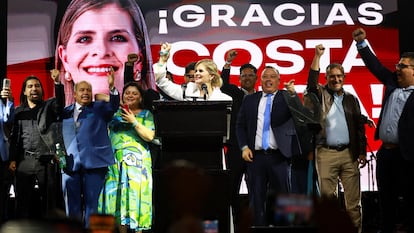
Laura Fernández, 39, is set to become the next president of Costa Rica after winning a decisive first‑round victory in Sunday’s general election. With more than 80% of ballots counted, the Electoral Tribunal reported that the Sovereign People’s Party (PPS) — the political organization of outgoing President Rodrigo Chaves and Fernández — secured about 50% of the vote. The election also marked a symbolic turning point in Costa Rica’s chronic problem of low voter turnout.
Before Fernández addressed her supporters, Chaves called her live on television to congratulate her. She responded that she would fight tirelessly and ensure a smooth transition.
Speaking to her followers, Fernández celebrated the strength of Costa Rican democracy, saying the people had chosen to continue a process of change aimed at strengthening institutions and returning them to the “sovereign people” to promote greater prosperity. She argued that the peaceful vote demonstrated how elections can spark a genuine political transformation.
Fernández said the victory was well deserved and criticized the opposition, calling it “cannibalistic,” though she emphasized that her administration would be based on dialogue and respect for the rule of law. She promised that laws that no longer serve the country would be reformed or repealed, but stressed that existing laws must be respected because democracy depends on adherence to them. She also promised that the country’s republican principles would remain intact.
Voter turnout in the presidential election reached about 66%, reflecting strong mobilization from an electorate that has given Chaves’s political project a second chance. Chaves advocates for a “refoundational” model that would concentrate more power in the executive branch, weaken institutional checks and balances, and introduce constitutional reforms.
El Salvador’s president, Nayib Bukele, was the first foreign leader to congratulate Fernández on her victory. “I have just congratulated Costa Rica’s president-elect, Laura Fernández, by telephone. I wish her every success in her government and all the best for the beloved brotherly people of Costa Rica,” said the Salvadoran president.
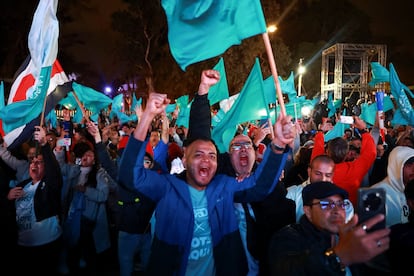
Sunday’s election unfolded smoothly in a country long accustomed to resolving its differences at the ballot box. From the moment polling stations opened at 6 a.m., long lines formed and remained throughout much of the day. Voters turned out enthusiastically, openly showing support for their preferred candidates. Neither the light afternoon rain in San José nor the drop in temperature discouraged participation: lines continued until the polls closed. Later that night, thousands of people took to the streets in caravans waving party flags, and the sound of car horns marked the end of an election day that once again showcased Costa Rica’s deep‑rooted pride in its democracy.
According to Alberto Cortés, coordinator of the Central America Chair at the University of Costa Rica, Fernández’s first‑round victory demonstrates the PPS’s ability to tap into more than a decade of built‑up social discontent — momentum that could now be used to seek full control of the country’s institutional power.
The expert argues that such a wide margin of victory opens the door to a government with few checks and balances, one capable of aligning the Legislative Assembly, exerting pressure on the judiciary, and even pushing structural reforms such as continuous presidential re‑election, which is currently prohibited in Costa Rica. The final impact will depend on the results of the congressional elections, which are still pending.
In this scenario, the incoming government would face a dual challenge, the expert argues. First, it would try to push forward an agenda of state reform, fiscal austerity, and reductions in public-sector employment — measures that are likely to reignite social tensions and citizen mobilization, which have historically served as an important counterweight in Costa Rica. Second, it would need to navigate a complicated relationship between the president‑elect, Laura Fernández, and the outgoing president, Rodrigo Chaves, whose presence dominated the campaign and whose popularity remains higher than that of his successor.
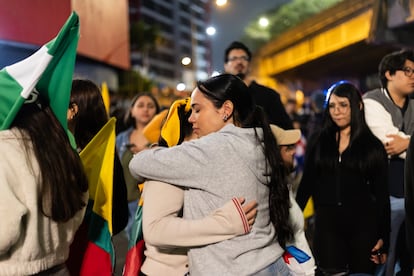
Although Fernández was presented during the campaign as Chaves’s direct successor, there are signs of internal tensions within the governing bloc. Comparative experience and Costa Rica’s own political history suggest that it is entirely possible the new president will try to build her own identity and assert political autonomy once in office.
Behind the governing party’s victory lies a profound shift in Costa Rica’s political culture: declining social mobility, widening territorial inequalities, the erosion of traditional parties, and the persistent association between politics and corruption. This environment enabled the rise of a confrontational, anti‑establishment style of leadership. Now that the governing movement is firmly in power, a new phase begins — one in which it must test how far it can govern without legislative majorities and how much of the public discontent that fueled its rise it can actually address.
Costa Rica ended Sunday’s presidential election with more than just a change in government: it marked the country’s definitive entry into a new political era, shaped by the erosion of traditional political identities, rising polarization, and the mobilization of public discontent that had been building quietly for years.
“We are seeing a profound transformation of identities, an attempt by a brand to force its way into the market and displace traditional ones,” explains Ronald Alfaro, coordinator of the Center for Political Research and Studies (CIEP) at the University of Costa Rica. In his view, the key now is to assess how deep this realignment truly is, something that will become clearer through the election results and, above all, through the composition of the Legislative Assembly. “That will determine whether or not substantive changes in the political system are feasible,” he warns.
Costa Rica, long portrayed as an exceptional democracy in the region, has been showing clear signs of institutional strain and social discontent for at least a decade. Ronald Alfaro notes that back in 2016 researchers already identified a strong but unorganized base of public frustration. Now, he says, that discontent has found channels of expression and is attracting a wide range of “anti‑” voters. He also highlights the influence of international political trends and the appeal of “cool,” outsider‑style leaders in shaping how that anger is being translated into electoral support.
For Mario Quirós, political analyst and former adviser to the National Liberation Party (PLN), the country is risking more than just the next four years. “We are in a cycle of change that has not yet been fully processed, and now the country’s path for the coming years is being defined,” he says. The challenge, he adds, is not only to win, but to govern without deepening social divisions, in a context of mistrust, polarization, and increasingly heated public discourse.
Quirós warns of democratic risks that stem not from any single leader but from the system itself. “Qualified majorities bypass that part of democracy that involves negotiating and reaching agreements,” he argues. The campaign offered vivid examples of this tension: in one widely discussed incident, President Rodrigo Chaves reacted to protesters shouting “¡Fuera Chaves!” by sticking out his tongue and blowing kisses — an image that encapsulates the confrontational tone shaping Costa Rican politics today.
Sign up for our weekly newsletter to get more English-language news coverage from EL PAÍS USA Edition









































