
Costa Rica at risk of radio and TV shutdowns after reform ordered by Rodrigo Chaves
Amid a tense election campaign, the government is auctioning off frequencies at prices most broadcasters cannot afford. Those affected have raised concerns about freedom of expression
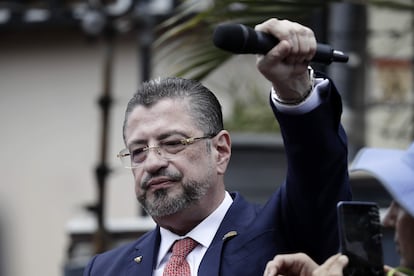
The vast majority of Costa Rica’s radio and television stations are at risk of having to stop broadcasting, after failing to meet the requirements of a spectrum auction ordered by the government of Rodrigo Chaves.
The auction was supposedly aimed at “democratizing” the use of state resources and ensuring that companies pay “a fair price” for their operations. But dozens of stations announced that they were unable to submit a bid before the Friday midnight deadline set by the authorities for the process. This will deal a blow to freedom of expression and democratic plurality, according to complaints from affected parties, industry associations, experts, opposition parties, and organizations including the Catholic Church.
The reform of the radio spectrum management model — already controversial due to Chaves’ frequent attacks on critical media, which he has vowed to dismantle — comes amid a tense election campaign, in which Chaves is seeking to advance his so-called “peaceful revolution” against traditional elites. Political tensions are running high due to the warnings and complaints from regional, cultural, journalistic, and religious media, whose future will depend on judicial decisions or last-minute changes accepted by Chaves or the Telecommunications Superintendence (Sutel), the technical authority under the executive branch.
Parallels with Chavista Venezuela
“Let’s not reduce frequencies to the highest bidder,” the Episcopal Conference urged this Monday. The bishops were speaking on behalf of three Catholic radio stations and one lay Catholic TV channel, but also for the wider diversity of media that could disappear once the new frequency allocation is implemented — still without a set date. “Defending their existence is defending the possibility that Costa Rica hears all its voices, not just those that come from economic power,” the bishops said in one of the many statements issued on the topic in recent days.
Other criticisms have been stronger, such as that of opposition politician Rodolfo Piza, who drew a parallel with Hugo Chávez’s Venezuela, where numerous stations were shut down in 2009 under the justification of legal noncompliance.
Minutes after the Episcopal Conference’s statement, the presidency issued another communication blaming critics for “misinforming” the public and opening the door to possible solutions — but only for affected Catholic or evangelical stations facing high starting prices and the exorbitant costs required to meet the auction requirements. The auction starts at $386,000 for a nationally broadcast radio station and $1.6 million for a television frequency. The amounts for regional coverage are lower but still exorbitant for the business model of these outlets, which are also struggling with declining traditional advertising, according to industry spokespeople.
The situation has united groups across the ideological spectrum, who argue it will cause direct harm for low-income audiences and older listeners, who have relied on traditional radio stations or religious channels throughout their lives.
“I thought that if they took away Radio Fides [a Catholic station], I could switch to Santa Clara [another Catholic station], but now I see that the government is even going to take away the music stations we’ve listened to all our lives, like Sinfonola or Musical,” says Marta A., 77, a resident of a rural area in Alajuela province. “Look, I feel angry, as if that man were going to break into my house and steal my radio or force me to listen to whatever he wants.”
Radio Sinfonola, a station specializing in retro music and beloved by older listeners, signed off on Friday with these words: “Despite being one of the five radio stations most listened to in Costa Rica, Radio Sinfonola is a small business that has no possibility of paying the hundreds of millions that the government of Mr. Chaves is demanding if it wants to continue operating.” In a somber tone, the station’s manager, Carlos Lafuente, added another controversial point: “Frequency 90.3 will go to foreign capital.”
So far, only 15 companies are known to have registered for the auction. In television, one participant is the group owned by Mexican magnate Ángel González, which already operates in Costa Rica. Another is Televisora de Costa Rica, whose owners and TV news channel have been repeatedly disparaged by Chaves as enemies of his government and defenders of the elites he claims to be fighting.
“It’s ironic. This man’s revenge against the owners of Channel 7 has affected everyone except them, who do have plenty of money to continue operating. For us, it’s absurd, crazy,” says Saray Amador, manager of Telefides, a channel that has been broadcasting since 1990 with a staff of 15 employees and dozens of volunteers.
Not all excluded stations are small. On Monday, the position of the Columbia group became known; it hosts four radio stations, including one of the country’s three main radio journalism platforms, in a nation of just 5.2 million people, on a territory one-tenth the size of Spain. Columbia reported that its financial model has been sustainable so far, but far from meeting the figures required in the auction. As a result, it will continue broadcasting only while legal challenges to the licensing process, including cases before the Constitutional Court, are still pending.
Critics argue that the auction lumped all media into the same basket, regardless of their social or cultural contribution. Not even geographic origin was considered, as noted by lawyer and consultant Juan Manuel Campos, who said he was aware that the Russian state network RT had shown interest but did not submit an offer, possibly because it did not have enough time to meet legal requirements.
“It is serious that the country has reached this point in a climate of animosity toward local media, fueled by rhetoric from those in power,” he says. The practical result, he points out, is the shutdown of most stations operating under the open broadcasting model, which reaches everyone, including those without access to paid services. He cautioned, however, that this closure will not be immediate, as legal processes remain unresolved and Sutel has not been clear on the details.
The political moment is decisive, says historian and communications expert Patricia Vega of the University of Costa Rica (UCR), who points to signs of decline in the foundations of the democracy that has long characterized the country. She adds, however, that the allocation of frequencies is not a new dispute. “The country has had this controversy since the 1950s, when Channel 7 was granted its frequency,” Vega points out.
Years have passed, and neither the frequency allocation model nor the fees that media outlets must pay for their use have been modernized. This is one of the issues Chaves highlighted in 2023 when he expressed his intention to change the conditions, always citing Channel 7 as an example. “There were problems that went unresolved for years and are now being addressed, but with the added problem that it is a delicate political moment, with a government taking an authoritarian path,” says Vega.
Opposition candidates and political parties echo this view. Until October, Chaves enjoyed 62% public approval, just three months before the February 1 elections and six months before leaving office in May. His presumed successor, presidential candidate Laura Fernández, who is leading in the polls, also stresses the need to prevent “the continued exploitation of frequencies for 71 years, practically free, by businesspeople who profit from them, making millions.”
Sign up for our weekly newsletter to get more English-language news coverage from EL PAÍS USA Edition









































