
Guatemala, caught between gang bloodshed and the Bukele effect
The Central American country is under a state of emergency after a massacre of police officers that calls into question the state’s ability to deal with the violence of an army of 30,000 gang members


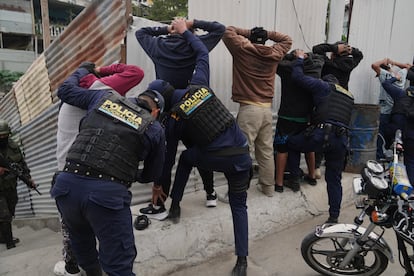
El Mezquital is neither a neighborhood nor a district. It started out as one, but now it’s a motley patchwork of gray houses and corrugated metal roofs on the outskirts of Guatemala City. From here, the capital’s buildings appear in the distance as tiny lights, as unattainable as green spaces, shopping malls, or health centers. Old yellow school buses burst noisily down the main street, belching smoke and carrying silent residents who travel with their cell phones hidden away. The Barrio 18 and Mara Salvatrucha gangs, which have brought the country and the government of Bernardo Arévalo to its knees, emerged from here. Arévalo has declared a state of emergency in the country. Although the decree marked its first week in effect on January 25, in the streets of El Mezquital, only the old rules apply: “See no evil, hear no evil, speak no evil.”
Guatemala is one of the poorest and most violent countries in Latin America. With nearly 17 million inhabitants, the Central American nation boasts 22 Mayan languages, 37 volcanoes (four of them active), coastlines on both the Pacific and the Caribbean, and 10 people murdered every day. This security crisis is being confronted by a weak and isolated government that took office in January 2024 and is attempting to defeat an army of 30,000 tattooed gang members determined to overthrow it.
To explain why Guatemala has declared a state of emergency and deployed thousands of police and soldiers in its streets, it’s necessary to go back a few months, long before the bloody Saturday of January 17, when a wave of attacks orchestrated by gangs left 10 police officers dead and just as many wounded.
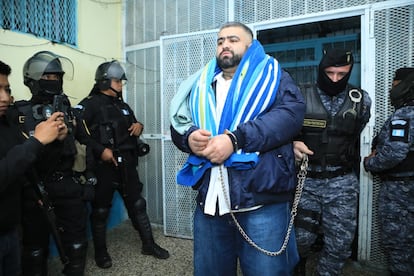
During the previous summer, the Ministry of the Interior decided to transfer the leaders of the Barrio 18 and Mara Salvatrucha (MS-13) gangs, considered terrorist groups by the United States, to a different prison. The government had decided that for all of them, the king-size beds, high-speed internet, mariachis, alcohol, and drugs they had access to behind bars were over, and placed bloodthirsty leaders like “El Lobo” and “El Diabólico” in the same maximum-security prison — something that had been unthinkable until then.
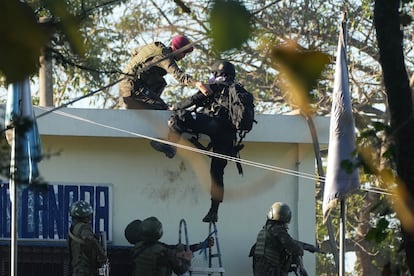
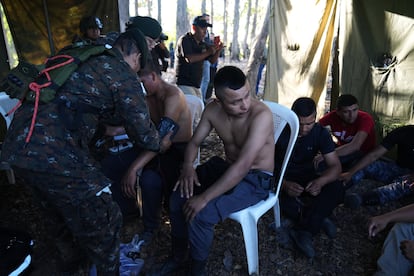
For several months, the leaders of Barrio 18 and MS-13 demanded their return to their old prisons until, tired of official silence, they ordered three riots to begin last Saturday in different penitentiaries across the country. The result was a wave of violence that burned mattresses, destroyed facilities, and led to the kidnapping of 37 prison officials who, locked in a cell, were forced to record a video stating that the prisoners’ demands were legitimate.
The Guatemalan government said that it would not give in to “blackmail.” The police intervention managed to quell the riots and arrest Aldo Duppie Ochoa Mejía, alias “El Lobo” (The Wolf), a massive man weighing over 440 pounds (200 kilos), whom the officers displayed kneeling and covered in blood, like hunters showing off their prey.
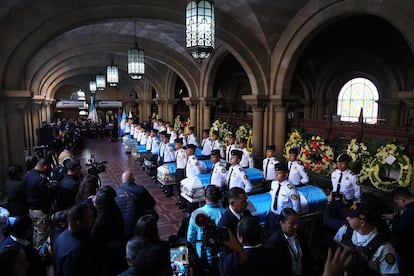
The gangs responded by mobilizing their members in the streets with a single order: start killing police officers. Any officer, anywhere, anyhow. It didn’t matter. A pair of officers on a motorcycle, another officer guarding an office, two more patrolling a neighborhood on the outskirts of town, two officers in a patrol car… One by one, at point-blank range, the gangs carried out their revenge, leaving 10 officers dead and another 10 wounded in just a few hours.
The gangs’ response demonstrated the bloody efficiency of those who — with a few phone calls — managed to organize a massacre in a few hours and put a government that appeals to dialogue, social programs, and the strengthening of institutions to confront violence on the ropes.
Arévalo’s government maintains that behind the massacre lies a “political-criminal mafia” that seeks to overthrow the president and in which all the powers that made his complicated rise to power such an ordeal are involved.
Arévalo, a 67-year-old diplomat, surprisingly won the 2023 elections at the head of Semilla (the Seed Movement), an organization that brought together Indigenous people, academics, and a middle-class fed up with the last three right-wing governments — those of Otto Pérez Molina, Jimmy Morales, and Alejandro Giammattei — which left a long trail of corruption cases behind them.
However, Semilla lacks a majority in Congress and has faced opposition from the military and the country’s leading business figures, as well as from the justice system. According to the Arévalo administration, Attorney General Consuelo Porras — sanctioned for corruption in Europe and the United States — is the figurehead of the so-called “pact of the corrupt,” an informal alliance of politicians, bureaucratic elites, and businesspeople who protect each other to maintain power and which has forced dozens of prosecutors, judges, journalists, and opposition members into exile.
With a conciliatory and progressive discourse, Arévalo promised to strengthen institutions and promote social programs to combat violence, in contrast to those who asked him for a hard line against gangs in the authoritarian style of Nayib Bukele in El Salvador.
“Gangs have operated as the armed wing of these powerful groups,” argues former Deputy Interior Minister Arnoldo Villagrán. For Villagrán, who was responsible for the country’s security between 2008 and 2010, the recent murders of police officers “are the first warning” of a politically charged year, in which a new attorney general, the magistrates of the Supreme Electoral Tribunal, and those of the Constitutional Court — the true shadow operators of the country’s direction — will be elected.
“The reports warning of possible attacks by Barrio 18 against Arévalo are well known,” recalls Francisco Solórzano Foppa, former prosecutor and former director of criminal analysis of the Public Ministry (MP), in his office in Guatemala City’s Zone 10.
The political-mafia connections denounced by Arévalo point primarily to Attorney General Porras and opposition leader Sandra Torres. “You don’t defend terrorists, you marry them,” a congressman told Torres this week. Torres is the leader of the main opposition party (UNE) and a candidate in the last three elections, which she lost by a handful of votes. Torres’s niece is married to El Lobo, the gang leader sentenced to 191 years in prison and who has put the president on the ropes.
The Bukele effect
But political squabbles do little good on the ground in the face of violence. “Here, everyone wants a Bukele,” says Alejandra Béliz, a social worker from El Mezquital, who weeps as she recalls the day her brother was shot “by mistake” by gangs, even though he religiously pays a weekly extortion fee of 800 quetzales (around $100) to keep his stationery store open.
Since Bukele won the elections in El Salvador at the age of 38, his model has become the benchmark for the entire continent. But, for better or for worse, Arévalo is the complete opposite of the Salvadoran leader. Bukele is a boastful and authoritarian president; Arévalo insists on dialogue and strengthening the weak institutions that emerged from Guatemala’s civil war. However, the former resolved the problem of violence in his country, while the latter is overwhelmed in his.
Paradoxically, Bukele’s rise to become the scourge of the gangs had a very similar beginning to Arévalo’s. In March 2022, Salvadoran gangs challenged Bukele, killing 88 people in two days to force the government to negotiate, among other things, better prison conditions. The Salvadoran president’s reaction was the complete opposite: he declared a state of emergency — which remains in effect — deployed the army to the streets, and began arresting people. First gang members, then anyone with tattoos, and later family members or friends of suspects.
The consequence is that in four years he has imprisoned almost 2% of El Salvador’s adult population. He then disregarded the Constitution and was re-elected, despite the fact that the law only allows one term. During this period, dozens of journalists, lawyers, and opposition politicians have been forced into exile. In return, gangs are virtually nonexistent, and the country recorded 82 homicides last year, compared to almost 6,700 ten years ago.
With a renewed, energetic tone, Arévalo has promised to build new prisons in Guatemala, joining a growing trend in Latin America in which Ecuador, Honduras, and Costa Rica have followed Bukele’s example with plans to build prisons modeled after the infamous CECOT, the inhumane maximum-security facility where El Salvador incarcerates gang members.
Mexico faces a similar challenge. After Andrés Manuel López Obrador’s “hugs, not bullets” policy, Donald Trump has escalated his rhetoric and the current president, Claudia Sheinbaum, has pursued drug cartels more aggressively than her predecessor, who insisted that poverty and lack of opportunities “are the causes” of violence.
“The combination of increasing U.S. pressure and Bukele’s right-wing approach, which provides a response to security problems, has forced governments to pragmatically balance their own principles with the growing demands for repression,” says Tiziano Breda, an expert in analyzing violence in Latin America at the U.S.-based organization ACLED.
The latest Latinobarometer surveys confirm that the population does not mind living in authoritarian regimes as long as they guarantee food and security, a trend “that will continue to increase as long as violence continues and less populist or more human rights-conscious formations do not find formulas that yield results,” Breda adds.
Prisons and Barrio 18
Meanwhile, the crisis in Guatemala has highlighted the critical situation in its prisons. The Minister of the Interior acknowledged that the country’s 23 prisons hold more than 23,000 inmates, despite a maximum capacity of only 6,000. For years, Central America’s overcrowded prisons have served as hubs from which gangs have continued to operate even after their members were captured. From there, they issued calls, extorted money, and gave orders to kill.
One of the gang leaders transferred by Arévalo last summer was Yahir de León, alias “El Diabólico,” a Mara Salvatrucha leader sentenced to more than 160 years. To illustrate the impunity in Guatemalan prisons, one need only recall when, in 2019, this newspaper arranged an interview with El Diabólico. EL PAÍS went to the Fraijanes prison without a camera or recorder because they were prohibited inside. “Look, just tell me what you need,” El Diabólico said. When the journalist arrived at the Salvatrucha leader’s cell, he found a brand-new recorder and camera ready to be used.
El Diabólico spoke on behalf of an army of more than 10,000 men who live off robbery, extortion, kidnapping, and drug dealing. It is the most sophisticated gang, acknowledges Aníbal Argüello, a criminalistics expert and former member of the CICIG, the United Nations anti-corruption organization. “They are more hierarchical, organized, they answer to the leader, and it is not uncommon to find lawyers, with degrees from abroad, in their ranks,” he explains. Mara Salvatrucha has traditionally been at odds with Barrio 18, “which is more disorganized, violent, and chaotic,” he adds. They have always been rivals and have divided the country between them, but now they seem to be working together, Argüello explains. “It is telling that they haven’t attacked each other; their intention was to destabilize the government.”
The maras, or gangs, in Guatemala originated from the Latino gangs that emerged in Los Angeles in the 1970s and 1980s. In subsequent decades, the United States tried to eradicate the problem with mass deportations, which shifted the phenomenon to a broken country, lacking resources and a functioning state, where the gangs gradually gained strength. From 1993 to 1998, the United States deported more than 15,000 Guatemalans, 20% of whom had criminal records. Thousands of young people without jobs or families were reunited with an impoverished country that became the perfect breeding ground for crime. El Mezquital was the main destination for many of them, and by the end of 1998, MS-13 and Barrio 18 controlled the capital. “Now they are disposable puppets used by the political powers,” adds a dejected Béliz, the social worker from El Mezquital, with the city lights in the background.
Sign up for our weekly newsletter to get more English-language news coverage from EL PAÍS USA Edition









































