
Nayib Bukele consolidates his authoritarian style in El Salvador
The president’s approval ratings remain high as he nears six years in power, but both his image and leadership have evolved significantly
On September 15, 2021, thousands of people marched peacefully in San Salvador to protest against Nayib Bukele, in one of the largest demonstrations of his term in office. The protesters called him a “dictator,” shouted their opposition to his recently approved Bitcoin policy, and condemned his use of the military to intervene in Parliament. Bukele responded ironically, calling himself “the coolest dictator in the world” on X, then Twitter. The joke amused many.
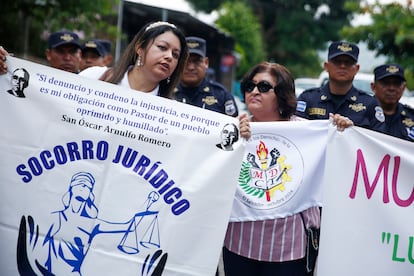
A little over two years later, on May 12, 2025, a much smaller group — about 150 farmers pleading for Bukele’s help to avoid being evicted from their homes — gathered near the president’s residence. The response this time was different: a group of soldiers and police officers suppressed the demonstration and captured five of its leaders.
This June 1st, Bukele will complete his sixth year as president of El Salvador. Six years after rising to power with a fresh, modern image that won over Salvadorans, the president still enjoys domestic approval ratings above 80% and is one of the world’s most popular leaders. He is a political phenomenon in Latin America. However, the cool side of the self-proclaimed dictator is fading, as his authoritarian image grows stronger, according to experts consulted by EL PAÍS.
“At first, he tried to connect with a younger audience,” says Edwin Segura, a journalist and researcher who has worked for 21 years measuring public opinion in El Salvador. “He had a slightly more open and tolerant approach, and so, the image that suited him best was that of ‘I’m a different politician, who dresses differently and is capable of embracing new ideas,’” he explains. “Now he’s ended up adopting old-school punitive measures.”
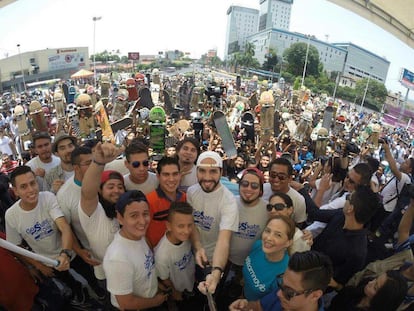
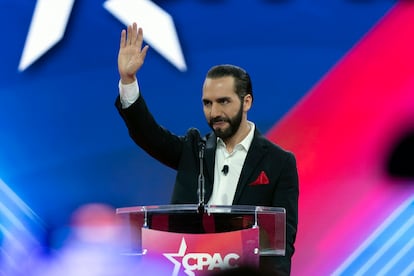
Bukele — a former publicist who has put enormous effort into carefully crafting his image — has changed the way he projects himself to the world. He’s gone from wearing youthful clothes and backward caps to donning a long-cut black suit adorned with gold trim and a high collar — evoking historical figures like Simón Bolívar or Muammar Gaddafi, says Segura. But it’s not just his look that has changed. His populist politics have also taken a significant turn.
“He went from a populism in which he spent more than the state could afford — giving away cash, Bitcoin, and even food packages — to a punitive populism through which he projects himself as a strongman, experienced and capable of getting things done, even by force,” says Segura.
When Bukele dubbed himself a “cool” dictator, he was seeking to project an image of a modern president who had broken with old paradigms. He promoted Bitcoin and sold El Salvador as “the land of surf, volcanoes and coffee.” Now, his main claim to fame abroad is being a jailer — a role he assumed after reaching an agreement with the United States to accept deportees from that country.
“There has been a noticeable change in his iconography — from the suits he wears to his personal style,” says Willian Carballo, a professor and researcher at the Mónica Herrera School of Communications. “He began projecting the image of almost a mischievous kid wearing backwards caps, and has moved on to presenting himself as a more old-fashioned leader,” he explains. “It’s been a slow and long process, but he’s not someone who improvises these kinds of things. His communication, appearance, and actions are all carefully planned to achieve something.”
Since coming to power, Bukele has not hesitated to implement despotic measures. On his first day in office, he fired hundreds of public employees and dissolved entire institutions with a single message on Twitter. Over time, he took even bolder steps — like in February 2020, when he entered the Legislative Assembly with soldiers and sat in the chair of the Assembly president as a pressure tactic to get lawmakers to approve a loan to fund his security strategy.
Later, in 2021, after winning an absolute majority in Congress, Bukele dealt a blow to the Supreme Court of Justice and handpicked judges who later approved his reelection bid, despite it being prohibited by the Constitution. He also removed the attorney general who was investigating his negotiations with the MS-13 and Barrio 18 gangs, and forced prosecutors to flee the country. That same year, he launched a purge of the judiciary to install judges aligned with his agenda.
But the move that most accelerated his global image as an authoritarian was the implementation of the state of emergency — a measure allowed by El Salvador’s Constitution in cases of natural disaster or national emergency, and intended to last one month. Bukele has renewed this measure more than 36 times.
While the president frames it as a strategy to combat the gangs that had turned El Salvador into one of the most violent countries in the world, the imprisonment of nearly 80,000 people in a country of 6.3 million has raised serious concerns among the international community and human rights organizations. Since then, local groups have documented nearly 400 deaths without convictions inside prisons, many of them showing signs of torture.
Repression grows in response to criticism
Bukele has responded to most of the criticism with sarcasm. But increasingly, his approach appears to lean more toward repression and less toward mockery, as shown by how his government has handled communication crises of the past two months. In mid-March, El Salvador began a prison agreement with Donald Trump’s administration to hold undocumented immigrants in its maximum-security prison, CECOT.
At first, Bukele claimed they were criminals, but later, U.S. authorities revealed that many of the people sent on the first flight were simply migrants whose only offense was entering the United States without papers. It was later revealed that Bukele’s real motivation behind the agreement was to bring back nine gang leaders, allegedly to prevent them from testifying in a New York court about his secret deals with them. The agreement significantly damaged Bukele’s image, to which he responded by attacking the media and humanitarian organizations.
In early May, the newspaper El Faro published an interview with two gang leaders — including one released by Bukele — who shared details of their negotiations with the Bukele administration. Days later, the outlet’s director, Carlos Dada, said in a live broadcast that he had received an alert about potential arrest warrants for some of his journalists. Several of them have since left the country as a precaution.
The latest event that, according to experts, has further exposed Bukele’s true nature occurred on May 12, when a small protest near the president’s residence prompted the deployment of Military Police to repress civilians. This marked a historic moment, as military forces had not been used for such duties — reserved exclusively for the National Civil Police — since the peace accords signed in 1992.
The following day, persecution and arrests continued against other community leaders who had taken part in the protest. Bukele responded, as he often does, with a post on X, announcing reprisals against human rights NGOs, which he accused of orchestrating the demonstration. He introduced a new Foreign Agents Law that will withhold 30% of their donations.
These actions, however, have not yet impacted Bukele’s approval rating, according to analyst Edwin Segura. “When you measure approval or disapproval, the response is binary: approve or disapprove. That approach misses the nuances. What’s happening is that many people have reservations about the president’s actions or abuses, but ultimately still choose to approve,” Segura explains. He also notes that “in authoritarian environments, public opinion is hard to assess because people are afraid and don’t dare to express their opinions.”
Carballo, for his part, believes that this strongman archetype is popular in El Salvador. “Talking to people or conducting more complex studies, we can see that they are very satisfied with what he does,” says Carballo. “Rather than hurting his popularity, it is actually reinforcing it.” On the streets, as EL PAÍS has observed, criticism of President Bukele is increasingly rare. And those who dare to speak out often ask not to be quoted, out of fear of reprisals.
Meanwhile, with every new move, Bukele seems to drift further away from the youthful, disruptive leader who made headlines in 2019 — and closer to the mold of traditional autocrats. He no longer needs to joke around to wield power: all he needs is an order. The cool persona of the self-proclaimed “the coolest dictator in the world” appears to be fading.
Sign up for our weekly newsletter to get more English-language news coverage from EL PAÍS USA Edition









































