
Trump takes cues from Bukele in plan to deport a million people
The pressure to meet immigration arrest targets is fostering the systematic violation of human rights, as seen in El Salvador
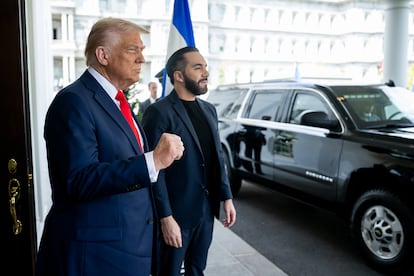

Donald Trump and Nayib Bukele are undeniable allies. Beyond sending several hundred Venezuelan migrants — accused with scant evidence of being members of the Tren de Aragua gang — to Bukele’s maximum-security prison, Trump sees a reflection of himself in the Salvadoran leader’s authoritarian approach as he unleashes his machinery to fulfill a promise of the largest deportation effort in U.S. history. In both El Salvador and now the United States, respect for rights takes a back seat when it’s time to show “results.”
Trump had only been back in the White House for three days when the first report of an irregular detention came to light. On the afternoon of January 23, during a raid on a fish market in Newark, New Jersey, immigration agents arrested a Latino U.S. citizen on suspicion of being an undocumented immigrant. Officers reportedly did not believe the validity of his military veteran ID. The man was quickly released, but in the months since, cases of unlawful or irregular detentions and deportations have multiplied, making headlines and escalating in the courts.
On the campaign trail, Trump claimed he would deport up to 20 million people — even though the official number of undocumented immigrants in the country is around 11 million. Once in power, although the number of irregular crossings have dropped, the message remains largely the same.
After a few weeks in which arrest and deportation numbers failed to meet the White House’s expectations, Trump and his administration officials have begun to speak almost obsessively of deporting one million people in a single year, according to multiple reports. The pressure to meet that goal has resulted in a daily detention quota.
According to The Washington Post, every local office of Immigration and Customs Enforcement (ICE) has been ordered to carry out 75 arrests per day, and local directors are being held directly responsible if targets are not met. Nationally, this translates to around 1,500 arrests daily.
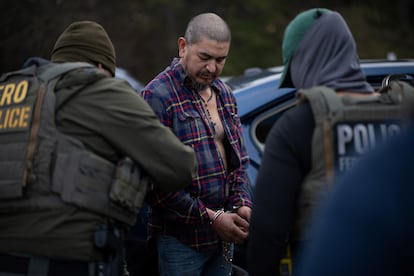
For observers like Juan Pappier, deputy director of the Americas Division at Human Rights Watch (HRW), the situation is all too familiar. “It’s a dangerous policy. There are plenty of examples globally that these quota policies without safeguards can produce ‘errors’ that have an enormous human cost, such as arbitrary detentions or deportations that don’t follow due process,” he says.
“It’s similar to what has been seen in other countries in the region, such as in Colombia with the false positive scandal, where soldiers and units were rewarded for reporting enemy casualties in combat; or, more recently, in El Salvador, where quotas establish the number of people the police must arrest per week,” adds Pappier, who argues that this creates a culture in which hitting quota becomes the priority for officers and erodes respect for human rights.
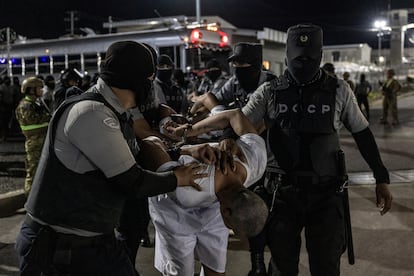
The parallel with El Salvador is the clearest. Following the declaration of a state of emergency on March 27, 2022, and 38 consecutive extensions that have kept it in place, Bukele’s government has arrested over 80,000 people, according to its own figures.
The detainees — just over 1% of the country’s total population — are allegedly gang members, but there have been numerous reports of arbitrary and wrongful arrests. This includes arrests of minors and people with disabilities, some of whom have died in custody. Additionally, opposition figures have been accused of being criminals.
According to estimates, there have been over 6,000 reported instances where human rights have been violated, including these wrongful detentions. These allegations — made by NGOs, victim movements, and regional or international human rights organizations — are met with “silence, indifference, and a lack of transparency, further cementing a model of repression and impunity,” according to a report by Amnesty International published on the 1,000th day of the state of emergency.
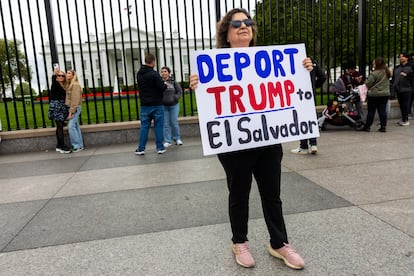
In the United States, Donald Trump declared a national emergency at the U.S.-Mexico border on his second first day as president. This expanded his ability to act by freeing up defense funds and the military to handle certain immigration tasks.
Additionally, with the first law passed by Congress during this current session, he reduced the rights of detainees under the declared immigration emergency and broadened the list of offenses for which an immigrant can be deported without trial, which now even includes minor traffic violations. In the three and a half months since then, the U.S. government has claimed — without providing clear evidence — that it has arrested over 100,000 migrants accused of being, under the new criteria, undocumented criminal immigrants.
However, as in El Salvador, complaints and lawsuits have quickly followed. Across the country, civil rights groups and victims have filed lawsuits to halt the mass arrests, which, according to the accusations, have ensnared innocent people, protected refugees, U.S. citizens, and even minors with cancer.
In response to the flood of legal action, the government has defied orders from lower court judges and has threatened to do the same in front of the Supreme Court if it rules against its measures. If the government disregards the highest court in the nation, a constitutional crisis could erupt, putting the institutional order of the world’s most powerful democracy at risk.
For Noah Bullock, executive director of the Salvadoran human rights organization Cristosal, the foundation of these authoritarian parallels lies in the dialectical framework.
“The main axis is the establishment of the narrative and the idea of an internal enemy: that there is a society, and within it, groups that are threats and should not be protected by the law,” says Bullock, who is living in El Salvador. “This has been the legal and philosophical framework of the state of emergency in El Salvador. And during the presidential campaign, Trump escalated the anti-immigrant rhetoric to the level of a threat, even a national security threat,”
In practice, this has translated into daily detention quotas, which, in turn, jeopardize the respect for laws and fundamental human rights. According to Bullock, this is a slippery slope. “In El Salvador, we’ve seen the numbers escalate. First, there were 10,000 who needed to be arrested, then 20,000, and now the government says it’s 85,000, but suddenly a minister says there are still about 7,000 more to be captured. So the issue of quotas is more emotional, to generate this idea of enemy groups that pose a threat. I think that’s the classic logic in scenarios of massive human rights violations: first they come for a stigmatized group, and then it expands to more and more people.”
In the case of the United States, it’s still too early to speak of this kind of expansion, although the detentions and revocations of visas for foreign university students could be seen as an initial extension of the objectives of the repressive apparatus. For now, the issue is the repeated and systematic violation of rights driven by excessively high numerical targets.
“The evaluation criterion can’t be just a number. If it is, the message it sends to officials is that the only thing that matters is arresting people, and it doesn’t matter who they are or whether they are detained appropriately,” says Pappier, who is aware of what often comes next when this is the first step.
Sign up for our weekly newsletter to get more English-language news coverage from EL PAÍS USA Edition









































