
'Cover-Up': A reporter against the impunity of power and the horror of war
Watching the Netflix documentary about Seymour M. Hersh, the legendary journalist who uncovered the My Lai massacre and the Abu Ghraib abuses, is especially timely right now
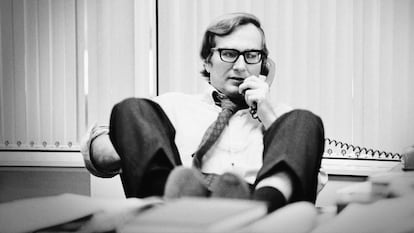

Seymour M. Hersh, 88, greets you with the phrase “it’s worse than you think” on his Substack blog, where he has more than 230,000 followers. He is not an opinion writer. He is an investigative journalist who has spent six decades exposing government abuses with exclusives such as the My Lai massacre during the Vietnam War, the abuses of Iraqi prisoners in the U.S.‑run Abu Ghraib prison, and the alleged CIA sabotage of several gas pipelines in the Baltic Sea at the start of the war in Ukraine.
Cover-Up is now available on Netflix. Unflinching in its depiction of the extreme violence of U.S. society and built on spectacular archival footage, the documentary portrays both the highs and lows of a legendary reporter known for his tenacity in confronting abuses of military, economic, and political power.
In a declassified conversation included in the film, U.S. president Richard Nixon can be heard telling Henry Kissinger — apparently lamenting yet another Hersh scoop — “the son of a bitch is a son of a bitch, but he’s usually right, isn’t he?”
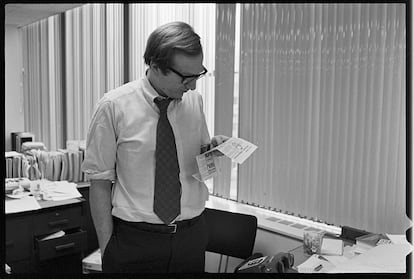
The documentary by Poitras (who directed the Oscar-winning CitizenFour about Edward Snowden) and Obenhaus (who made Buying the Bomb with Hersh, a 1981 documentary about a Pakistani agent who tried to buy components for his country’s nuclear program) reveals the process that led the reporter to uncover the My Lai massacre, a slaughter of such abject cruelty that it nearly destroyed the reporter’s health and shocked U.S. society.
Hersh admits that in the darkest hours of his investigation he called his wife, Elisabeth Klein, a psychoanalyst, from a phone booth, crying over the horrors he was uncovering.
And Myrtle Meadlo, the mother of Paul Meadlo, a soldier involved in the My Lai killings, says on camera in a recording recovered in the documentary, as if looking straight into the eyes of the government officials of the time: “I sent them a good boy, and they made him a murderer.”
Opposing the war
The astonishing journalistic story of My Lai began in the fall of 1969, when Hersh received a tip that the U.S. Army was conducting a court‑martial at Fort Benning, Georgia, against a soldier for the murder of several Vietnamese civilians. Hersh looked for information at the Pentagon about criminal investigations in Vietnam and found nothing. But in hallways, offices, and cafeterias he spoke with several officials, until one of them revealed the surname Calley, and Hersh never let go of the story.
He devoted himself to tracking down documents until he found a brief note explaining that a certain William L. Calley, an infantry officer, had been charged with murder for the deaths of an undetermined number of “Orientals” in March 1968. The journalist then decided to have coffee with a military officer who might know about the matter, but instead of asking him questions about Calley, he simply chatted about the case. The officer continued the conversation, adding a few more details — in other words, he confirmed the story.
From there, Hersh managed to find Calley’s lawyer in Salt Lake City, and while interviewing him in his office, the reporter was able to read — upside down — part of the indictment report the attorney had on his desk. He then traveled to Georgia, where he covered nearly 90 miles inside Fort Benning — a military base spanning more than 270 square miles — asking about Calley to telephone operators, officials, soldiers, pool workers, gym employees, shop clerks, and bartenders, until he finally tracked him down.
What followed was an investigation into the killing of 109 civilians in My Lai — girls, boys, babies, grandmothers, grandfathers, teenagers and women — a news story that shook the world, and which was decisive in the mobilizations against the Vietnam War.
Overwhelmed by the violence of the conflict, Hersh explains in the documentary that he considered two hypotheses: one was that it was such an atrocious event that everyone was in shock and wanted to cover it up, and the other was that it was such an unremarkable event that it went unnoticed. He focused on the second, and he was right. “The whole army ran on body count,” Hersh says to the camera, recalling how, by reading and listening to military strategists, he understood that under the grim logic of the military, winning or losing the war depended on how many dead you had (he later discovered that on the same day a similar massacre had taken place in Co Luy, a village near My Lai).
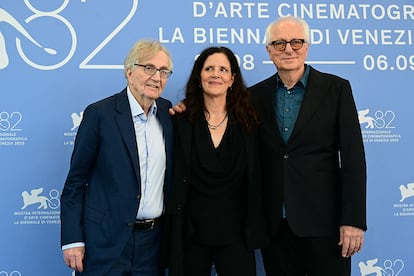
At the last Venice Film Festival, Poitras explained that Cover-Up “is a film about the cycles of impunity that have brought us to the present day and the essential role of a critical press.” For his part, Obenhaus warned that showing work like Hersh’s “has become increasingly urgent as the forces aligned against investigative journalism have grown worldwide.”
Carlos Aguilar, film critic for the Los Angeles Times, praises the fact that Poitras’s latest work focuses on Hersh. “At this moment when the United States is experiencing terrible repression, her focus on a figure like Hersh is extremely timely,” Aguilar said in an email exchange. “The importance of a free press that is not subjugated by the government or other external forces is absolutely vital.”
Lies and deceivers
Although nearing 90, Hersh continues to document atrocities. In the film there is a scene in which he speaks with a researcher who updates him on her progress in studying the count of children killed in Gaza.
There are many other stark moments, some personal for the journalist, such as when he admits he was deceived by Syrian leader Bashar al-Assad when he was accused of using chemical weapons against civilians. “I saw him two or three or four times and I didn’t think he was capable of doing what he did,” he confesses.
At another point in the film, Hersh explains that one of the things that motivated him to become a reporter was that he liked people. Perhaps he still feels the same way now, but he has been spied on and pursued so much for his work exposing abuses of power that he no longer knows what to think of others.
“It’s complicated to know who to trust. I barely trust you,” Hersh tells Poitras and Obenhaus, half-jokingly, half-seriously.
Sign up for our weekly newsletter to get more English-language news coverage from EL PAÍS USA Edition









































