
Dying for the Revolution: Cuba asks its people to sacrifice themselves, but the population is ‘hungry and disgruntled’
Amid tensions with the United States, the regime is demanding that Cubans sign a pledge to defend the country at any cost
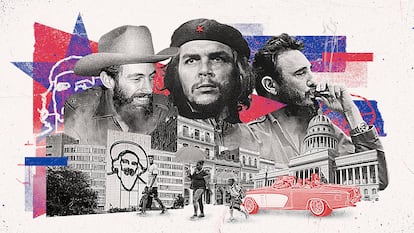

Dawn breaks in Havana. It’s May Day – Labor Day – and people begin gathering early at four strategic points in the city, in order to march with signs and banners to the José Martí Anti-Imperialist Platform. In the year 2000, Fidel Castro ordered that the public event venue be built across from the United States Embassy, in order for him to speak directly to the U.S. and demand the return of Elián González, the six-year-old boy whom Cuba turned into a political trophy in the eyes of Washington.
Today, it all seems so distant: Castro died a decade ago. And Elián, now 32, graduated as an industrial engineer and has a daughter. Certain things, however, remain unchanged: the enduring cold war with the Americans, and the warning to Cubans that, if they miss the annual parade, they could lose their meager monthly salary — even their job — or at least earn the disapproval of their boss.
Irma, an epidemiologist who asks that, as a precaution, her real name not be used by EL PAÍS, isn’t even worried about getting into trouble anymore. “I’m not going to the Platform,” she says over the phone from her workplace, the Institute of Immunology and Hematology in the Havana neighborhood of Vedado. “I can’t make that walk while I’m starving, no way; I have to save my energy.”
Some people got up before dawn and joined the throng heading toward the Malecón, the esplanade that stretches along the coast of Havana. José Luis Amador, a resident of the Palatino neighborhood, told the state press that the homeland was in danger and, therefore, the people had to “defend it.” A taxi driver from El Mónaco heard the urban singer Bebeshito’s music blasting near Carlos III Street, while some neighbors were finalizing preparations for the patriotic event.
In other parts of the capital, however, there was silence. People were staying home; it didn’t seem like the government had called for a major parade. “Most people aren’t in that May Day spirit,” the taxi driver says. “People are hungry, people are fed up. I was just at the hospital: I got my daughter’s tests, because I know how to get things done. With a little money for the doctors, the antibiotic appeared.”
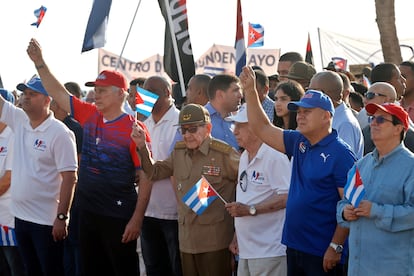
The caravan of workers, numbering more than half-a-million Havana residents, according to official figures, carried Cuban and Palestinian flags, a banner that read “Ideas are our weapons,” a sign demanding the release of Nicolás Maduro from a New York City jail, as well as portraits of José Martí, Camilo Cienfuegos, Che Guevara and, of course, Fidel Castro. None of the images of Castro showed him in his later years (when he was a frail old man in his Adidas tracksuit), but rather as the young guerrilla fighter wearing an olive green uniform: strong, vibrant, capable of waging a sustained struggle against an empire. The imagery is a reminder that the revolutionary leader remains alive in the nation’s consciousness. An industrial worker grabbed the microphone and declared: “Fidel continues to call on us to resist and win.”
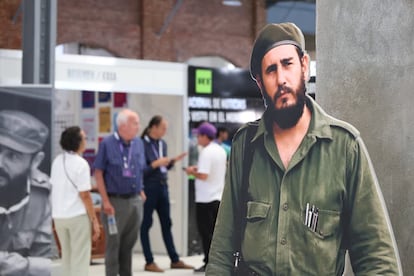
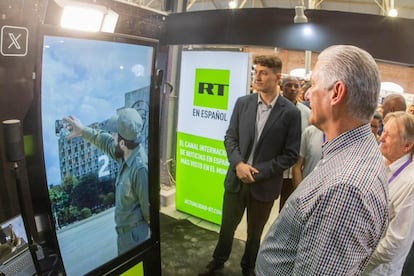
The Cuban leadership has no intention of letting the figure of its supreme leader die. Recently, they installed a screen in Havana that, through the use of artificial intelligence, invites Cubans to take a picture with Castro. “Hello, compatriots,” Fidel could be heard saying on May Day. People posed, and the deceased leader’s voice, still intact, said: “Until victory… one, two, three… forever!”
President Miguel Díaz-Canel, along with several attendees, had his picture taken with the Comandante. This was a gesture from the government, meant to remind the population about the man who brought them all to where they are today.
Emilio Basilides Alfonso, a professor of Philosophy at the University of Havana, vehemently believes that Castro is “more alive” than ever. “Fidel’s influence is as omnipresent as the misery that defines daily life on the island. And I’m not referring only to material hardship, which is already serious enough, but [also] to a deeper desolation: the distortion of the national character.” However, there’s a part of Castro that, according to the university professor, is fading with time. “Castro survives only in the minds of those who are ‘asleep’ — those who are afraid to admit that they were deceived — and in the minds of the ‘awakened,’ who know exactly where power resides. Outside that circle of nostalgia or cynicism, his figure fades into irrelevance.”
This is the fear that the leaders of the regime have today: that people will forget the man who, for decades, kept an ideology afloat despite the country’s collapse. This is especially concerning for them now, as there’s not only a crushing economic crisis, but also a notable leadership vacuum.
Marching at the head of the workers’ caravan on Friday, May 1, was Raúl Castro – Fidel’s brother and former first secretary of the Communist Party – escorted by his bodyguard and grandson, Raúl Guillermo Rodríguez Castro, known as “El Cangrejo” (“The Crab”) and the man who met with U.S. Secretary of State Marco Rubio to negotiate Cuba’s future.
Raúl hadn’t appeared in public since the announcement of the deaths of 32 Cuban soldiers who were killed in the attack on Venezuela back in January. At the age of 94, some say that he still pulls the strings of power in Cuba. To his left walked José Ramón Machado Ventura, a 95-year-old former member of the Politburo who once hinted that he wants to live to be 200; and to his right, Miguel Díaz-Canel, 66, who was born when the other two men were immersed in the 1959 Revolution. Amid the dialogues with Washington, the possibility of removing Díaz-Canel from power in Cuba was leaked, but the president has said that he won’t step aside. “I’m not afraid,” he asserted. “I’m willing to give my life for the Revolution.”
On May 1, as the Cuban people marched in Havana, President Donald Trump – speaking from Florida – announced new sanctions against the island. He promised to end the war in Iran in order to free up an aircraft carrier, send it to the Caribbean and take Cuba “almost immediately.” Díaz-Canel responded to the threat: “No aggressor, however powerful, will find surrendering Cubans,” he asserted. Rather, “they will encounter a people who are determined to defend sovereignty and independence in every inch of the national territory.”
At first glance, the march on May Day may seem like a repetition of previous years. But the Castroist regime knows that this is a unique event: not only are they celebrating Fidel Castro’s centennial, but they’re also reaching the 70th anniversary of the Revolution with a completely devastated economy, blackouts lasting more than 20 hours a day, a migration exodus of almost three million people in the last five years, widespread discontent that has led people to take to the streets, as well as real tension with the United States. Trump has promised “a new dawn for Cuba.”
Faced with this scenario, the Cuban government has called on the people to reaffirm their commitment to the homeland. On the Anti-Imperialist Platform, an improvisational poet recited a few décimas (10-line stanzas) in front of the parade attendees: “If the socotrocos (slang for “idiots”) enter the Cuban capital, they’ll find out that Havana is full of crazy people.” Some attendees applauded him.
Defending the homeland
Among all the posters in the parade, one stood out with a statistic: more than six million Cubans, according to the official registry, have taken part in the “Signature for the Homeland” movement, an initiative launched by the government a couple of weeks ago to commit Cubans to defending the achievements of the Revolution at any cost. This comes amidst the small cold war being waged in Cuba’s perpetual summer, with threats from Washington, an oil embargo having been in place for more than three months, drones flying over the island and U.S. Navy military exercises in Caribbean waters.
According to Díaz-Canel, the campaign is about more than just signing a petition. “It’s an act of unity in defense of national sovereignty,” he asserts. The petition also serves to support a declaration entitled “Girón is today and always,” referring to Playa Girón, a beach on the east bank of the Bay of Pigs. It makes it clear that Cuba is prepared to defend itself with arms, just as it did 65 years ago when a failed military landing by Cuban exiles took place.
The message put out by the campaign has been explicit: the Cuban Revolution “will never negotiate its principles.” It’s necessary to keep repeating this amidst a discontented population that has taken to the streets not only to demand food and electricity, but also freedom.
Katrin Hansing, a professor of anthropology at the City University of New York (CUNY), has spent the last three decades researching race, migration and inequality in Cuba. She has observed how, today, the official rhetoric resonates with very few Cubans. “The political, ideological, revolutionary aspect is barely felt. In Havana, you no longer see the slogans and posters on almost every block like you used to; the ones that are there are old. Most people are exhausted from the daily struggle [to survive], but also from politics, from the lies. There’s a collective weariness. The symbols, the codes… everything looks very old. Everything is very worn out.”
Even so, the anthropologist notes how the Cuban government still insists on continuing to speak to the people with the same language that it used 40 years ago. The people, however, have changed. The people are tired.
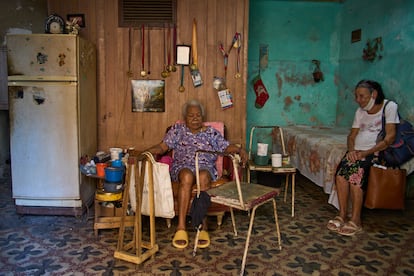
Some government delegates arrived at the door of Irma’s neighbor, asking her to sign her “Commitment to Cuba.” The 80-year-old woman came out of her house angrily: “I’m not going to sign,” she told them. “I’m diabetic and I don’t have milk for breakfast. Bread comes once a week. And I’m only surviving because of my daughter and grandson. Otherwise, I would have starved to death.”
Irma herself, like her co-workers at the Institute of Immunology and Hematology, was forced to sign the commitment book at her workplace. She did it. “If you don’t, you don’t get paid,” the woman explains. She earns about 5,000 Cuban pesos a month, equivalent to just under $10.00, and, when her workday ends, she has to go out and clean houses. “They want the world to believe that people sign voluntarily, [but] that’s not the case. It’s outrageous. This isn’t a country anymore; this is the end for Cubans.”
Maydelis Solanis is a resident of the city of Bayamo, in eastern Cuba. The government delegate from her neighborhood didn’t come to her door, “because she knows” what Solanis thinks of the system. But she did go to other homes to ask for signatures in defense of the homeland.
“People don’t want to sign; they say they have [no reason] to,” she shrugs. Yesterday, she heard a commotion. When she looked out the door, she saw that it was a neighbor arguing with the delegate. “He told her, ‘What am I going to sign [for]? The lack of electricity? The lack of food? The lack of medicine?’” Solano warned her children that they couldn’t sign any documents at school without her consent.
Yoel Acosta and his wife’s greatest fear is that the Cuban Army will conscript their 17-year-old son (he’s the minimum age for mandatory military service in Cuba). Their fear has grown, now that Díaz-Canel speaks about a “people’s war,” with Donald Trump not entirely ruling out the possibility of a military attack against Cuba. An officer from the Ministry of the Interior came to their home in Baracoa, a city in the province of Guantánamo, to have their son begin the required examinations for military service. “Neither I nor his mother agree [with this],” Acosta says. “We fear he’ll be recruited to participate in wars, or be sent out of the country as a mercenary, as they’ve already done with other young men. Now, with the tension between the United States and Cuba, we’re even more scared about his physical safety.”
According to Acosta, young men who do their military service are also being made to sign a pledge to “defend the country against aggression.” Otherwise, they’ll be “labeled as counterrevolutionaries and could be imprisoned,” he says. In Cuban hospitals, according to people interviewed by this newspaper, authorities are threatening staff with restrictions on their participation in medical missions abroad. While the government takes a considerable portion of their salaries, these missions provide some economic relief to healthcare professionals. Some workers in micro, small and medium-sized enterprises (MIPYMES) are also being forced to sign a written agreement with the state.
But on the island, Solano notes, people are preoccupied with whether or not Trump is coming. “You spend your life wondering what he’s going to do. Is he coming? Is he not coming? That’s what many Cubans are hoping for these days, because daily life is a burden and it becomes overwhelming,” she says. “It’s like trying to climb a mountain with a heavy backpack and never reaching the top.”
The creative resistance that nobody wants
On April 30, the day before the May Day march in Cuba, Díaz-Canel met with dozens of workers to tell them that it was essential to resort to “creative resistance,” a concept he’s been using since taking office as president of the country. Throughout his eight years in power, Cuba has never emerged from its deep crisis. In a conversation with Pablo Iglesias — a former left-wing Spanish politician who visited Havana this past March as part of a humanitarian flotilla — the president seemed almost proud of the creative resistance that Cubans have demonstrated during this crisis. He referred to a variety of actions: people gathering to watch telenovelas in front of the only working television in the neighborhood; electric trikes being converted into ambulances; or residents who set up communal kitchens and cook with charcoal.
“With the concept of creative resistance, you not only resist, but you develop,” the Cuban president explained to Iglesias. “It’s not about resisting with submission, but resisting with creativity.” He also said that he understands that “the people are suffering, that there are limitations, that there are shortages,” but emphasized that the “Cuban spirit of resilience, solidarity and joy hasn’t been lost.”
“This rhetoric stems from a political construct built from within the government, which tries to highlight certain convenient aspects amidst the profound structural crisis that Cuban society is experiencing,” notes sociologist Elaine Acosta González, a research associate at the Institute for Cuban Studies at Florida International University (FIU). The expert explains that, “by highlighting certain aspects of Cuban sociocultural identity, [the government] deliberately conceals the ineptitude of the leaders [with the] everyday survival strategies that citizens have had to develop to cope with the various impacts of the crisis.”
Some (those who can) continue to leave the island. Writer Jorge Fernández Era was accompanied by members of the state security apparatus until the very last moment when, a few weeks ago, he boarded a plane to Spain. It pains him to see how the thing that he dedicated his best years to has ended. “The Revolution stole my dreams,” the 63-year-old writer laments. “Nothing remains of the Revolution… and even less of socialism. [Cuba is now] a mixture of capitalism, feudalism and slavery, with a dash of primitive communism. The rest is crude propaganda.”
Fernández Era didn’t leave Cuba with relief, but with despair. He knows that something has been taken from him. “I’m leaving behind a country that I love… but [it] has ceased to be a country.”
Sign up for our weekly newsletter to get more English-language news coverage from EL PAÍS USA Edition









































