
The collective burial of the Cuban Revolution: ‘I am watching my dreams die’
The world is witnessing the end of the greatest feat of the 20th century in Latin America, although for Cubans the Revolution ended long ago

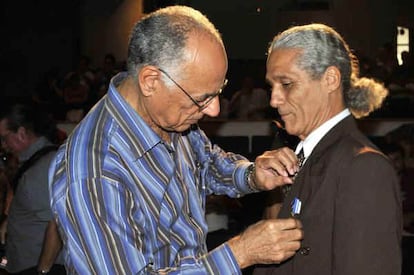
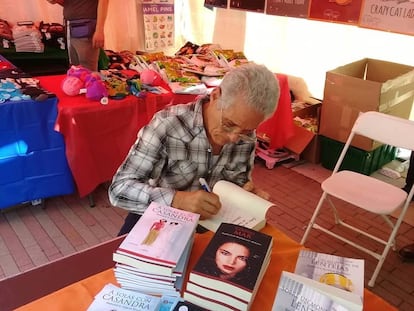
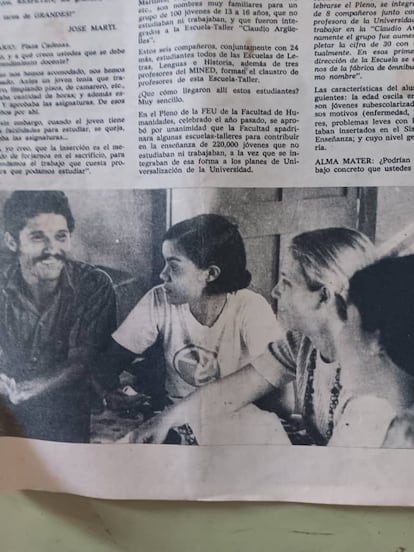
It’s 9 p.m., the power has just returned after 17 hours at Santo Suárez’s house in Havana, and the writer Rodolfo Alpízar turns on his old computer and looks for photos from other times. “I have very few,” he apologizes. He has a picture from when he was three months old, in 1947; a newspaper clipping from his time at the old School of Letters, from 1970; one from when he went to the war in Angola, in 1976; and even another of the moment when the late former culture minister, Rafael Bernal, pinned a medal to his chest.
There are no pictures from when he went to pick coffee in Oriente, nor of the sugarcane harvests, nor of the volunteer work, the blood donations, his time in the Armed Forces as a founder of the anti-aircraft missile troops, or his role as a delegate of the People’s Power political party. In other words, there isn’t a single image that captures everything he gave to Cuba. “I have done everything I believed was my duty as a man of the Revolution,” he says. “And I don’t regret it, because I believed in what I was doing, and because my convictions never led me to harm anyone.”
He is 78 years old, and everything seems to indicate that just as he witnessed the triumph of the Revolution in January 1959, he may also be witnessing the final burial of the greatest feat of the 20th century in Latin America. It sounds simple, but for Alpízar it is a source of pain, the pain of someone who has seen the edifice of his political and sentimental altar slowly collapse.
— What are you feeling? Sadness?
— More than sadness. Remembering the poet Miguel Hernández, for me Cuba today is “the wound that never heals.” My streets, my neighborhood, my people, the needy I see every day, the widespread hopelessness, my country, the anthropological damage suffered by my people, all of it pains me. Everything is ruined, physically and spiritually.
He knows this well, a child of the Republic who struggled to study, who more than once went to bed hungry, and who started working at the age of 13. The project of the young Fidel Castro promised to end all of this. “January 1959 was, for me, as for millions of Cubans, a great revelation,” he recounts.
Alpízar joined the workers’ strikes with the adults during those years, participated in the neighborhood youth patrol, and, along with his parents, visited the Fifth Military District, where they were degreasing all kinds of weapons, as if they were attending a national celebration. “Many dreamed of one day wielding them in defense of that Revolution that some bearded men had brought so that there would be no more poverty in the country. That popular fervor was like a virus that took hold in every cell of my body. I dedicated myself wholeheartedly to everything I considered a contribution to building the promised world of justice and widespread happiness.”
The gamble taken by Castro and other charismatic leaders, such as Che Guevara and Camilo Cienfuegos, was ambitious: to make Cuba, an island of some 110,000 square kilometers, 90 miles from the American empire, a bastion on the map of the Cold War. “It arrived amid the historical tension between the Western capitalist bloc and the socialist bloc, and Cuba became the pride of the Non-Aligned Movement, of small, poor countries with the potential for independence and sovereignty. It also became a paradigm of support for decolonization movements in Africa and for the guerrilla movements fighting military dictatorships in Latin America,” says historian and jurist Julio Antonio Fernández Estrada.
For writer and historian Enrique del Risco, “at the time, Fidel Castro came to represent for the left what Trump represents today for the right: someone who breaks all the rules of the game accepted until then and disrupts the geopolitical landscape.”
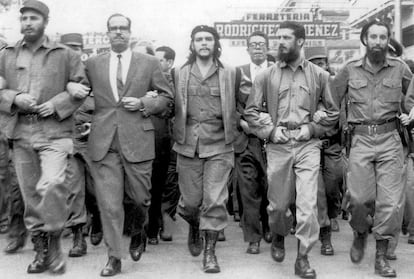
The Cuban Revolution was born as a mid-century experiment, a test tube where Castro would try out his most sublime ideas. The challenge was to make Cubans the best possible people: the “most cultured country in the world,” where cows would produce 100 liters of milk daily, a medical powerhouse with the “largest cotton mill” in Latin America, located in Santiago de Cuba, and “the largest printing press in Latin America,” in Guantánamo.
But there came a moment when the narrative of the Revolution began to crumble in the collective memory of the nation, and also in the individual memory of each Cuban. The end of the struggle, of Cuba as a symbol, did not arrive when Donald Trump declared a national emergency on January 29, thus depriving it of any remaining support. Nor did it come on the day when power outages became more frequent and food on the table became scarcer. Some will say that the Revolution began to falter in 1959 itself, others that it began with the centralization of all the unions in 1960, while still others see the beginning of the end in the speech “Words to the Intellectuals,” when Castro defined the country’s cultural policy with the phrase: “Within the Revolution, everything; against the Revolution, nothing.”
Alpízar still believes that “the Revolution never failed anyone; it was failed.” “It has been gradually demolished by the very people who led it. Its downfall began from the very beginning, only we, the idealistic revolutionaries on the ground, didn’t realize it; we saw mistakes, extremist or opportunistic attitudes from this person or that, even some betrayals, when in reality what existed was a more complex and profound phenomenon,” he asserts.
Today, with direct threats of a possible takeover of Cuba by Trump and his team coming from the White House, Alpízar has begun to hear people in the street even calling for U.S. intervention. “Anything, as long as we get out of this,” they say. “It’s a phrase uttered by people of all ages, everywhere. It means accepting everything, even a military intervention, even the transformation of the republic into a U.S. protectorate,” the writer explains.
— What makes you feel that, at this point, Cuba’s fate is being decided at the American gambling table?
— I am disappointed, watching my dreams die, they haven’t even left me with the hope of ever dreaming again.
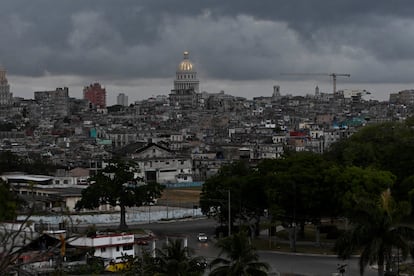
Forged by the Revolution
For Enrique del Risco, in terms of the freedom and well-being of Cubans, the Revolution betrayed its people as soon as it triumphed, by dismantling the rule of law. “What should have been a democratic revolution that had just overthrown a dictatorship and was supposed to return power to the people, began by dissolving the political parties and the parliament, and dismantling the judiciary with 10-minute trials and predetermined death sentences. And this justice system, with its expedited procedures and tailor-made rules, very soon began to be used against anyone who questioned the new regime.”
This is what intellectuals Alina Bárbara López and Jenny Pantoja later suffered. The Revolution shaped them, as it did many others, and today it seeks to condemn them both to four and three years of imprisonment, respectively, for the fabricated crime of assault, following a confrontation with police officers for exercising their rights. This was not, apparently, what the Revolution had prepared them for.
López was a poor girl from the Jovellanos neighborhood in Matanzas. Her house, furnished with metal rods, didn’t have a television or refrigerator until she was 10 years old. Her father, who saw children go hungry or stand in front of shop windows overflowing with toys, believed the Revolution would take care of it.
“That idea of equality, of fighting for a just society where no children would go hungry, where they could study, where you could take them to a doctor without having to pay — for him, it was a vision,” says Rodríguez from her current home in the El Naranjal neighborhood, a housing development built with Soviet technology. There, the doctor of philosophical sciences and member of the Cuban Academy of History has a leaky roof and has been without electricity for four consecutive days.
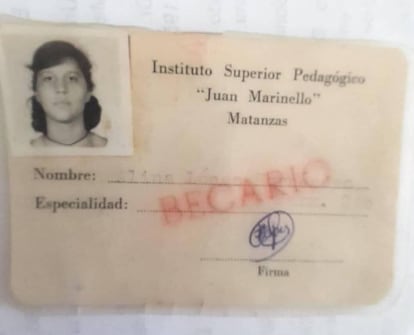
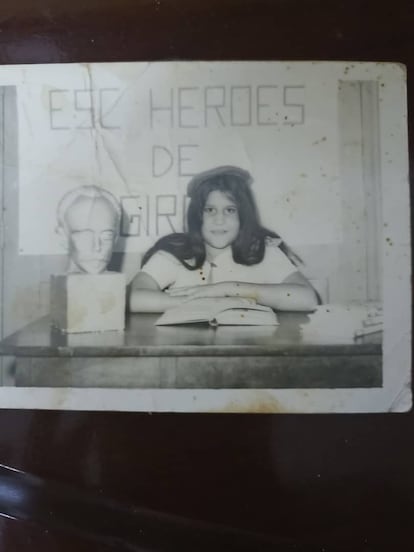
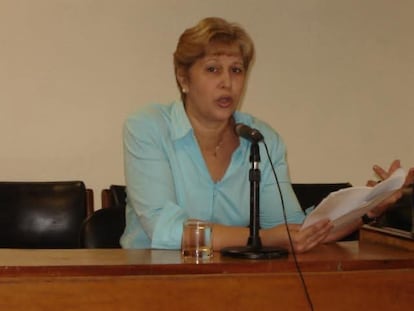
Pantoja’s family was “very committed” to the revolutionary process. “My mother worked for the Party, in the Central Committee; almost everyone in the family was a leader, or a military officer,” he says from the rooftop of his house in Havana, the only place where he can connect to the internet during a blackout. His childhood home was modest; they had no luxuries, nor relatives abroad. “Everything was the result of people’s hard work. That’s how I was raised, with real, civic, patriotic values, with a commitment to the country and the homeland.”
Pantoja’s family believed she would be the pioneer the Revolution hoped she would be. Rodríguez’s father, who had to leave school to work, always aspired for his children to attend university. And so it was. Pantoja began studying medicine, dropped out, then started law, and switched to history. She was an actress, became an astrologer, and earned a degree in religious studies. Rodríguez studied history, became an editor, studied Marxism-Leninism, and was a professor of contemporary European history. The education they both received gave them the tools to dissect the Castro project.
Pantoja read The Great Deed, 1984, and Animal Farm. She met many people, discovered new spaces, and engaged in new dialogues. “In high school, I was very inflexible. I believed that if you were strong and tenacious, you would build a better world. But by my twenties, I had changed a lot.” At some point, she began to see things she hadn’t been able to detect before: “Opportunism, duplicity — I declared myself an enemy of that.” The year 1989 arrived to shake up much of what Rodríguez had previously taken for granted. Marxism also showed her the way. “All those categories of the economic base, the superstructure, property relations, and production relations have helped me deconstruct what is happening in Cuba.”
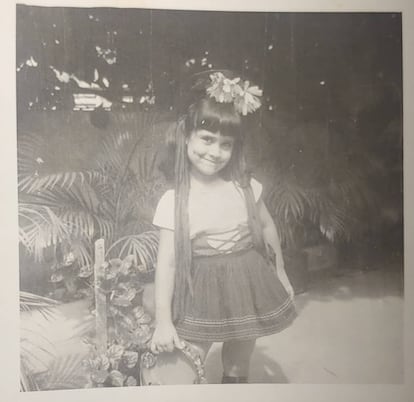
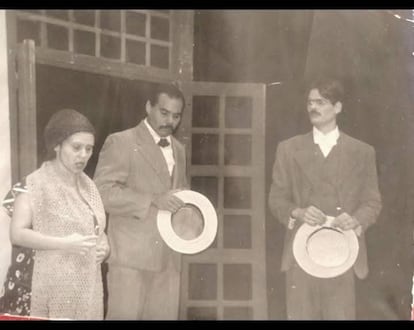
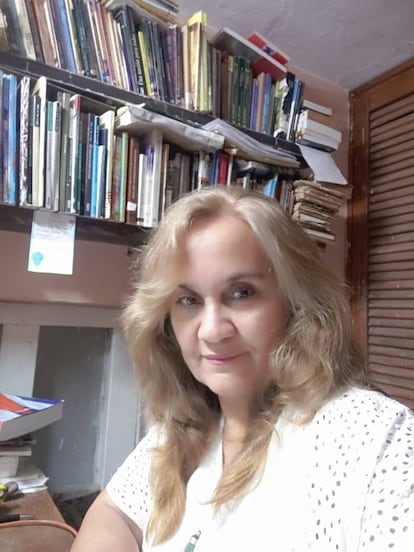
For a time, Pantoja was a woman of the Revolution. “What I saw in my family was the effort to build that good future for the whole nation, working even on Saturday and Sunday, doing volunteer work to build a building, a daycare center, all for the future we were going to have, where everyone was going to be happy.” Rodríguez, she says, was a reformer. She believed that much could be changed from within. “As a young woman, I was convinced that I lived in a system that wasn’t democratic, where there was a great deal of authority in the treatment of people, but what I did believe for a while was that the system itself could generate transformations.”
It was never like that. The country, in a sense, cheated its people. Del Risco says that the Cuban people’s disillusionment with the Revolution can be measured by their exoduses: “The half a million in the early years, the 135,000 in [the] Mariel [exodus] in 1980, the 200,000 in the nineties, and the almost three million in the last five years,” he asserts. That’s what happened to Rodríguez. The Mariel exodus came into his life as his first revelation.
Fidel Castro opened the country’s borders so that the “social parasites” who wanted to reach the United States could leave. “Seeing unions in the workplaces organize to yell at someone who had been part of it until the day before, and all of that orchestrated in a strategically effective way by the Cuban state, was disappointing for me. I became convinced of the double standards of the people who claimed to defend the system.”
For Pantoja, however, there was one event from which there was no turning back. The turning point in her life came when she watched on television, like the rest of Cuba, the trial of Revolutionary Armed Forces General Arnaldo Ochoa in 1989. The Castro regime ended up executing a high-ranking military officer who had previously been considered a hero of the Revolution, and whom they then accused of illegal drug trafficking. “It made me realize that this wasn’t what people were saying,” says Pantoja. “There was a clear agenda to dominate the rest of the country so that an elite could run it like a family estate, where the beneficiaries were those with ties to them. From that point on, I broke away completely.”
Then came the protests of July 11, 2021, in which the government unleashed a massive crackdown and imprisoned over 1,000 citizens as political prisoners, a turning point for both Pantoja and Rodríguez. “After that, I haven’t worked for the state again, and now it would be very difficult unless the system changes,” says Pantoja.
Since 2023, she and Rodríguez have joined peaceful protests on the 18th of each month, and since then, they have been arrested countless times for their direct opposition to the government. Today, they are awaiting trial for the alleged crime of assault. Rodríguez says that every injustice has served to dismantle the Cuban system from within.
“Every legal process I’ve been through has been like a kind of educational model of how power operates in Cuba, from the judiciary and the police to the public prosecutor’s office and the courts. For a long time, we were a totalitarian state, with total control over people through subtle means, and we became a dictatorial police state with openly repressive control mechanisms,” she asserts. “What I feel is tremendous shame at living in a system like this that doesn’t respect its own laws, nor human beings, nor human dignity.”
The end of the story
Although the narrative of the Revolution has long since faded for many Cubans, much of the global left still celebrates it. “The Cuban Revolution was and still is a living symbol of Third World resistance to U.S. domination in the Latin American context, and it is also a symbol of the experience of real socialism on the continent,” says historian Fernández Estrada.
For Del Risco, although Castroism has long ceased to be “a redemptive reference point, people prefer to look the other way because criticism of Castroism is perceived as an act of collaboration with U.S. imperialism. Virtually the entire global left, which claims to stand in solidarity with the Cuban people, has fallen into this trap.”
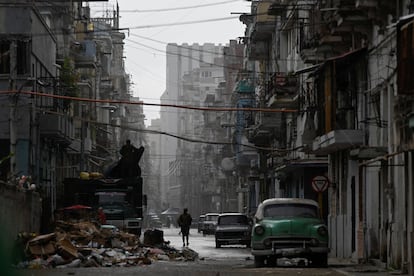
Cuba, the land of the literacy campaign, now finds itself with a collapsed education system; the country that exported doctors, with a healthcare system in ruins; the one that offered social security, with its elderly abandoned; the nation that promised a future, from which its young people have fled. Now, while some welcome the possibility that any change might come about under Trump, others look back on the past with despair. As if they have all been equally betrayed.
“It kills me, it devastates me, it causes me terrible pain. I believe that Cuba’s problems must be resolved among Cubans, not by the United States or any other country,” says Pantoja.
Rodríguez struggles to see how a people have ended up without hope, “with this crisis of patriotism.” “Many people who don’t want annexation or foreign intervention are placing their hopes on a government external to ours to bring about change in Cuba. It is unforgivable for the history of a country like Cuba to have reached this point.”
Among the many questions some are asking today, there are those who wonder if we are truly reaching the end of something historical, or what will survive from the time of the 1959 Revolution. “The Cuba we once knew can no longer exist because the Cuban people are no longer present, as before, standing at attention, listening to Fidel’s endless speeches. That’s in the past and won’t happen again,” says Fernández Estrada.
Some, like Pantoja, believe “that the symbol will remain for scholars and so that we never repeat the same mistakes.”
Del Risco is a bit more scathing: “Cuba has been falling apart for a long time now, and no trace of the Revolution remains. If anything is left to fall, it is Castroism.”
Sign up for our weekly newsletter to get more English-language news coverage from EL PAÍS USA Edition









































