
Trump declares ‘national emergency’ over Cuba and targets oil suppliers with new tariffs
An executive order declares that ‘the situation with respect to Cuba constitutes an unusual and extraordinary threat’
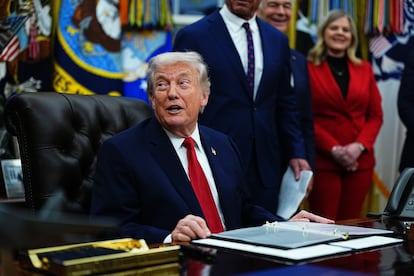

U.S. President Donald Trump has intensified the pressure against Cuba, targeting the island’s most vulnerable point: its oil supply. After Venezuela halted its shipments, the White House issued an executive order declaring a “national emergency” with respect to Cuba and announcing tariffs on any countries that provide oil to the island. This move could affect Mexico’s ability to resume its own oil shipments to Havana.
“The government of Cuba has taken extraordinary actions that harm and threaten the United States. The regime aligns itself with — and provides support for — numerous hostile countries, transnational terrorist groups, and malign actors adverse to the United States,” the executive order states. Therefore, it asserts, “the situation with respect to Cuba constitutes an unusual and extraordinary threat” to the national security and foreign policy of the United States.
To address this threat, it considers it “necessary and appropriate” to establish a system of tariffs on products from foreign countries that “directly or indirectly” supply any type of oil to Cuba.
Mexico has become Cuba’s main supplier of crude oil following the U.S. intervention in Venezuela. Mexican President Claudia Sheinbaum has argued that the oil shipments sent by her government are of two types: humanitarian aid and contracts signed by Pemex, the state oil company, with the Cuban regime. Until early January, ships sailed regularly from the Gulf of Mexico coast to the island. However, Pemex suspended oil tanker shipments to Havana in mid-January.
Sheinbaum has repeatedly assured that humanitarian aid in the form of hydrocarbons will continue, and after a call with Trump on Thursday, she denied that the issue was part of the conversation. In its latest report, published in December, the Mexican oil company estimated that in the first nine months of 2025, Mexico exported 17,200 barrels of crude oil per day, representing 3.3% of its foreign shipments.
According to a calculation by the Financial Times, Cuba has enough oil to last for the next 15 to 20 days. Venezuela supplied an average of 46,500 barrels per day to the island before the U.S. intervention. Mexico delivered an average of 17,200 barrels per day, which stopped arriving in early January, just days after the U.S. incursion into Caracas. Other crude oil suppliers include Russia, which sent its last ship in October, and Algeria, which has not sent a tanker since last February, according to the same source.
Since the U.S. military operation that captured Venezuelan president Nicolás Maduro and his wife, Cilia Flores, in Caracas on January 3, Trump — emboldened by his success — has employed increasingly aggressive rhetoric against the Cuban regime, which he claims “will be failing pretty soon.”
On Tuesday, in statements made before traveling to Iowa to deliver an economic speech, Trump told reporters that the island “is a nation very close to failing.”
Meanwhile, Secretary of State Marco Rubio pointed out on Wednesday in an appearance before the Senate Foreign Relations Committee that Washington is not trying to force regime change in Havana. At least, not directly. “We would like to see the regime there change. That doesn’t mean that we’re going to make a change, but we would love to see a change,” he said. “There’s no doubt about the fact that it would be of great benefit to the United States if Cuba was no longer governed by an autocratic regime.”
Sign up for our weekly newsletter to get more English-language news coverage from EL PAÍS USA Edition









































