
Jeromin Zettelmeyer: ‘If the US continues to exercise coercive leadership, Europe will move to the non-aligned bloc’
The head of the European think tank Bruegel argues that Washington, under the Trump administration, has become an unreliable partner, and this strengthens China’s ties with Latin America, Africa, and Asia

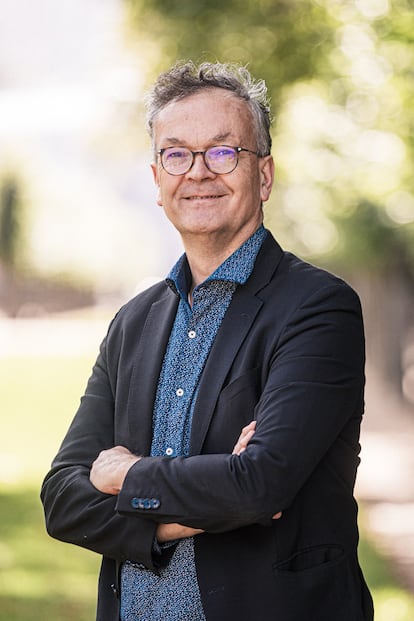
Bruegel, the European think tank led by Jeromin Zettelmeyer, 61, recently published a report on the risks and scenarios of geopolitical movements on the global stage. In that report, Zettelmeyer himself predicts a world divided into three blocs, dominated by the rivalry between China and the United States.
“The most interesting thing is to analyze where Europe will be. It will never be in China’s bloc, but it will not necessarily be in the U.S. bloc either. If Washington continues to exercise coercive leadership, we will end up in the non-aligned camp, alongside India and most developing countries. It depends on the U.S.,” the economist said during a recent trip to Madrid to celebrate Bruegel’s 20th anniversary.
Question. Is Trump’s policy pushing some of America’s traditional allies into Beijing’s arms?
Answer. The most notable development so far has been the Shanghai Cooperation Organization (SCO) meeting, with its strong symbolic weight of seeing Indian leader Narendra Modi alongside Xi Jinping, Vladimir Putin, and Kim Jong-un. This does not establish an alliance, but it is concerning.
Although India will remain in the non-aligned camp, it continues to have border disputes with China and has not developed a manufacturing base that would allow it to compete with Beijing. In the case of Africa and Latin America, some countries have significant ties to China through the Belt and Road Initiative, but others have been negatively impacted, such as Ecuador, Peru, and Suriname. These countries may be compelled to reduce their dependence on the U.S., given the experience with free trade agreements in the region, but this doesn’t directly push them into China’s camp, whose main unifying factor is opposition to the West. Most countries are not in that position.
Q. Europe does have security ties.
A. That’s why NATO will give us a clue. If the Alliance stays afloat, Europe will remain on the side of the U.S. At the same time, if the EU strengthens its autonomy within NATO, as Washington is demanding, it will gain more independence in areas like trade, and there we will find common ground with countries that defend free, rules-based trade, the foundation of our model.
Q. Do you think the change in the U.S. is irreversible?
A. The U.S. has become an unreliable country. And to become reliable again, it’s not enough for a new Democratic administration to simply reject the policies implemented by Trump; a large majority of the Republican Party must also do so. Otherwise, we will remain in the same situation we’ve been in since January 6, 2021.
Q. How does China’s overcapacity influence the shaping of this new order?
A. It’s a complex story involving subsidies, but also a smart industrial policy that has fostered innovation and significantly reduced marginal costs. It also has a very positive component overall, for example, regarding cheap and clean technologies. Chinese solar panels, very affordable, may be one of the few things giving us hope for the climate transition. It’s not all bad, that’s what I mean to say. At the same time, I don’t think this phenomenon can last, because the level of Chinese competition and its production capacity are too great; there will be some kind of upheaval.
Q. What if that doesn’t happen?
A. It has become clear that the equation is not simply that they produce goods and we produce services, because an authoritarian regime like China will exploit that dependence. We will probably need tariffs, as is already happening in sectors like the automotive industry, and to impose conditions on Chinese foreign investment entering the EU.
Q. Under these conditions, could China’s overcapacity influence geopolitical blocs?
A. Yes, especially in countries with no industry, which open their markets to very cheap Chinese products that they could produce themselves, in exchange for China building infrastructure for them. The Belt and Road Initiative was headed in that direction, but it hasn’t quite worked because the fees demanded by Beijing for building the infrastructure were too high, and the countries had trouble making payments. If Beijing changes its policy and provides genuine fiscal support to those countries, then yes. But not in the military sphere.
Q. The SCO is going precisely in that direction and is turning commercial alliances into military or political alliances.
A. That only applies to countries that have neither the geographical location nor the ambition to develop a foreign or security policy that could clash with China, for example, over Taiwan.
Q. What can the EU offer in that context?
A. Europe needs to fight for these countries because we need them — first, because we need them and also China to decarbonize the global economy, and second, because this is how we reduce dependence on China for critical raw materials and other intermediate goods. Our leverage lies in being more generous to these countries in their industrialization and importing from these economies goods that are energy-intensive, which we lack on our continent. We must forge our own alliances.
Sign up for our weekly newsletter to get more English-language news coverage from EL PAÍS USA Edition









































