
Putin-fearing Europe returns: EU ramps up military service
A dozen member states have some form of Armed Forces civilian training program, a growing trend since Russia’s invasion of Ukraine. Germany is the latest to follow suit
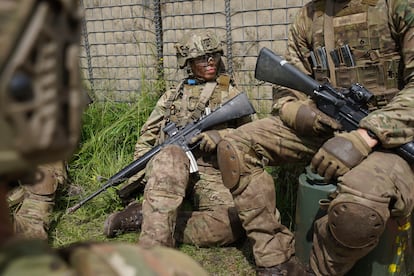
March 9, 2001, was a happy day for an entire generation of Spaniards, who would be freed from the burden of military service a few months later. Five years earlier, France had taken the plunge. Seven years before that, Belgium. And four years later, Italy would follow suit. The long shadow of Vladimir Putin and — above all — the Russian invasion of Ukraine, however, has changed everything. In this regard too, several countries, including Germany — the most populous and powerful nation in the European Union — have reversed course, reinstating military service for their young people.
The final approval by Friedrich Merz’s government for the return of military service — although initially it will be voluntary — with a symbolic meeting Wednesday at the German Ministry of Defense, seeking to send a signal of strengthening the army, is particularly significant. But it is by no means a drop in the ocean. Croatia will do so in early 2026. And over 600 miles east of Berlin, in Vilnius, the Lithuanian authorities took the same step in early 2015, just seven years after it was abolished. The Russian annexation of the Ukrainian peninsula of Crimea — and the outbreak of the war in Donbas — were the main justification for that decision, which led and continues to lead 4,000 young men chosen each year by lottery to join the Armed Forces for a period of nine months.
A decade later, nine of the 27 EU member states have some form of compulsory military service in their legislation for those who have just reached the age of majority, including all Nordic and Baltic countries bordering or geographically close to Russia. Some, such as Finland, Estonia, and Denmark — as well as Norway, a non-EU country with close ties of cooperation with the bloc — never abolished it.
“Once considered an issue of the past, conscription has increasingly made its way back onto European, EU and global policy agendas in recent years, mainly since Russia’s invasion of Ukraine in 2022,” acknowledges a recent European parliament working document on the topic. Several factors are added: “Mounting threats to European security, fears of transatlantic disengagement, as well as the position of the new United States administration and potential peace plans for Ukraine involving the presence of European troops.” A cocktail spiced up by demographic decline, which, the report says, has “raised awareness of the need to ready Member States’ armed forces for the most extreme military contingencies.”
Although fear of the Kremlin — which Lithuania explicitly asserted in 2015 — remains the main factor behind this reversal of course, the circumstances are manifold. Far from northern Europe, and for reasons unrelated to Moscow, three members of the EU club maintain compulsory military service. On the one hand, Austria, a neutral state and not a member of NATO — similar to Switzerland — whose young men never stopped serving in exchange for around €600 (almost $700) a month; on the other, Greece and Cyprus, two countries in constant tension with Turkey.
The aforementioned monograph from the European parliament’s research department also notes “growing support” for the reintroduction of military service among public opinion polls. This is especially true among conservatives, but not them alone: in Germany, its main supporter has been Social Democrat Boris Pistorius. In the latest editions of the Eurobarometer, security and defense were the population’s top concerns, with nearly eight out of 10 citizens “concerned” about what might happen in the next five years.
One country, one model
The pattern of military service varies considerably among northern European countries, both in format and duration. Finland and Estonia — the two EU and NATO members with the longest borders with Russia — are the only ones where all adult males (with few exceptions) are required to serve. Denmark, Latvia, and Lithuania select recruits by lottery. In Sweden — the model Germany has adopted — a small proportion of young men who reach the age of majority are recruited, selected each year based on various criteria, with priority given to those who express a willingness to undergo military training.
Military service models in the Nordic and Baltic countries — considered among the most egalitarian in the world — can also be classified as those that apply exclusively to men and those that make no distinction between genders. In Sweden, Norway, and, since last July, Denmark, women who are drafted are required to undergo military training, a policy that Latvia plans to implement starting in 2028. The Finnish government, for its part, argues that, in the short and medium term, it will not be possible to have the necessary infrastructure and personnel to double the number of young people receiving military training each year — from 20,000 to 40,000.
Although without military service as such, the Polish government, one of the most concerned about Russian expansionist ambitions, announced in March “large-scale military training for adult males.” It doesn’t seem like a mere flash in the pan: the goal, it detailed a month later, is to train 100,000 volunteers each year, starting in 2027.
Different sensitivities
Unlike Spain and other southern European countries, in northern Europe there are few voices critical of compulsory military service. These are countries where the idea of contributing to national defense is much more deeply rooted than in other parts of the continent, and where many young people proudly undergo their military training. Various surveys place Finland and Sweden — which abandoned decades of neutrality to join NATO shortly after the invasion of Ukraine — as the two EU members where the largest proportion of the population would be willing to “fight for their country” (around 65%, more than three times as many as in Germany, Italy, or Spain).
At the request of EU Commission President Ursula von der Leyen, former Finnish President Sauli Niinistö detailed Europe’s defense shortcomings in a report late last year. In it, the liberal-conservative politician praised military service as a way for civilians to contribute to the security capabilities of member states. He also urged governments to strengthen their collaboration to learn from the “good practices” of their neighbors.
Sign up for our weekly newsletter to get more English-language news coverage from EL PAÍS USA Edition









































