
Donbas, the prized objective of the Kremlin’s New Russia
Complete control of the depressed industrial belt of eastern Ukraine, from which millions of Ukrainians have fled in the last decade, would offer a major victory to Putin and put Kyiv at risk of a new invasion
Irina Artyomova, 42, lives in Kramatorsk, in the eastern Ukrainian province of Donetsk, about 12 miles from the front lines. Her reflection is simple but powerful. “What would you think if a neighbor came to your house and said it was his, not yours?” she asks in a phone call. “Would you give up?” Artyomova, along with her husband, Roman Dubinin, also 42, runs the aquarium in this Ukrainian city, a small oasis for civilians and military personnel battered by the Russian siege.
Kramatorsk is one of the Kremlin’s coveted keys to bolster Russian control over Donbas, the region comprised of the Donetsk and Luhansk provinces and located at the heart of the “New Russia” desired by Vladimir Putin. The Russian president made this clear to his U.S. counterpart, Donald Trump, at the recent bilateral summit held in Alaska.
The Russian leader’s dream — with deep historical and economic roots — has clear consequences for the conflict and defense of Ukraine. According to the well-documented account of the meeting between Putin and Trump on August 15 in Alaska, the Russian president would be willing to freeze the front line if the Ukrainian government of Volodymyr Zelenskiy hands over Donbas to him.
“We are against it,” Artyomova continues in a new message. “We don’t want to live under Russian control. We dream of victory and life in a free Ukraine.” The Kremlin’s goal is not new: the pro-Russian uprising that began in Donbas in April 2014 and was supported by Moscow managed to conquer a third of the region. And since February 2022, after three and a half years of a full-scale invasion, Russian troops have occupied almost all of Luhansk, while Kyiv retains control of only 30% of Donetsk. Of the six million people who lived in Donbas in 2022, barely half remain today.
Ukrainian historian Serhii Plokhy, in his book The Russo-Ukrainian War: The Return of History, recalls Putin’s long television appearance in April 2014, in which he defined what he considers Novorossiya, the New Russia, a term rescued from the imperial past: it would include, as the Russian leader then stated, the provinces of Donetsk and Luhansk, as well as Kharkiv, Kherson, Mykolaiv, and Odessa. “All of these are territories transferred to Ukraine in the 1920s by the Soviet government,” he said. “God knows why they did it.” Putin and the nationalism he represents reject that gift — as he has sometimes referred to it — from the authorities of the Soviet Union to the Ukrainian republic at the time.
Donbas, a territory bordering western Russia, has been a key industrial center since the 19th century; first for the Russian Empire, then for the Soviet Union, and finally for Ukraine. However, the lack of investment and modernization following independence in 1991 damaged this economic pillar, according to a 2020 World Bank report. In the decade prior to the 2014 occupation, the region had lost both population and economic clout, in a downward trend that perhaps further distanced its inhabitants from the center of power in Kyiv.
“The standard of living in Donetsk and Luhansk provinces,” Plokhy recounts, “was one of the lowest in the country, and for years the local Russian-speaking population had been mobilized by politicians who, in order to win votes, stirred up resentment against Western Ukraine.”
Ukraine’s steel and mining industries, moreover, have been decimated by the loss of territory. Continuing to hold on to it, without definitively ceding it to Russia, is also a mission to ensure that what was lost can be recovered in the future. Donetsk and Luhansk have been nourished for decades by labor migration from what is now the Russian Federation. Former Donetsk governor Pavlo Kirilenko admitted in an interview with EL PAÍS in April 2022 that half of the remaining population in the province was pro-Russian and that enemy collaborators were a major problem.
It is estimated that before the 2022 invasion, the population of the Donbas region was just over six million. Now it is barely half that. Tetiana Kozlovska, 40, is originally from Donetsk, the capital of the province of the same name. She left her hometown in 2014 and now lives in Kyiv. “I feel frustrated after more than 10 years in which many people have died for their land, and perhaps for nothing,” she says by phone, when asked about a possible cession of territory. “It’s painful.” This graphic designer also doesn’t believe that Russia will stop if it obtains Donbas. “It’s not about the land,” she says, “they don’t want Ukraine to exist.” Kozlovska hopes to return home one day.
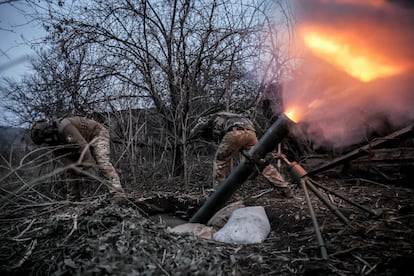
Traveling to the Donetsk strip still under Ukrainian control, especially to towns near the front lines, is like entering war-ravaged terrain, in almost uninhabited towns where a handful of people rebel against the daily terror of Russian bombing. Kyiv’s efforts to defend its sovereignty are concentrated in this 30% of the territory resisting the offensive. If Kramatorsk and Sloviansk, separated by less than 10 miles and in the heart of the Ukrainian resistance, key logistical centers for the army, were to fall to the invader, the doors would be opened for Russia to attempt to advance on Dnipropetrovsk province in the future. And from there, toward the river that is the backbone of Ukraine: the Dnipro.
On August 12, the Washington-based Institute for the Study of War noted: “The surrender of the rest of Donetsk Oblast as the prerequisite of a ceasefire with no commitment to a final peace settlement ending the war would force Ukraine to abandon its “fortress belt,” the main fortified defensive line in Donetsk Oblast since 2014, with no guarantee that fighting will not resume.” This belt, on which Ukraine has invested 11 years of efforts to block a possible Russian assault from Donbas to the west, runs for about 30 miles along the highway between Kostiantinivka in the south and Sloviansk in the north.
Pokrovsk is another of the few large municipalities in Donetsk still in Ukrainian hands, but it is practically surrounded by the invading troops. During the siege of Pokrovsk, the Russian army has already taken up positions inside Dnipro. That’s why Finnish President Alexander Stubb illustrated in epic fashion last Monday in Washington during the summit convened by Trump, that “Kramatorsk and Sloviansk are the bastion against the Hun hordes.”
Occupied Donbas
The part of Donbas under the control of Russian authorities and troops can be divided into two zones: the area hit by the invasion and the pro-Russian separatist territory that remained more or less untouched by the fighting. Devastated forests and ruined cities marks the separation between the two. The withdrawal of the front from the city of Donetsk has brought a certain calm to the provincial capital, where more children and families are now on the streets, although the break with Ukraine more than a decade ago has also plunged this area into a severe economic depression. Peeling houses and abandoned factories and offices dot the landscape.
The occupied region is also suffering from a severe water shortage crisis. The war unleashed by the Kremlin has devastated the Ukrainian water infrastructure that supplied the so-called “separatist” cities for years, even though they were under Moscow’s supervision. Water often doesn’t reach the upper floors of buildings, and the Russian regime has imposed strict rationing, with homes going days without supply.
The city of Mariupol, the greatest conquest of the Russian army, was exploited by Kremlin propaganda as an example of post-war reconstruction. Three years later, almost all construction work has come to a standstill, with progress only being made on the buildings that will be sold to Russians in this coastal city.
The situation in the towns near the front is much worse. Drones hover menacingly over Gorlovka, less than 10 miles from the disputed Toresk, and shells fall with some regularity. “We just want peace,” Ukrainians in the occupied zone often say. Raisa, a woman from Mariupol, asked a few months ago if she felt “liberated” by the Russians, replied: “From whom?”
However, in the self-proclaimed “separatist republics” of Donetsk and Luhansk, most people openly support being part of Russia. Those who considered themselves Ukrainian have fled or remain silent. It is unknown how many thousands of civilians have been detained in occupied territory, and some of them, like journalist Victoria Roshchyna, have died in prison.
Sign up for our weekly newsletter to get more English-language news coverage from EL PAÍS USA Edition









































