
Russia achieves its largest advance on the frontlines in Ukraine since 2024
The invading army is targeting logistics lines, the Achilles’ heel of the Ukrainian army, to conquer key cities in the Donetsk province

Sometimes, facts explain more than a picture or a thousand words. In August 2022, six months after the Russian invasion began, the Ukrainian municipality of Dobropillya was 55 kilometers (34 miles) away from the occupying troops. On August 8, 2024, a year ago, the Russian army had advanced to within 32 kilometers (20 miles) of this town in Donetsk Province, in eastern Ukraine. In June, when the Russian summer offensive began, the invading soldiers were still 25 kilometers (15.5 miles) away from Dobropillya. Two months later, they are now only 11 kilometers (6.8 miles) away.
The litmus test that a city is preparing for an inevitable siege isn’t just the columns of smoke rising on the immediate horizon, the artillery blasts, or the enemy surveillance drones hovering overhead: it is above all the fact that it’s rapidly emptying out its residents. The NGO Proliska evacuates 200 people from the area every day. Vans, cars, and families loading their belongings onto carts leave for Dnipropetrovsk province. The number of refugees fleeing Dobropillya has multiplied fivefold in two weeks, according to Proliska.
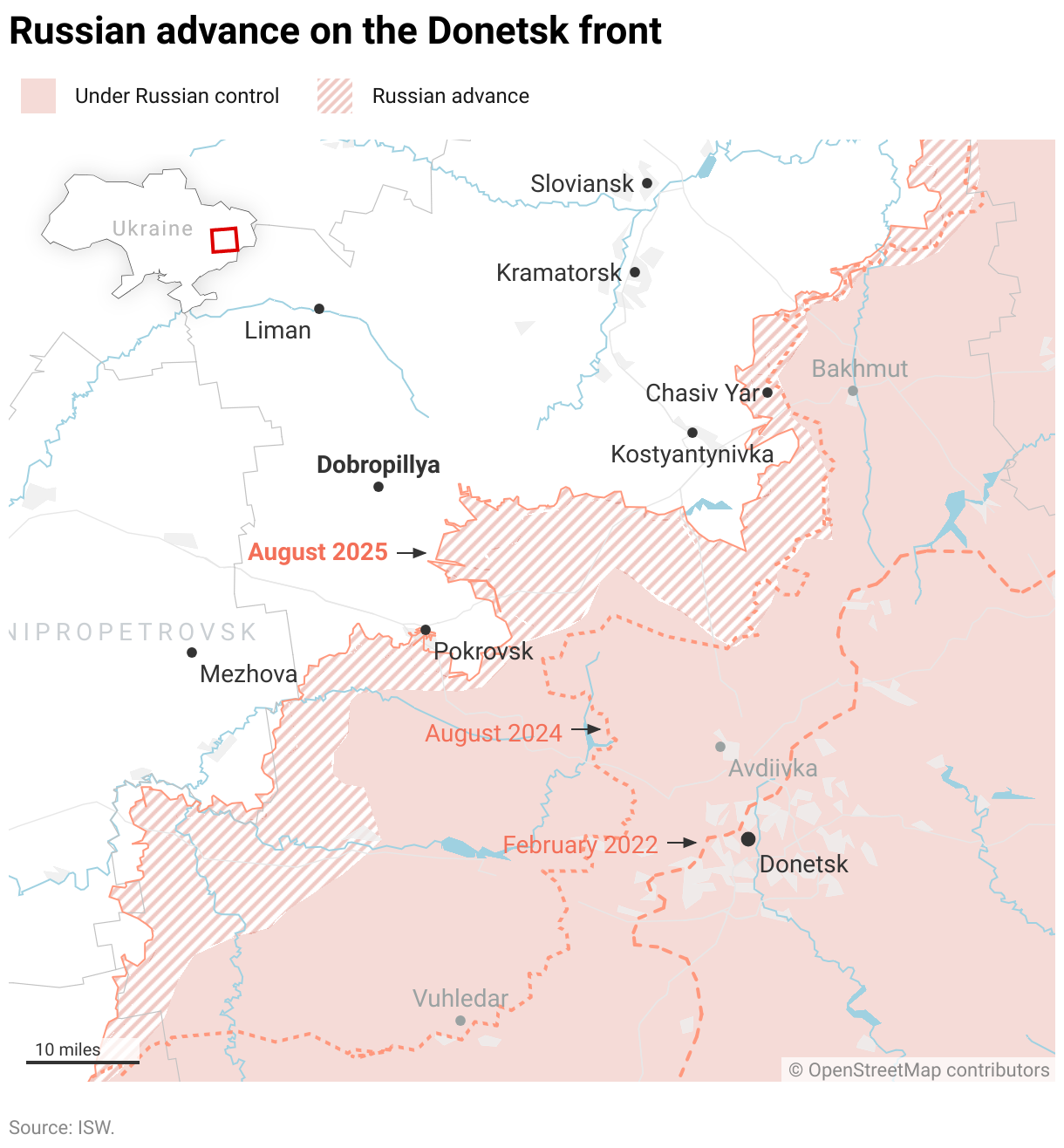
Dobropillya is perhaps the epitome of Russia’s most consistent military streak since the spring of 2022, when it invaded Ukraine by surprise. The war is still a conflict spanning hundreds of kilometers of active front, but without major changes. The line of contact between the two armies is about 1,200 kilometers (745 miles). Much of this remains in stalemate, but Russia is pressing ahead in a way it hasn’t for two years in multiple provinces, opening new hot spots in the Kharkiv region, Zaporizhzhia, and Sumy.
With such a wide front, Moscow wants to push Ukraine, which has fewer troops, to its limits. The defending army has achieved the impossible: containing the invader. Therefore, in this war of slow and small changes on the front, what Russia is achieving in Donetsk province this summer is unusual.
British intelligence services estimate that Russian troops commanded by General Valery Gerasimov have captured 550 square kilometers in the last month. According to the Institute for the Study of War (ISW), a U.S.-based group analyzing the Russian invasion, the figure exceeded 700 square kilometers, the fourth consecutive month of increased advance. According to ISW, not counting the first months of the war, similar figures were obtained only in November 2024.
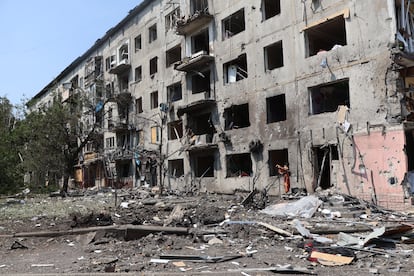
Dobropillya is located in the middle of the most important territory in the current Russian offensive: on one side is Kostyantynivka and on the other, Pokrovsk, the two cities that are the main prize Moscow wants to capture by the end of 2025. Thousands of vehicles circulate through the Dobropillya region, connecting the Ukrainian defenses in Donetsk, roads that the invader wants to cut off. Because if there’s one thing the Russian army has excelled at in recent months, according to military personnel and experts, it’s breaking through Ukrainian logistics lines.
“My son is in the army, and three weeks ago he asked me to leave, saying that the Russians would be at the gates of Dobropillya by August, and I couldn’t believe it,” explained Irina, a woman who runs one of the few cafes still open on the town’s main avenue, last Friday. Irina is already prepared for a last-minute escape and assumes she will lose her establishment: “I guess I have hours left here; the power is out, and in the last week, at least three times a day, there have been drone or missile strikes around my cafe.”
First objective, Pokrovsk
Kostyantynivka and Pokrovsk are being surrounded, with the Russian army following the same tactic that allowed it to capture the Donetsk municipalities of Avdiivka and Vuhledar in 2024. In both cases, Oleksandr Syrskyi, commander-in-chief of the Armed Forces of Ukraine, ordered the withdrawal of his fighters to prevent them from becoming isolated in the urban areas.
If the pace of advance of the last six months continues, the next piece to fall should be Pokrovsk. The city, besieged for a year, has already been infiltrated by Russian reconnaissance groups. Enemy regiments are within 4,000 meters on its southern, eastern, and northern flanks. “The front remains unsteady,” says Faber, a major with the 155th Ukrainian Mechanized Brigade. “What’s happening is that it’s shifting wherever the Russians are allocating the greatest number of resources, and now that place is Pokrovsk.”
The 155th Brigade is assigned to the defense of Pokrovsk. Faber, a 21-year army veteran, speaks to the journalist at a base in his area of operations, with the intermittent buzzing of enemy drones nearby. “The Russians continue to sacrifice their men as cannon fodder, often using them as decoys to identify our positions,” he says.
“The enemy is constantly attacking us in Pokrovsk, two or three guys on one flank or the other,” explains Sjid, the code name for an infantry lieutenant in the 155th Brigade. “It’s like drop after drop of water falling on a stone until it makes a hole.”
But it’s not a given that Pokrovsk will be conquered by Moscow either. Kupiansk, a key city on the border between Kharkiv and Luhansk provinces, has been under threat from invading troops within 10 kilometers to the north and south for over a year. Kupiansk is being razed to the ground, access to it is closed off, and Russian forces are infiltrating more easily, but it is still holding out.
Another case is that of Chasiv Yar, in Donetsk. This municipality, located on an elevated position, is of fundamental importance for capturing neighboring Kostyantynivka and for future advances on Kramatorsk and Sloviansk. The capture of these two cities would mark the end of the Donbas region as part of Ukraine. The siege of Chasiv Yar began in January 2024, and today almost all of its ruins are under Russian control. But Syrskyi’s men continue to hold their own on the outskirts, holding off the enemy assault on Kostyantynivka.
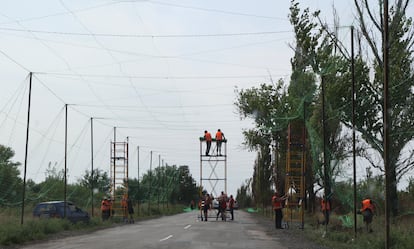
Kostyantynivka is now closed to civilians, controlled by Russian drones. The access road, like those leading to Dobropillya, is being covered with nets to prevent enemy drones from hitting vehicles. “Russian progress since May has been enormous, and the key to this is that they are hitting our logistics routes further [from the front] and with greater precision,” explains Uziv, the code name for a member of an assault platoon of the Ukrainian police special forces (KORD).
He and his comrades spoke with this newspaper on Thursday just a few kilometers from Kostyantynivka, as they prepared to return to combat positions. The most difficult time for infantry in both armies is front-line rotations, when soldiers must move under the threat of bomb-drones. Uziv confirms what other military personnel and analysts have highlighted in 2025: Russia has, as of this year, become clearly superior in unmanned aerial vehicles, not only in numbers but also in technology.
“Rotations are more difficult for us; on average, they have three times as many personnel-guided drones (FPVs) to attack our men,” says Uziv. His unit emphasizes that Russian aircraft guided bombs are another decisive difference. And they have detected an increased use of cluster munitions. “They burn everything with these,” notes the commanding officer, nom de guerre Miti. Just minutes earlier, the EL PAÍS team crossed a roadblock that had been hit with cluster munitions, while the surrounding fields continued to smoke.
Death zone
In a July 31 analysis, Michael Kofman, a military expert at the Carnegie Endowment, noted that the Russians had extended their aerial dominance with drones beyond the 15 kilometer (9.3-mile) boundary, known as the “kill zone.” Their ability to systematically strike has now been extended to 25 kilometers (15.5 miles), thanks in part to their superiority with drones connected to the pilot via fiber optic cables. This makes it impossible for radio frequency systems to disrupt the connection between pilot and aircraft.
That’s why dozens of kilometers of roads in the Donetsk region are being protected with tunnel networks. Faber, of the 155th Brigade, expands the “kill zone” to at least 20 kilometers and confirms that Russian FPV drones have acquired longer-lasting batteries, and some models even have built-in photovoltaic panels. “Their use of FPV drone bombs is now widespread,” this officer explains. “I would say that on many occasions they launch them without even waiting to receive the target coordinates from their Mavic surveillance drones, hitting whatever they find with them, including civilians.”
“The Russians are attacking deeper and forcing us to use longer and more difficult logistical routes; this is the main factor in their rapid advance,” Miti added. His words were confirmed by an August 7 ISW report: “The shift in drone tactics is allowing the Russians to carry out more sophisticated attacks on Ukraine’s logistical lines, defensive positions, and military industry.” The Russian military, writes ISW, can strike “deeper into the rear with new reconnaissance and attack drones that have longer flight times.”
Last Saturday, south of the city of Liman, in Donetsk, about 25 kilometers from Russian positions, this newspaper was able to verify the ISW’s statements on the ground. The area, like the entire region under Ukrainian control, is constantly monitored by Russian surveillance drones that can fly at altitudes of more than three kilometers. In a grove of trees, an area where military vehicles and artillery are usually hidden, three columns of smoke rose, preceded by explosions spaced a few minutes apart. Ash began to rain down within a 400-meter radius of the blasts.
Assault on Dnipropetrovsk
Andrii was an infantry armored vehicle driver in a mechanized brigade. He hasn’t attended his soldiers’ rotations with these armored vehicles for months now because, as he knows from his own experience, they are easy targets for drones. Andrii now rides a quad bike, a four-wheeled motorcycle, which he uses at sunset — the hour he knows well when daytime drones switch over to nighttime ones (with thermal imaging equipment) — to deliver supplies to the front line and transport soldiers on a trailer.
The Russians were the first to use quads and motorcycles in 2024 as the optimal vehicles for evading drones on the front lines. The Ukrainians are now also using them, just as they have emulated the Russians in developing fiber-optic drones. Faber explains that the last time they used armored vehicles to reach the front lines, they lost three in one fell swoop. They now rely on ground-based drones for cross-line supplies, in addition to motorcycles.
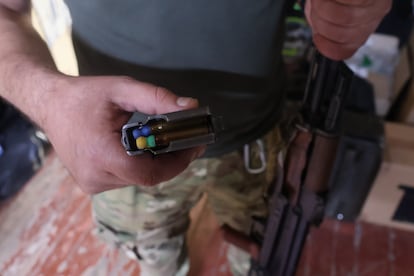
Andrii’s only armament is a shotgun with buckshot, the best-known weapon for shooting down fiber-optic drones. “In the last three months, I’ve already shot down six. Despite this, it’s much more dangerous to approach the zero line in an armored vehicle,” Andrii says near Mezhova. Andrii’s brigade is fighting on this part of the front, bordering the provinces of Donetsk and Dnipropetrovsk. This sector was initially linked to Russian attempts to besiege Pokrovsk, but as the Ukrainian General Staff warned in May, the objective would not stop there: the invaders also want to occupy part of a new province.
Deep State Map, Ukraine’s leading mapping service tracking the conflict, confirmed on August 7 that for the first time in three and a half years of war, Russian regiments had taken up positions inside Dnipropetrovsk.
Hundreds of residents of the village of Mezhova are being evacuated this August. Their tragedy parallels that of Dobropillya. The war front was 50 kilometers from Mezhova a year ago; today, the municipality is 15 kilometers from the front and is being attacked by Russian drones every two hours, according to Andrii.
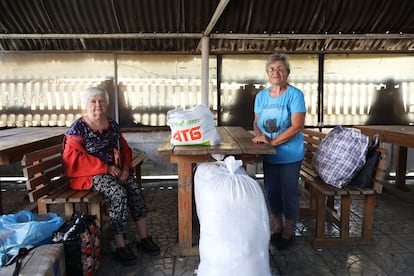
Those fleeing are primarily elderly, like 86-year-old Claudia Katasonova and her friend Irina Chervenko. Katasonova had been living in Mezhova for three years after fleeing another region of occupied Donetsk. She thought that municipality and Dnipropetrovsk would be safe places: “But you can’t live there anymore. The police convinced me today to leave immediately, that maybe the Russians will be in the town in three weeks.”
“It would be a problem if the Russians overcome Pokrovsk because from there to Pavlograd (a major city in Dnipropetrovsk) there are no longer strong enough urban bastions to contain them,” warns Yuri Arabskii, captain and spokesman for the 155th Brigade.
Volodymyr Kuzinov is from Pokrovsk and held out in the city until the mine where he worked was completely closed. In June, he left on his bicycle and has been living in Dobropillya ever since, also thinking it would be a safer place. He lost his house in a bombing raid and sleeps in basements or in the park. Visibly intoxicated, he says that, unlike Katasonova, he doesn’t want to be evacuated: “If I leave Dobropillya, they’ll draft me at the first roadblock, and I don’t want to go into the army.” “I’ve seen those fighting in Pokrovsk for over a year,” says Kuzinov, “and I don’t want to die.”
Sign up for our weekly newsletter to get more English-language news coverage from EL PAÍS USA Edition









































