
Zelenskiy faces first street protests since start of war with Russia
Thousands of people gathered in Kyiv and other cities to oppose the Ukrainian president’s measures to control anti-corruption agencies
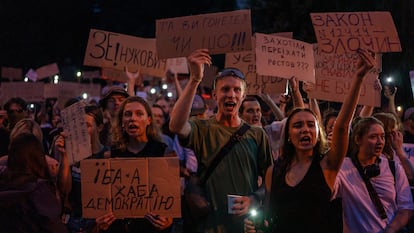

Volodymyr Zelenskiy’s political power in Ukraine is almost absolute. He has held the presidency since 2019, dominates the government at will, and has an absolute majority in parliament. But what he doesn’t control are the streets, where Ukrainians have proven indomitable since the country declared its independence from the Soviet Union in 1991. For the first time in three and a half years of war, the president has faced public protests. Thousands of young people gathered Tuesday in the cities of Kyiv, Dnipro, Odesa, and Lviv to denounce the legal measures and actions taken by Zelenskiy’s majority that affect the autonomy of the country’s anti-corruption bodies.
Events unfolded in a manner that was difficult to foresee. The Security Services of the Ministry of the Interior (SSU) laid the first stone of unrest when they carried out a raid on the National Anti-Corruption Bureau (NABU) and the Anti-Corruption Prosecutor’s Office (SAPO) on Monday. The operation was harshly criticized by Ukrainian civil organizations as well as by Kyiv’s international allies, who consider it a political action to purge the NABU’s autonomy.
Other similar actions by the government and the presidential office in recent weeks — violating the independence of anti-corruption bodies — had sparked protests from civil society, the media, and the opposition, but nothing compared to what happened Tuesday in the Rada, the Ukrainian parliament. The absolute majority held by Servant of the People, Zelenskiy’s party, approved a legal reform that de facto nullifies the independence of the NABU and SAPO, placing them under the jurisdiction of the government-controlled Prosecutor General’s Office.
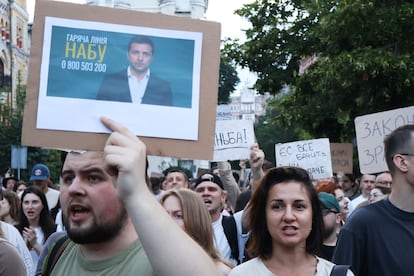
Dozens of prominent pro-democracy activists called on citizens to protest against Law 12414. The call spread like wildfire, and for the first time since the beginning of the Russian invasion, thousands of people took to the streets to confront the president. The demonstration in Kyiv was supervised and monitored by Ozon, a division of the Center for Civil Liberties, an institution dedicated to promoting human rights in Ukraine.
Demonstrations were staged in several cities, all with the same slogans in support of NABU and demanding that Zelenskiy reverse course and not sign the law. “Zelenskiy is one signature away from betraying Ukrainian democracy,” wrote the Kyiv Independent in an editorial.
EU Enlargement Commissioner Marta Kos expressed her discontent with the legal reform on social media: “Seriously concerned over today’s vote in the Rada. The dismantling of key safeguards protecting NABU’s independence is a serious step back. Independent bodies like NABU & SAPO are essential for Ukraine’s EU path.”
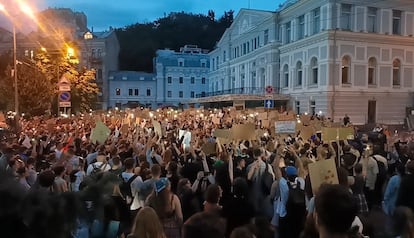
The largest mobilization, as is usual during times of heightened political tension in Ukraine, took place in Kyiv. Thousands of demonstrators, mostly young people, gathered in the square in front of the Ivano Franko Theater — a poet and icon of the Ukrainian nation — from 8 p.m. until midnight, when the curfew went into effect.
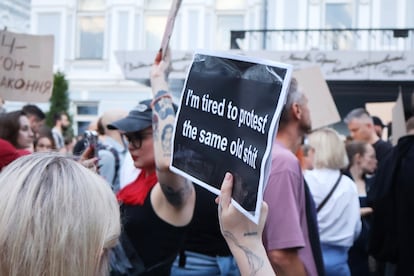
The country has not witnessed such large public gatherings during the war, which have been banned for security reasons following the implementation of martial law. The authorities did not attempt to suppress them, and to avoid any tension, police were not deployed in or around the square.
Just 500 meters away is Maidan Square, the site of massive protests that ultimately overthrew pro-Russian former president Viktor Yanukovych in 2014. The Maidan revolution was cited by many protesters as an example of the struggle for reforms that would bring Ukraine closer to the European Union. “Ukraine is not Russia” and “Let’s return to Europe” were two of the most chanted messages at the protest in Kyiv.
Participants brought dozens of cardboard cutouts from recycled boxes from the Nova Poshta postal service or pizzerias, and distributed them along with markers to write their slogans.
Zelenskiy ignores demands
During the afternoon rally in Kyiv, not a single shout directed at the president was heard. Critical remarks throughout the day were aimed at Andriy Yermak, the head of the presidential office and one of Ukraine’s least popular politicians.
The situation changed when the Rada’s information service reported that Zelenskiy had signed the decree late last night. The news reached the protesters’ cell phones, and for the first time, those gathered reacted with chants against the president.
Zelenskiy thus ignored the protests, but an indication of how difficult the decision was is that on Tuesday he did not broadcast the video message he shares every night on his social media channels addressing the most important issues of the day. “Ukraine is regressing to the Yanukovych era,” headlined Pravda, the country’s main newspaper.
The signing of the law prompted calls on social media to continue the protests Wednesday. Another piece of news arrived the same day: the third round of negotiations in Turkey between delegations from Ukraine and Russia to agree on new prisoner exchanges and narrow the gap toward a ceasefire, which the Kremlin has ruled out.
On Tuesday, the Ukrainian General Staff also confirmed that Russian troops had entered the city of Pokrovsk for the first time, the main target of the invader’s advance in Donetsk province. Protesters throughout the cities interspersed anti-government messages with cheers for the army and patriotic songs. Among those present were very few military personnel, but many men of mobilization age who have avoided enlistment.
Sign up for our weekly newsletter to get more English-language news coverage from EL PAÍS USA Edition









































