
Ukraine war leaves Russia-occupied Donetsk without water
Inhabitants of the frontline province survive on a few hours of supply per week following the closure of the largest canal in the eastern Donbas region
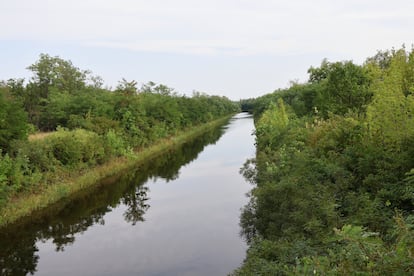

The Donbas war began in Sloviansk, the prelude to the catastrophe that is ravaging Ukraine today, and it is home to the region’s most important source of life. In April 2014, this city in the Ukrainian province of Donetsk was the scene of the first armed uprising by pro-Russian separatists against Kyiv. The Ukrainian army regained control of Sloviansk two months later and, with it, control of the Siverskyi Donets water canal, the largest hydraulic infrastructure in Donbas, which since 1958 has supplied water to millions of people, industry, and agriculture.
The canal originates in a reservoir on the Siverskyi Donets River, north of Sloviansk. The reservoir is full and the river flows abundantly, unlike at its most important destination, 90 kilometers (56 miles) to the south: the city of Donetsk. The provincial capital and its region, illegally annexed by Russia in 2022, suffer from a permanent water supply deficit, but this summer the crisis has escalated and its citizens only receive a few hours of supply every three days. One of the reasons is that the Siverskyi Donets canal stopped functioning in 2022, at the beginning of the war.
The authorities in occupied Donetsk accuse Ukraine of sabotaging the main pumping station in its final phase at the start of the invasion, in the village of Mayorsk, which was still in Ukrainian hands at the time. Furthermore, according to the occupying administration, the pumping system can only be reactivated from the initial checkpoint, north of Sloviansk. Russian media outlets in exile, such as The Moscow Times, also claim that Ukraine shut off the water supply.
Dual accusations
Moscow accuses Kyiv of deliberately interrupting the water supply to occupied Donetsk, causing a humanitarian crisis. The Ukrainian government in the region has not responded to EL PAÍS’ request for an interview. Larisa Guseva, regional head of community services, told state television channel Suspilne on August 6 that the canal was inoperative because fighting and Russian bombing had severely damaged it. The situation, Guseva said, also affects the territory of free Ukraine.
The first pumping station, in the village of Mykolaivka, shows clear signs of having been attacked by Russian fire. Specifically, the electrical substation that powers the system is partially destroyed. Mykolaivka is located 20 kilometers (12 miles) from the invading positions, and on August 7, the day this newspaper visited the site, a Russian missile struck the town, destroying several houses.
From Mykolaivka, not only are traces of the current conflict visible, but the destruction left behind by the pro-Russian armed uprising of 2014 also remains. During the Donbas War (2014-2022), the canal continued to operate, supplying water to the regions controlled by the pro-Russians, because it also served industrial areas of Donetsk in free Ukraine, such as Avdiivka and Mariupol. Both cities are now under Russian control.
Despite the damage to the main pumping station in Mykolaivka, water continues to flow from there, through the canal and its aqueducts, at least 13 kilometers (8 miles) southeast, toward the front line in the town of Chasiv Yar. The EL PAÍS team followed the canal’s auxiliary road to a point eight kilometers (5 miles) from the front line, dodging multiple potholes caused by artillery fire and drones. The infrastructure crosses the road from Sloviansk to Bakhmut, a devastated route empty of Ukrainian troops due to the risk of attack by Russian drones.
The last time journalists from this newspaper were in the center of Chasiv Yar was in February 2024, when the Russian siege of this key municipality for control of Donetsk had already begun. EL PAÍS was able to visit the Ukrainian defense lines in front of the canal, which served as a moat that was difficult for enemy infantry assaults to overcome.
To reach the canal, you had to follow a path marked out by Ukrainian soldiers: the entire perimeter was mined, and you could also see the bodies of Russian combatants who had fallen while attempting to cross it. In those early months of 2024, the presence of observation and attack drones was already commonplace, although not as dense as it is today.
The noise of their engines was constant, and the front line could only be reached by armored vehicles and with drone flight alerts. Today, this journey is impossible because armored vehicles avoid the last five kilometers before the zero line, due to highly likely fatal attacks by enemy drones.
Chasiv Yar is now a devastated municipality, controlled by the Russians. If in February 2024 the canal might have remained intact, it is possible, as Guseva assured, that after a year and a half of fighting, it is now seriously damaged.
Public unrest
But the closure of the Siverskyi Donets canal is not the only reason for the water crisis in occupied Donetsk. The situation is so serious, due to the unrest it is causing among the population annexed by Russia, that on August 4, the Kremlin broadcast a meeting between President Vladimir Putin and Denis Pushilin, his governor in occupied Donetsk, to discuss the situation. Pushilin blamed the “Ukrainian blockade” for the lack of water, as well as a drought that has left the reservoirs in his region at minimum levels. He also admitted that the canalization systems in his territory are in poor condition, having not been modernized since the 1990s, with supply losses of 60%.
Putin questioned Pushilin about the high prices of water transported from other regions in tanker trucks, which local media claim is unaffordable for the local population. Moscow is building a new water canal to alleviate the problem. Russian propaganda media have insisted in recent weeks that only the conquest of Sloviansk will end the crisis: that is, the total occupation of Donetsk.
Sign up for our weekly newsletter to get more English-language news coverage from EL PAÍS USA Edition









































