
‘We are dying’: Cuba sinks into a health crisis amid medicine shortages and misdiagnosis
Hospitals are overwhelmed and fatalities are soaring. The island is suffering from combined viruses that include dengue, chikungunya, Oropouche and other respiratory diseases

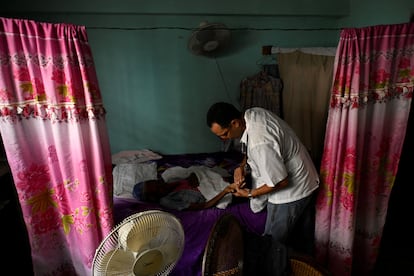
Mercedes Interian is unable to hold a glass of water. If she tried, it would fall to the floor. The fever and vomiting are over, the diarrhea and headaches gone. Now that she is out of danger, what Mercedes fears most is that she will be forever stooped. Once a strong 57-year-old woman, these days she cannot take a step without leaning on a broomstick. “We are a hunchbacked people, scratching around for something to eat,” she says, her voice choking due to breathing difficulties as she lies on the sofa of her house in El Cerro, in Havana. “Nobody is okay here, this thing numbs your fingers, ankles, knees... We are an army of zombies.”
Cuba today is indeed a country of sick citizens who do not know exactly what they are suffering from. All they know is that they are being infected by “the virus” – a sinister ghost that has drifted across the entire island, wiping out its inhabitants. First come the high fevers, then red spots develop, or else peeling skin. Vomiting, diarrhea and headaches are inevitable. The hands and knees swell. Victims can barely stand on their feet, and there are those who have not walked again even after the worst is over. A limp indicates a virus survivor. Citizens who drag their legs or complain about achy joints have likely also been hit. According to Maidelys Solano, 38, who was ill at home in Bayamo along with her two children, her father and nephews, every morning in every Cuban neighborhood, people are saying, “It hurts here, it hurts there, today I am a little better, or I could not get out of bed. That’s how all the neighbors are, it’s what they repeat daily.”
Almost all families in Cuba have had someone sick at home due to the country’s epidemiological crisis. The disease is in fact a combination of several mosquito-borne viruses, a model of “combined arboviruses” that includes dengue, Oropouche and chikungunya, as well as other respiratory viruses such as H1N influenza, respiratory syncytial virus, and Covid-19. According to figures published by the Ministry of Public Health, 5,717 new cases of chikungunya were reported in the last week, bringing the number of patients suffering from it to 38,938. As for dengue, the ministry said the disease remains active in the country’s 14 provinces and 113 municipalities.
An alarming 33 deaths were reported at the beginning of the week which the government was forced to recognize, including 21 minors – the demographic most affected by these arboviruses along with the elderly. “There are many one-month-old children who have died, and also those between two and four years of age, as well as other young people, because the vomiting and diarrhea dehydrates them and they arrive at the hospital already in a state of collapse,” a worker at the Institute of Hematology and Immunology of El Vedado told El PAÍS on condition of anonymity.
Cuban officials, who are always reluctant to acknowledge any catastrophe, have been refusing to accept that there is a health crisis, insisting that these are common diseases for the islanders, accustomed to the summer heat and torrential tropical downpours. “They are neither new, nor are they rare or unknown,” Public Health Minister José Ángel Portal Miranda said in October. He then tried to dismiss speculation arising from the countless reports of deaths: “No one can hide an epidemic or the dead,” he claimed.
While the minister was expressing this view, Cubans in the province of Matanzas were complaining about the high rate of infections without knowing exactly what they were dealing with. Now, with hospitals and morgues overflowing, it is difficult for the ministry to ignore the evidence, though many Cubans maintain that the number of the ill and the dead is far higher than the state is willing to acknowledge.
The government has managed to disguise the figures by issuing death certificates that fail to mention arboviruses. “The doctors say that they died of a heart attack, anything but the virus,” says the worker at the Institute of Hematology and Immunology. In Solano’s neighborhood in the east of the country, several people have died in recent weeks. She says that in medical centers they put the deaths down to underlying conditions such as diabetes, pneumonia or hypertension. “But in my town, there are several people who have died from respiratory arrest or dehydration,” she says.
On October 18, Alexander Hernández’s 81-year-old mother felt ill and went to bed to rest. She was completely doubled over. Shortly after, she was taken to hospital and the doctor suspected a case of chikungunya. After a week, she experienced alterations in her diabetes and blood pressure and was suffering tachycardia. “The doctor saw her twice and checked her vital signs,” says the son. A few days later, they said everything was under control, and that she could return home. On November 5 she died. Hernández asked for an autopsy, but the doctor resisted. “He said no, and I didn’t insist because there was no transportation. He practically convinced me that it would be pointless.” His mother’s death certificate states that hers was a natural death.
No medicine or food
Finally, the Cuban government has been left with no choice but to recognize the “national epidemiological situation” that has Cubans in a state of panic. The outlook is so critical that some have appealed to the international community not to let their so-called diseased ship sink with its millions of people on board. While state officials downplay the matter, insisting that it is not an outbreak exclusive to Cuba, and that cases are being reported in Brazil and Colombia, the truth is that the general shortages and state of collapse in Cuba have severely undermined the authorities’ ability to control the disease.
Mercedes Interian says that she is using medicinal plants to self-medicate, because of the absence of prescription drugs in a country that suffers a 70% deficit of medication supplies. She boils water and adds oregano leaves, a clove of garlic, and four cloves – a concoction she drinks in the mornings and evenings. “The truth is we don’t know how to fight it,” she says. “They send you home to rest. We are unprotected in every way. We don’t even know what we really have.”
What worries Cubans most is the lack of proper diagnostic procedures in health institutions that can tell them what type of virus they are suffering from. “For chikungunya, Oropouche or sika there are no diagnostic reagents, only at health institutes in Havana, including the IPK. The doctors write down Non-Specific Febrile Syndrome,” says a nurse from a clinic in Matanzas who prefers to remain anonymous. “To determine if it is dengue, the Immunoglobulin M [IgM] test needs to be run, which tells you the strain. It is not a lie to say that we are dying.”
Solano says that, once you go to hospital, no one tells you what type of disease you have. “If you start to swell, they tell you it’s chikungunya, if not, it’s dengue. Almost everyone has swelling, so most of them have chikungunya. You don’t hear a doctor giving a specific diagnosis. On the certificates they say that you have a virus – always trying to mask the reality we live in,” she says.
EL PAÍS’ source at the Institute of Hematology and Immunology says that many times the results of IgM tests never arrive. “It was reported that they were discarding the samples a lot of the time because there were no reagents to process them, and the patients were given a negative result. There is no such thing as an accurate diagnosis. From the symptoms, it is known that it is an arbovirus.”
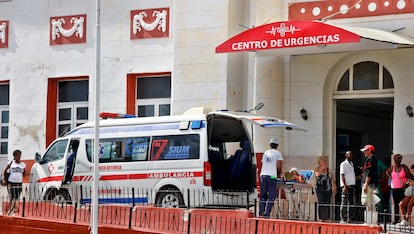
Right now, Yudinela Castro Pérez has a scar left by almost 20 stitches that furrows her belly. For the doctors, everything was fine and the symptoms were “normal.” First there was the usual fever, pain, swelling and stiffness. “They told me that I was not the only one going through that,” says the 44-year-old. Then she ate a taro dish and her abdomen swelled to such a degree that she was rushed from her home in Arroyo Naranjo to the Julio Trigo hospital. “They did tests that supposedly came back negative,” she said. Subsequently, she learned that the virus – she’s not sure which – had inflamed her intestine and she had perforations due to silent peritonitis. She has had to buy her own antibiotics and painkillers on the black market, when available.
Several Cubans interviewed by EL PAÍS are concerned that the dearth of good food is damaging their chances of recovery. A nutritional guide to which EL PAÍS had access, circulated by the Pedro Kourí Institute (IPK), reports that, among other things, chikungunya consumes iron reserves, decreases albumin and other proteins, and raises C-reactive protein, all factors that weaken the immune system. According to IPK, a prestigious research center for infectious disease, it is vital to eat eggs, yogurt, whey, fish such as salmon, tuna or sardines, vegetables, nuts and certain grains. Most of these products are inaccessible to most Cubans. “Cubans’ diet nowadays consists of picadillo and rice, and once in a long while a dish made from roots, so it’s impossible,” says Mercedes Interian. “Here, you might not eat any protein in the whole year – only some people can – and without a good diet, the impact of the virus is more virulent.”
The source of the epidemic
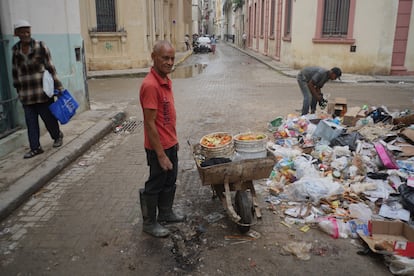
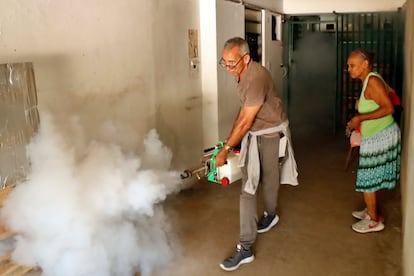
The reasons why Cuba became a hotbed of mosquitoes and disease overnight is what many today are trying to figure out. The authorities have come up with the fact that Cuba has a “virgin” population in the face of a virus such as chikungunya, which was discovered on the island for the first time in 2014. They have also attributed the causes to the months of heat and rain that create favorable conditions for the mosquito. Although the country has mobilized forces at the last minute for garbage collection, the fact is the garbage got out of hand due to a lack of government action. And large garbage dumps have fostered a proliferation of mosquito infestations. With daily blackouts, Cuba lacks the fuel to guarantee fumigation. Meanwhile, insecticides are scarce and the lack of water means even minimum hygiene is difficult to attain. The infestation rate, which has become practically uncontrollable, stands at a high risk 0.89%.
Dr. Geanela Cruz Ávila, director of the Provincial Center for Hygiene, Epidemiology and Microbiology of Holguín, told Cuba’s state-controlled news outlet ¡Ahora! that if they had failed in anything, it was in prevention. “In vector-borne diseases, the focus must be on the vector. Without a mosquito outbreak, there is no transmission,” she said, adding that the problem had to be tackled at source. “We can eliminate flying mosquitoes, but if we don’t eliminate the larvae, eggs and pupae, they will continue to emerge and transmit the disease.” Cuban officials believe that with lower temperatures coming, the arboviruses will also decrease. However, they insist on mosquitos being dealt with in the home.
No one escapes the virus
In a country with a collapsed health system, not even the doctors themselves have escaped arboviruses. Those who are still working in Cuban hospitals – 70,000 workers in the sector have quit and more than 30,000 doctors have emigrated in the last three years – “do so with the bare minimum, with almost nothing,” said a nurse from the Matanzas polyclinic, who had the virus and remains in severe pain that will probably stay with her for another six months to a year. According to the nurse, eight clinics closed last month because the staff had been infected.
“Sometimes I read that we are accomplices of tyranny. But it is not like that. This is a profession that we choose because we love it, irrespective of politics. It hurts when you can’t cure the patient and they have to go out to buy their medicines on the street. When we speak out in meetings with the management and the municipality, they just say that there are no resources, because of the blockade.”
At the end of last month, Dr. C. Osvaldo Castro Peraza, a specialist at IPK, said on the official program Mesa Redonda that the chikungunya epidemic “is going to pass” and will soon be history. People are tired of this argument, of the figures being manipulated.
Time will pass and the pain that Matitza Ricardo Velázquez feels as she fights the virus in her home in the municipality of Gibara, will linger. Several days ago, she lost her 42-year-old cousin who was fit and healthy, contradicting the official version that the virus only kills sick elderly folk. “She was strong and full of life,” she says. The day they had to take her cousin to the hospital, the ambulance did not arrive. “Her kidneys began to seize up and the liquid spread through her body. She died in the early hours.” Now she wonders who will be next.
Sign up for our weekly newsletter to get more English-language news coverage from EL PAÍS USA Edition









































