
New nationwide blackout leaves Cuba in the dark amid a growing public outcry: ‘How much longer?’
Some provinces have been without power since the weekend. President Díaz-Canel assures his government is ‘working hard to reconnect the national electricity grid’
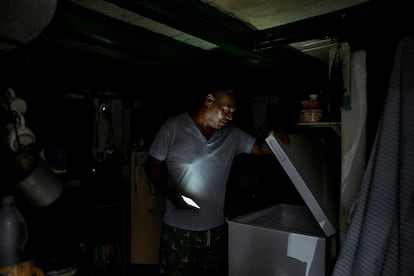

It was only a matter of time before Cuba would be completely in the dark. Like a dying man, the country began shutting down over the weekend: first, the eastern provinces of Las Tunas, Granma, Holguín, Santiago de Cuba, and Guantánamo were plunged into blackouts. Power outages were also reported in Matanzas and Havana. And on Wednesday, news emerged about the collapse of the national energy system. This isn’t even the first time, but the fifth one since the massive blackout of October 18, 2024, when the island became a blind spot in the Caribbean Sea for several days.
Despite the almost daily power outages, some lasting up to 18 hours, and the constant failures of the Antonio Guiteras thermal power station—which has become a laughingstock due to its frequent breakdowns—it can hardly be said that Cubans are accustomed to spending many hours without electricity. Although this is a situation that the island’s inhabitants have experienced since the early 1990s, it has gotten worse in recent years. Few things arouse the population’s anger as much as a blackout, because it brings stifling heat, mosquitoes, food that begins to spoil, no gas for cooking, a dwindling water supply, and children struggling to get to school.
So when the Cuban Electricity Union (UNE) confirmed that the grid had “completely failed” at 9:14 a.m. on Wednesday, the situation had already exhausted Cubans’ patience. “Go away, all of you, it’s what you need to do now”; “I’ve developed anxiety due to the daily stress, it’s 2025 and nothing’s improving”; “How much longer? Please think of the people, at least once in your life,” some users wrote on X.
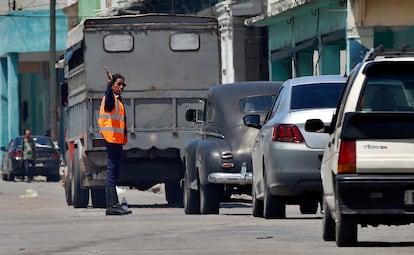
A failure in the largest power plant
In a brief statement, the Cuban Ministry of Energy and Mines said that, although the causes were still being investigated, the blackout could be associated with “an unexpected shutdown” at Guiteras, the country’s largest thermal power plant. They also assured that they would begin the process of restoring electricity. “We have a well-defined strategy to address this situation,” Cuban Prime Minister Manuel Marrero said on X, adding that they would work “in the shortest possible time to restore the system.”
Just after 3 p.m., the UNE reported that they had more than 200 megawatts in microelectrical systems distributed throughout the country, and that they had prioritized essential locations such as hospitals, bakeries and water pumping stations. President Miguel Díaz-Canel—whom people were asking about, since he hadn’t commented on the situation—emerged hours later with a post on X saying that they were “working hard” and that each province was taking its own measures to restore electricity.
Even so, Cubans live with the knowledge that it’s just a matter of hours before the next blackout hits. Massive or not, this is the daily routine on an island where experts see no possible solution in an aging and completely deteriorated electricity system, lacking the necessary maintenance and infrastructure. This is compounded by the fuel shortage in a country that lacks the foreign currency to guarantee electricity in every Cuban home. Experts have estimated that overhauling the electrical system would cost between $8 and $10 billion.
Jorge Piñón, an energy expert who predicted the blackout in October of last year, told EL PAÍS that, despite the temporary fixes the government put in place to overcome the immediate collapse, he did not see a change in the Cuban electricity sector possible until the government “changes its economic model, decentralizes the economy, and allows open investment,” something that, he warned, could take years. “That doesn’t happen overnight.” Neither the oil coming from Venezuela or Mexico, nor the aid coming from China and Russia is sufficient for a country in a systemic crisis.
Some Cubans manage to cope with the electricity shortage with solar panels or generators, often purchased by relatives abroad. Others, on the verge of desperation, have taken to the streets in protests that are quickly silenced by the authorities. This Wednesday, the official UNE account was forced to deny that the official institution was inciting Cubans to take to the streets, as recently happened in Nepal, after messages circulated on social media comparing the situation in Cuba with that Asian country and calling for Cubans to take the island by force.
Sign up for our weekly newsletter to get more English-language news coverage from EL PAÍS USA Edition









































