
Cuban political prisoner Duannis León Taboada has been on hunger strike for over 10 days
‘I’m preparing for the worst,’ says the 26-year-old’s mother. Earlier in July, Yan Carlos González González died in another prison after going more than 40 days without food in protest against a sentence he considered unjust


Duannis León Taboada has always been, as they say, a good eater. He empties his plate, never complaining about whatever is put on the table. When he was a baby, his mother, Yenisey Taboada, breastfed him for hours, but he almost always went hungry. At eight months old, his eyes lit up when he tasted a mango for the first time. At one year old, he was already eating chunks of sweet potato. Of all things, he always preferred milk. When his mother asked him what he wanted her to bring him on visiting days in jail, the political prisoner always replied milk; he could do without the rest. Hence Yenisey’s anguish, as she has always enjoyed the hearty eating of her “child,” who fed him and watched him grow, until the Cuban government imprisoned him. Now, without knowing exactly how Duannis is doing after a hunger strike of more than 10 days, she too can’t eat anything, surviving on tea and natural juices: “I haven’t been able to eat anything; I can’t get a bite down,” she says. “It’s impossible for a mother to eat knowing her child isn’t eating, and the danger that represents.”
Taboada’s hunger strike is the latest in a Cuban prison; the final gesture of a political prisoner for himself and for the rest of the inmates in the same situation. Duannis, 26, went on strike on July 18 at Combinado del Este prison, on the outskirts of Havana, almost 10 days after fellow political prisoner Yan Carlos González González, 44, died in La Pendiente prison, in the center of the island, after more than 40 days on hunger strike for a 20-year sentence he considered unjust. In a country where people complain of food shortages, the prisoners left behind by politics find no other way than to spread the message of hunger, of their own bodies slowly dying.
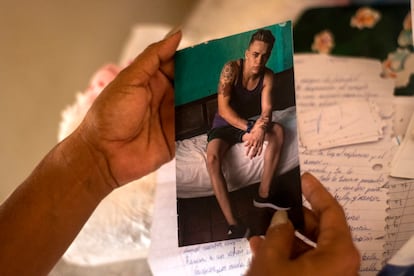
In recent days, Duannis has refused to eat the food his mother brings him every month, but in reality, he had stopped eating prison food much longer ago, perhaps as long as two and a half years. One day, he went with a small bowl to pick up the prison dinner, and the head of discipline in Building 1 — where the young man is held on the first floor, in a space intended for about 25 people — told him he wasn’t allowed and threw the container in the trash. “From then on, he abstained from eating regime food; he only eats what I bring in his jolongo (a cloth bag),” says Yenisey, 43, from her home in Havana.
Two weeks ago, Duannis told her he’d had to share food with other inmates, and that it hadn’t been enough. “So how are you going to manage?” she asked. His response was straightforward: “Don’t worry, I’ll survive.” Shortly afterward, she learned that her son was on a hunger and thirst strike. On July 21, after a call they were allowed when Yenisey “showed up” outside the prison, the mother “begged” him to at least drink water. Duannis agreed. “I heard him sound extremely weak. He apologized for making me feel this way, and asked me to please understand. He told me: ‘That’s enough, Mom. Justice and freedom.’”
She asked him why he was doing it, why he was exposing himself to so much, if anything in particular had happened to him. “He told me it wasn’t anything specific, but everything that had happened to him during his four years of unjust imprisonment. He said he couldn’t take it anymore, that he was doing this for all the prisoners and for all their families.”
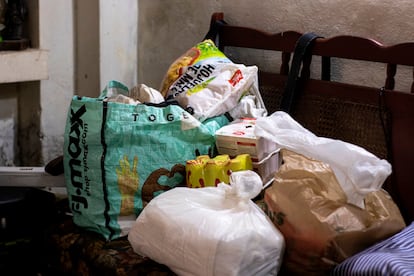
After several days of not knowing how her son was doing, the prison warden promised Yenisey that he would take her to see him in person. On Thursday, she says she was tricked by the guards: “I thought I was going to see him, but they took me out and put me in a patrol car to the local police station in Guanabacoa, far from the prison,” she says. Now she is waiting for State Security officials to allow her a meeting to convince Duannis to abandon his strike.
“When he makes a decision, it’s because he’s thought it through a lot and followed it through to the final conclusion,” she says. “But I hope his mother’s love and the respect he has for me will make him reflect. I hope I can get him to end the strike.”
“They locked me up when I didn’t even know who I was”
For four years, Yenisey has seen her son once a month, 12 times a year. On July 11, 2021, during the popular protests, her son was at a bar with some friends. It was a Sunday. Duannis was taking a break from his job as a barber, the trade he learned aged 13 to ease his mother’s financial burden and help with his three sisters. He worked in the house he built himself on a small piece of land Yenisey gave him in the Víbora Park neighborhood. He had decided to take a job and leave aside his profession as a metrology, standardization, and quality control technician. That was his day off, and he was going to watch a soccer game.
At some point during the day, the riot broke out in the La Palma neighborhood of Arroyo Naranjo, and Duannis joined the crowd that crossed Havana’s main thoroughfares until they were attacked by police at Esquina de Toyo in the Diez de Octubre municipality. The demonstration there produced one of the images that would remain in the memory of the Cuban protest: an overturned police car in the middle of the street, disobedience like nothing Cubans had seen in recent history.
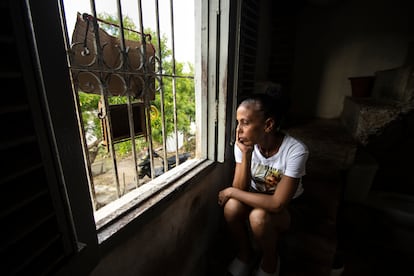
That day, Duannis slept at home. On July 16, as he was heading to his girlfriend’s house in the Santa Amalia neighborhood, plainclothes officers approached him and, according to his mother, beat him and arrested him in the most violent way possible. A neighbor called Yenisey and told her that her son had been taken. The mother couldn’t locate him; no one knew his whereabouts. Two days later, she learned that he was being held in the Cien y Aldabó prison, one of the more than 1,000 people detained after the protests. He was then transferred to the Valle Grande prison and later to Combinado del Este, where Yenisey has been able to see how much her son, who was imprisoned at 22, has changed. He is now almost 27, and if the 14-year sentence imposed by the government for sedition is served, he could leave prison at 36, a completely different person from the one they took away.
“Sometimes I tell him, ‘how you’ve grown. I thought you weren’t going to grow anymore. You’re older, you’re beautiful. I’ve missed out on so many things,’” his mother says. On other occasions, he has responded, “Mom, they didn’t even let me start a family. They locked me up when I didn’t even know who I was.”
Prison — where Duannis has staged other protests demanding his freedom, and where he has suffered beatings and abuse that have weakened his health, already deteriorated by a kidney condition and blood pressure problems — has also shaped the young man’s character over these years. Before, he spoke in a rapid-fire manner; now he speaks very slowly, as if he truly had all the time in the world. Sometimes he draws, sometimes he writes his poems. His mother says he has also become more analytical. “He tells me that, for him, even stones are important now, or a bird, or the little bit of sun he sees. The only good thing he can take from all this is that he has been taken to the true university of man, being with so many people, with different personalities. He once told me: ‘Mommy, here where souls leave and abandon you, you learn to speak with your eyes, you are able to decipher people’s gestures.’”
On Monday, Yenisey received a call from State Security agents. They promised that they would allow her to see her son this Tuesday morning. She says she wants her son to live, but she’s preparing “for the worst.” “I’m praying to God to give me the strength necessary for the worst-case scenario. I know my son and I know he’s very strong, but we’re talking about real medical matters. I’m preparing for the worst and praying for the best. I want him to understand that life is the most important thing in our hands, that if we have life, we have everything.”
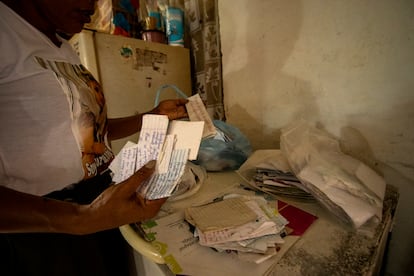
The mother has been informed by officials that her son is fine, but she knows that others have died in similar circumstances without anyone knowing exactly what happened. Johanna Cilano, Amnesty International’s Caribbean researcher, told EL PAÍS that “a relevant element” regarding the situation of human rights violations in Cuban prisons “is related to the lack of truthful information, opacity, the absence of scrutiny mechanisms, the lack of recognition by the Cuban authorities of the existence of human rights organizations, and the lack of commitment by the authorities to international mechanisms to ensure that prisons can be visited and that the abuses and human rights violations that occur there are effectively investigated and punished.”
Yenisey is horrified to know that her son will have to spend 14 years in a Cuban prison, but she says Duannis has already prepared for the worst. What he’s afraid of is not knowing how to deal with the country he’ll find upon his release. “He’s told me many times that what he feels is fear of freedom, of being on the streets, that he’s not ready for that right now.”
Sign up for our weekly newsletter to get more English-language news coverage from EL PAÍS USA Edition









































