
The punishment for protesting in Cuba: Beatings, solitary confinement and sleep deprivation
Human Rights Watch has gathered testimonies from those detained during the July 11, 2021 protests. Four years on, hundreds remain behind bars
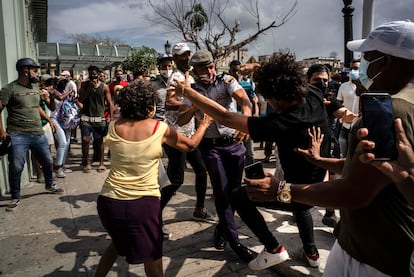

Beatings, solitary confinement, sleep deprivation, constant surveillance, lack of medical care, insufficient food, and unsanitary conditions. The punishments inflicted on detainees from the protests that began on July 11, 2021, in Cuba — which mark their fourth anniversary this Friday — span a wide range of abuses, according to a Human Rights Watch (HRW) report, based on the testimonies of 17 people who were held in six men’s prisons and two women’s prisons.
“Protesters detained for participating in the peaceful July 2021 protests in Cuba have been subject to serious abuses in prison,” says the HRW report.
The accounts of these political prisoners — who were released this past January thanks to Vatican-led negotiations with the government of Miguel Díaz-Canel, which also involved the United States — describe a systematic campaign of persecution behind bars. They report that they were beaten, subjected to unsanitary prison conditions, including completely inadequate access to food and water, and remained under constant surveillance and strict conditions, some of which appear to have been imposed informally. “Many fear being sent back to prison, and at least three of the people released have been rearrested,” states the report.
“Four years ago, the Cuban government unleashed repression on thousands of Cubans who peacefully took to the streets demanding rights and freedoms,” says Juanita Goebertus, Americas director at Human Rights Watch, adding that hundreds “remain behind bars in dismal conditions.”
According to the report, “numerous former detainees described physical abuse by prison guards. They said that guards beat them for shouting anti-government slogans or protesting about prison conditions. Many said they were subjected to stress positions such as ‘the bicycle’ (also known as the ‘wheelbarrow’), in which prisoners are forced to run, handcuffed, with their arms raised above their heads.”
One of them, José Daniel Ferrer, leader of the opposition movement Cuban Patriotic Union (UNPACU), recounts that prison guards tried to take him to the hospital at Boniato prison in Santiago de Cuba due to an arm injury. The activist says he refused to go because of a tuberculosis outbreak. The guards responded with violence: punching his head and injured arm.
“I was bleeding all day, from the wound,” Ferrer recounts, saying that they forced him to do “the bicycle” before making him get into a vehicle to be taken to the hospital. The same political prisoner also recalls what happened in December 2022, when seven guards beat him for shouting “down with [President Miguel Díaz] Canel, down with the tyranny” during a family visit. “I was lying on the floor, [a prison official] kicked me and fractured my nasal septum, blood was coming out of my nose.”
“Inedible food”
The testimonies collected by the organization reveal recurring elements beyond physical assaults. Among them are overcrowding in the cells and limited access to food and drinking water for all detainees. “If your family isn’t bringing you food, you die,” says one former detainee. “The food they gave you was inedible. It had worms in it,” explains another.
Additionally, the accounts document outbreaks of scabies, tuberculosis, dengue, and COVID-19, which, according to the interviewees, went untreated. According to the HRW report, “those who protested said they were frequently sent to solitary confinement, or denied visits, calls, or access to packages sent by their family members.”
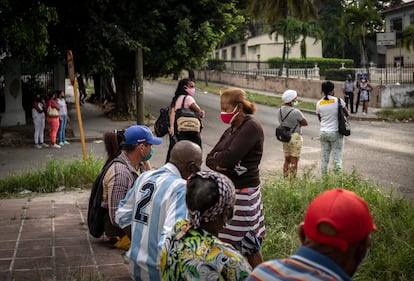
Many of the released protesters were forced to accept state-assigned jobs, they say, and to regularly report to security agents and request permission to leave their municipalities.
“At least in some cases, such conditions appear to have been imposed informally and arbitrarily, as they are not included in a written order or court-ordered conditions of release,” the report continues.
In other words, intelligence services, known as “state security,” keep the protesters under close watch. “Although I was released from prison, I am still a prisoner,” says one of the former detainees. “It’s like being a prisoner in the street.”
Sign up for our weekly newsletter to get more English-language news coverage from EL PAÍS USA Edition









































