
Why hundreds of women dance to Kate Bush every year on Wuthering Heights Day
Every summer there is a pilgrimage to the Brontë sisters’ hometown of Haworth in England, where participants do something that may appear ridiculous to some, and do it with absolute commitment
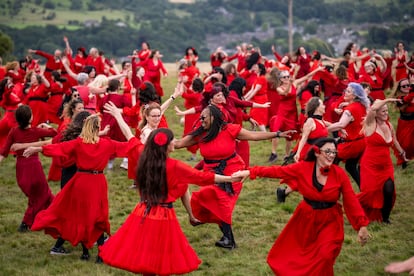

The Haworth moor, the birthplace of the Brontë sisters in the heart of the English countryside, was filled last weekend with women dressed in red. None appeared to know the others, yet all knew exactly why they had come: on July 30, a century and a half apart, Emily Brontë and the singer who turned her novel into music were born. In 1977, at age 18, Kate Bush wrote her song Wuthering Heights, named after the novel Emily Brontë published under the pen name Ellis Bell, and after watching the final scene of a BBC series: a hand coming through a window, featuring glass and blood. She only later discovered she shared a birthday with the woman who had written it. All those who dance are called Cathys, after both the novel’s heroine and the singer who gave her a voice.
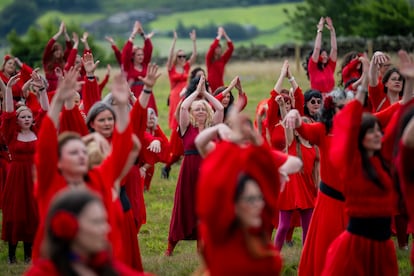
The Most Wuthering Heights Day is a joyful event. Every July it is danced in dozens of cities worldwide, with thousands of participants who mimic the choreography from Kate Bush’s music video: arms flung wide, sharp turns, hands pushing at the air… Its exaggerated theatricality seems to tell the story with the body and evoke Cathy’s spirit as she asks to be let in through the window. It is not a pretty or technical dance. It is strange, dramatic and a little ghostly. But it does not matter whether it is danced well or poorly because no one has come to show off; they have come to be part of the choreography. What began in Brighton in 2013 as a festival parody has accrued meaning until, in Haworth, it has become almost the opposite: a pilgrimage that brings together people from around the world on the actual land of Charlotte, Emily Jane and Anne Brontë. This year the 500 spots sold out quickly, and the proceeds will go to women’s organizations.
Pilgrimage to Haworth is not new. In November 1904 a very young Virginia Woolf climbed here and wrote about the visit in a London weekly. Sylvia Plath and Patti Smith, among many other women, signed the Brontë parsonage guestbook. For more than a century it has mostly been women who came here seeking other women. Woolf wondered whether this or other pilgrimages to writers’ homes were mere sentimentality, and answered that they are only justified when the place adds something to the books. With the Brontës, she concluded, the journey was worth it: Haworth and the sisters, she wrote, fit “like a snail in its shell.” It is impossible to separate the work from the place that produced it.
And it is true. Haworth today is something of a theme park, with magnet shops, literary-slogan t-shirts and the image of the three sisters repeated on every souvenir. A waitress at one of its cafés confirms it: more people have come following the latest film, written and directed by Emerald Fennell and released earlier this year, but the trend goes back much further. “The village has always received pilgrims,” she says. Yet when you step off the cobblestones and the moor wind blows down the street, something emerges beneath the merchandise: an energy that the literary souvenir shops cannot quite touch. Because Emily did not write about the moor: she wrote from within its logic, where love and cruelty are not opposites but the same untamed force. One could say there are no lessons in Wuthering Heights: there is force. The landscape is not a mere backdrop because it is the one in charge, turning people into geological accidents of its fury. That is why the place and the book, like the snail and its shell, cannot be separated.
The novel does not describe this land; it is made of it. The moor is not a pretty place: it is harsh, windy and seems to swallow people up. And yet from here came the work of three women who wrote out of narrowness, isolation and loss, without waiting for conditions to improve first, perhaps because they knew that was an impossible wish. The three signed their work as the Bell brothers (Currer, Ellis and Acton), keeping their real initials and adding a false surname, seeking just enough ambiguity so no one would know they were women. It was the condition for being taken seriously because, while the misty, sombre moor inspired their work, the world demanded they hide their authorship.
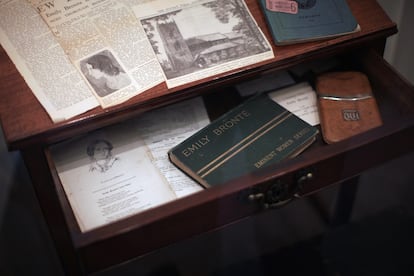
A century and a half later, one of its hills is full of women who hide nothing. They all wear the same red, and in that uniform they do not disappear: they recognize one another. Watching the dance, it is impossible not to think of the irony produced by a work created in the most extreme isolation, and how it continues to generate its own world a century and a half on. A short distance away is the Parsonage Museum where they lived, overlooking the churchyard and the church, but culture cannot be contained within a building; it is something reactivated in the living bodies of all these magnificent women, turning the moor into a sea of red mingling with the scent of heather in bloom, with mossy dry-stone walls and the undulating hills of the vast horizon.

One might think that dressed all the same they become a mass or mere crowd, and yet, when you see them, the opposite happens: without the common color, each would be just a lone woman like a flower in a field; with it, many discover they are both the same and different. The red does not erase anyone; it makes them appear together. And it is not, of course, an innocent color. Kate Bush did not choose red at random to embody Cathy. It is the red of the passion that pulses through the novel, the only color that refuses to go unnoticed against this tapestry of greens and browns. Among the women there is a man in a dark wig playing Cathy, and others adorned with a red flower at the throat. Red, ultimately, does not ask who you are: it only asks that you be there. What the Brontës had to hide is celebrated today with shouts on this astonishing hill by anyone willing to put on the dress.
There are people sitting on plastic chairs, a blue wheeled suitcase in the middle of the field, a table with things on it, some umbrellas and black coats over the dresses because it is a grey, rainy, windy day. It is not a perfect postcard: it is a real pilgrimage, with its disorder, its cold, its wait. And that is precisely what saves it from being kitsch. People have climbed a muddy field on a cloudy day to do something that appears ridiculous, and they do it with absolute commitment. There is dignity in the gesture, in that no one is posing for anyone. Emily, who wrote and described the moor as a force prior to any law, still summons the living. That is why she does not grow old.
Sign up for our weekly newsletter to get more English-language news coverage from EL PAÍS USA Edition









































