
A year of work by two Spanish mathematicians versus 88 hours and €15 million by OpenAI: ‘Without our idea, AI wouldn’t have solved it’
Diego Córdoba and Luis Martínez‑Zoroa’s research is the foundation of the announcement that artificial intelligence has solved one of the greatest enigmas in history. Both believe the achievement will radically change the discipline
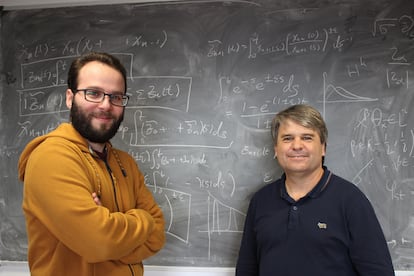

Mathematician Diego Córdoba had been awake for two days when he answered EL PAÍS’ call on Wednesday morning: “I’m still in shock, honestly,” he says, and admits he can’t say how he’s feeling when asked. On Saturday night he received a call from a U.S. number he didn’t pick up. At 8:00 a.m. on Sunday, he got a dozen emails with the same subject line: “Diego, you have to talk to so-and-so. Diego, stay alert.” Someone was meant to call him before he woke up and saw “all this,” says Córdoba, a researcher at Spain’s Institute of Mathematical Sciences (ICMAT).
“All this” was OpenAI’s announcement that one of its models had solved the Navier–Stokes equation, one of the so‑called Millennium Problems — seven complex mathematical challenges selected by the Clay Mathematics Institute, each carrying a $1 million prize for a solution. “All this” also referred to the controversy that arose because the method the machine used was the one that Córdoba had developed with Luis Martínez‑Zoroa, a researcher at Spain’s CUNEF University. The scientific community has recognized both as the originators of an innovative idea that paved the way for the AI’s “brute force,” as Córdoba calls it, to finish the job.
Martínez‑Zoroa, who only learned about “all this” on Monday morning, has not yet been able to read OpenAI’s 166‑page study carefully. “I skimmed it. There are things in it that do remind me of the strategies we developed, but the notation is unfamiliar to me. Until we study it properly it’s hard to know whether it really leans heavily on our approach,” he explains.
The whole mess began when Tristan Buckmaster, a mathematician at New York University and also a Navier–Stokes expert, posted a letter on his website explaining that OpenAI had contacted him. The company had learned about his private, unpublished research in the previous week and told him they already had “a proof” of the solution before reaching out, offering him the choice of a joint publication or of letting him publish the result himself while attributing it to an OpenAI model. The company also asked that his collaborator Levent Alpöge, from rival firm Anthropic, be excluded.
No one warned Córdoba — neither OpenAI nor Buckmaster, with whom he often crosses paths at conferences (he invited him to Madrid a year ago, he says). To understand what happened, one must go back to the research Córdoba and Martínez‑Zoroa have been carrying out since 2023. Their method builds a cascade of vorticity — the measure of how much a fluid spins or rotates at a point in time — made up of a sequence of structures at progressively smaller scales. Each layer generates a velocity field that amplifies the vorticity of the next layer, producing a cumulative mechanism that eventually causes a finite‑time singularity or blowup. Rough forcing allows the cascade to be maintained and coordinated without itself introducing the singularity. The major challenge is precisely tuning the geometry, scales and interaction among the layers.
What Buckmaster and Alpöge did was take that same method and automate the search phase instead of tuning the scenario themselves. OpenAI then went further, deploying overwhelming resources. Córdoba sums it up with one figure: the tokens (the smallest unit of information for a language model) the company consumed for its demonstration, he estimates, are equivalent to spending about €15 million ($17.4 million). According to OpenAI, it used 10,000 agents over 88 hours. “That’s what Luis and I have done in a year with what the ministry pays us, and we’re delighted,” he says, laughing.
Martínez‑Zoroa admits he doesn’t know how long they would have taken to solve the problem without the AI’s intervention, or whether they could have done it at all: “We might never have gotten there. We’ve been working on this problem for years and progress has come in drips. Occasionally there was an epiphany. It could have been in one year, in two… or it might never have happened. As things stand, it seems we’ll never know,” he reflects.
Fields Medal?
Buckmaster explicitly acknowledges that his team did not contribute mathematically to anything: they simply took Córdoba and Martínez‑Zoroa’s method, implemented it in the AI and let the system find the scenario. He even publicly asks that the Fields Medal (the most important prize in mathematics) go to Martínez‑Zoroa. For Córdoba, that ship has sailed: the Fields Medal is only awarded to mathematicians under 40. “I’m already past that,” he says. Martínez‑Zoroa, who today sounds like the first genuine Spanish candidate for the medal, responds cautiously: “Honestly, I see it as very unlikely. There are so many talented young researchers out there. I’ll keep doing my best on my projects. If I’m awarded it in a few years, it would be a very pleasant surprise, but I’m not counting on it at all.”
Córdoba has long joked: “I don’t use AI: I have Luis.” He calls Martínez‑Zoroa “a phenomenon.” What the AI has done, he repeatedly insists during the conversation, is “to buy time, not to produce new ideas.” Martínez‑Zoroa shares that underlying view and adds a warning: if an AI can take any scientist’s idea and, in a few hours, solve a problem of this magnitude, what incentives do researchers have to publish their results? “This is clearly a danger in mathematical research today. I know cases of people who explained a problem they were working on to another member of the community, and that other researcher finished the project with the help of AI without giving any credit. We need to rethink how we assign credit from now on, and honestly I have no idea how to do that,” he says.
Córdoba is more optimistic: in nearly 90 years of attempts no one had found a working idea to prove that the Euler or Navier–Stokes equations could be solved. That void was not filled by a machine. It was filled, in 2023, by a new method — theirs: “If our work hadn’t existed, the AI would not have solved the problem.”
Córdoba does not downplay what has happened; far from it: he speaks of a “revolution” when asked what this news changes. He acknowledges that from now on “you have to work with AI.” His reason is almost tactical: if it takes you five years to solve a problem, in the meantime a competitor can solve similar problems in a month with the help of a machine. He believes AI does not change the ideas needed to advance the discipline, but it radically alters the timelines — and with timelines, the competition that is crucial in science to publish first.
Asked whether this means the end of hand‑crafted proofs, he is blunt: no. The proof, he says, will remain a manual effort. What AI brings are two very concrete things: rapid access to information (library work that used to take him weeks is now resolved in seconds) and execution speed once a method to apply already exists. What AI has not done, and what he does not believe it will do soon, is find an idea that does not yet exist. When asked whether an AI will one day have that kind of original thought, he won’t venture an answer, nor does Martínez‑Zoroa, who thanks Buckmaster for publicizing their work. “He didn’t have to defend us publicly to make clear that the ideas came from our group. That speaks highly of him.” Córdoba, for his part, says he is “happy”: “Mathematicians are recognizing my work and Luis’s. It’s something to be pleased about.”
Sign up for our weekly newsletter to get more English-language news coverage from EL PAÍS USA Edition









































