
Abdul El‑Sayed, a progressive, wins Michigan Senate Democratic primary in key battle for party’s future
Critical of Israel and a proponent of universal public healthcare, the contender scored a narrow victory in the swing state after an all‑night count
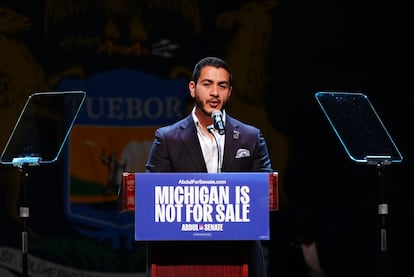

Abdul El-Sayed has won Michigan’s Democratic nomination for U.S. Senate, defeating U.S. Rep. Haley Stevens with 48.5% of the vote, both CNN and the Associated Press reported, calling it “a massive victory for the party’s progressive wing in a battleground state.” The close race reflects how divided the party is, as well as the rise of a leftist wing that demands change.
The 41‑year‑old physician, the son of Egyptian immigrants and a representative of the Democratic Party’s progressive wing, has landed a blow in the debate over the future of Democratic opposition to Donald Trump by defeating Haley Stevens, who had the backing of the party’s heavyweights as well as special interest groups. El-Sayed’s campaign said Stevens called to concede Wednesday, according to AP.
The vote shows that the rise of young left‑wing (and even self-styled socialist) politicians is not confined to liberal strongholds. The wave that Zohran Mamdani began last year with his win in New York has spread to a swing state like Michigan, where either Republicans or Democrats can hold sway. El‑Sayed’s victory confirms that the party of Barack Obama and Joe Biden is entering a new era in which the old rules no longer apply.
The hardest part still lies ahead for El‑Sayed. After beating the centrist Stevens, he will have to prove in November that a candidate like himself — a Muslim and a proponent of ideas that were until recently viewed as radical — can defeat the Republican candidate in the midterm elections. If he were to succeed, he would become the first Muslim senator in U.S. history and join figures such as Senator Bernie Sanders, Representative Alexandria Ocasio‑Cortez and Mayor Mamdani on the list of leaders changing the face of the Democratic Party.

El‑Sayed does not describe himself as a socialist, but he champions causes largely associated with the left. He rose to prominence in Michigan on platforms such as ending unconditional U.S. aid to Israel — which he accuses openly of genocide in Gaza — and advancing universal public healthcare. He combines that message with a personal magnetism, and is often seen wearing a fitted black T‑shirt in videos that show him lifting weights in a gym or dancing in a cowboy hat to Taylor Swift’s You Belong With Me. His campaign team likely studied how Mamdani’s videos went viral during the run that elected him New York mayor last year. Now another progressive has once again found the formula to win over voters.
With this victory, El‑Sayed has defeated the party establishment in Michigan, led by Governor Gretchen Whitmer and Senator Gary Peters, who backed his rival. He has also challenged the American Israel Public Affairs Committee, a lobby that spent about $30 million on this race — the largest sum ever poured into a single contest. It appears to have had little effect.
Accusation of antisemitism
In the final stretch of the campaign, Representative Stevens made a tentative charge of antisemitism against El‑Sayed — “Everyone in America understands you want to blame all of your problems on Jewish Americans” — and accused him of seeking only “fame and, probably, money” in his political career. But it was already too late. El‑Sayed had managed to establish himself as a breath of fresh air, someone who cares about people’s real problems and about ending the influence of dark money in elections, in contrast to the old style of politics Stevens represented.
Primaries were held Tuesday in states including Virginia, Missouri, Kansas, and Washington. But all eyes were on Michigan, perhaps the most consequential contest ahead of the elections that will define the second half of Trump’s term. Attention was intense for several reasons. First, because they were taking place in an important state that is neither solidly Republican nor solidly Democratic, making it a useful barometer of where a vast, diverse country like the United States stands.

Second, because the seat at stake is crucial if the Democrats hope to wrest control of the U.S. Senate from Republicans. It is not mathematically impossible, but if the Democrats lose Michigan, the prospect of retaking the upper chamber would become very, very difficult.
And third, because El‑Sayed’s victory confirms another trend that had already been evident: Americans are increasingly distancing themselves from Israel.
All of these signs had already been observed in other states, but they are now being confirmed in Michigan, with repercussions that will need to be assessed in the coming days. The Democrats will have to show unity so that El-Sayed — if his victory is confirmed — is elected to the Senate in November if they truly want to mount a serious opposition to Trump from Congress. But to do so many will have to defend someone they, until very recently, considered a radical. It remains to be seen whether everyone is willing to swallow that bitter pill.
Sign up for our weekly newsletter to get more English-language news coverage from EL PAÍS USA Edition









































