
Blade, Marvel’s cursed hero: ‘He always seems on the verge of becoming a major star, but never makes that definitive leap’
While Spider‑Man or Wolverine enjoy reboots, the film and video game projects of the Black vampire hunter created in 1973 languish in a limbo of delays and rumors
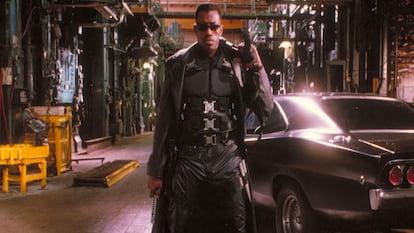

There are Marvel characters that seem to be a guaranteed success. Spider-Man is enjoying a renaissance, Wolverine is preparing his long‑awaited return with a new, huge video game, and the Avengers promise to smash the box office with the December release of Doomsday. But then there’s Blade. Rarely has a character so significant had such bad luck: the vampire hunter (and half‑vampire himself) has spent nearly a decade featuring in teasers that never quite come to pass. A new film was announced in 2019 and still has no release date; a video game was unveiled in 2023 and has vanished. In between, there have been director changes, script rewrites, ballooning budgets and cancellation rumors that have left the public wondering whether we will ever see Blade on screen again.
“He’s an unusual character. He’s cursed, because he always seems on the verge of becoming a major star, but never makes that definitive leap,” says Jorge Iván, co‑director of the Celsius 232 festival of fantasy literature and the Avilés Comic Conference. “He was created by Marv Wolfman and Gene Colan as a secondary character and, being one of the first Black heroes with such a charismatic personality, other writers quickly began to use him,” the expert explains.
Blade’s ill-fortune is especially striking because we are not talking about a minor hero. The vampire hunter debuted in 1973 in the comic The Tomb of Dracula and, at a time when Black protagonists were still very scarce in mainstream U.S. comics, Eric Brooks — the character’s real name — became one of Marvel’s first major Black heroes. Over the years he evolved into the publisher’s premier vampire hunter. “There is a paradox with Blade,” Iván says, putting it in context: “His solo series have never done especially well, but he constantly appears in Marvel’s big sagas and events, like Civil War, Marvel Zombies, or the Ultimate universe. He has always been there, and he carries a lot of weight within the Marvel universe for a character who, in reality, has never had massive solo success.”
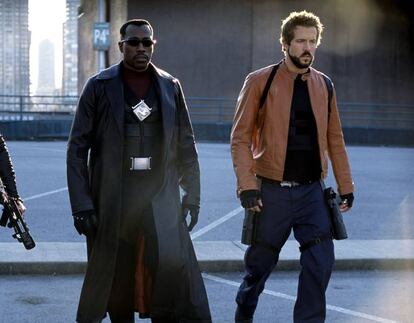
His importance goes far beyond the comics. The film trilogy starring Wesley Snipes, which began in 1998, proved that a movie based on a Marvel character could be a box‑office hit several years before the hugely successful Marvel Cinematic Universe (MCU) existed. Many genre historians, in fact, consider that Blade paved the way for later hits like X‑Men or Spider‑Man, changing Hollywood’s perception of superhero adaptations. But nearly 30 years on, the character is going through his lowest moment.
A film in limbo
Everything started at San Diego Comic‑Con in 2019. Kevin Feige, the all‑powerful head of the Marvel cinematic universe, made a surprise appearance to announce that Mahershala Ali would be the new Blade within the MCU. The announcement was met with enthusiasm: Ali is a prestigious actor — a two‑time Oscar winner — and Feige himself revealed that the actor had personally approached Marvel to propose playing the character. It seemed to be one of the studio’s most solid projects in its new phase. But nothing went as planned: over the following years the film went through multiple screenwriters, lost its original director Bassam Tariq and later Yann Demange, suffered numerous rewrites, and even shifted its entire focus. In some drafts, the story took place in different eras before finally returning to a contemporary setting.

The press also reported various internal problems related to budget and creative direction. Marvel seemed unable to find a version of the project that satisfied all parties involved, especially Ali, who demanded a truly good film that lived up to expectations. The release date was pushed back again and again until Disney decided to remove Blade from its schedule. Officially, the film is still alive but has no planned release schedule: it is simply listed as a project “without a date.”
A few weeks ago, Feige spoke about the matter with unusual candor: he said he felt “like a gigantic loser and failure” for not having been able to get the film made after so many years in development. A striking declaration coming from the president of Marvel Studios, a company that has successfully produced all kinds of projects this century. Still, he made clear that Marvel has not given up on the character and that the intention remains to make the film.
However, it now seems unlikely to be with Ali in the starring role. “Not with me, no offense to them,” the actor said last Friday in an interview with GQ, responding to Feige’s hints. “I’ve been doing this professionally for pushing 30 years now, and one thing I’ve learned is that what is for you is for you and what is not is not. For whatever reason, that project is not for me. If they wanted to do it, we would’ve done it. So I have to move on, and I have moved on,” Ali said.
A video game in the shadows
A proposed video game also seems not to have escaped the curse. Marvel’s Blade was announced during The Game Awards (the video game industry’s Oscars) in 2023 as one of Xbox and Bethesda’s major bets. The project was entrusted to Arkane Lyon, the acclaimed French studio behind Dishonored and Deathloop. The first trailer showed a Paris besieged by vampires and promised a third‑person action adventure with a wholly original story.
The choice of studio seemed perfect: Arkane had long shown tremendous talent and a predilection for dark worlds, so many fans felt Blade had found the ideal team. However, since that announcement almost nothing more has been heard: there is no gameplay demo or mechanics reveal, no development footage, no video of the game running and no approximate release window. Just that trailer from years ago and a brief comment from Bethesda Game Studios director Todd Howard, who in June told Entertainment Weekly that he had recently seen what Arkane Lyon’s Deathloop team was preparing. “I’m not at liberty to say when [we’ll see more],” Howard said. ”But I saw some stuff just yesterday [on May 21] and the folks at Arkane are doing a really, really great job.” In other words: nothing, for a project that various analysts estimate has already cost more than $100 million. Meanwhile, other Marvel game projects have continued to move forward, such as the successful Marvel’s Spider‑Man franchise and Marvel’s Wolverine, which is set to launch in September.
In fact, during the widespread layoffs and restructuring at Xbox in July, rumors even surfaced suggesting a possible closure of Arkane Lyon and cancellation of the project due to rising costs and accumulated delays. None of those reports has been officially confirmed and the game remains technically in development… even if only on paper.
A hero we’ve only heard from
“Blade has a very particular quality: when he seems to have vanished, he always ends up coming back. He’s one of those characters who reappears when no one expects it to reclaim the prominence many think he deserves,” Jorge Iván adds. Aside from Deadpool & Wolverine (2024) — in which Wesley Snipes returned to don the leather suit in a brief cameo full of humor and nostalgia — the most ironic part of this whole story is that Blade has indeed officially appeared in the Marvel cinematic universe. Or rather, almost.
In the barely 28 seconds of the post‑credits scene in Eternals (2021), supporting character Dane Whitman (Kit Harington) is about to lift a magical sword to begin his own superhero adventure. “Are you sure you’re ready for this, Mr. Whitman?” a voice off camera asks. Shortly afterward it was confirmed that the voice belonged to Mahershala Ali, in what was meant to be Blade’s introduction to the Marvel films. We’re still waiting: after seven years of announcements, rumors, delays and broken promises, that has been, to date, the only time the new Blade has made an appearance. The vampire hunter is threatening to become a ghost.
Sign up for our weekly newsletter to get more English-language news coverage from EL PAÍS USA Edition









































