
The epic life of Schwarzenegger, a bodybuilder-turned-legend: ‘If he had been born in the US he would be president’
The luxury art book publisher Taschen has created ‘Arnold’, a volume made in collaboration with the actor, bodybuilder and former governor of California that brings together the best images of a life beyond the limits of plausibility
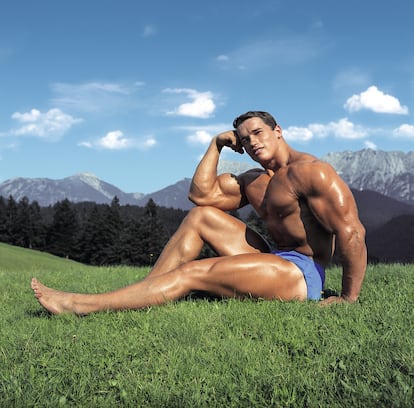

No matter how skeptical we may be about the American dream, Arnold Schwarzenegger’s personal story strains the limits of credibility as much as any of his most over-the-top films. That the destiny of Hollywood—not to mention California, the world’s fourth-largest economy all by itself—should be shaped for decades by an Austrian villager raised among the ruins of World War II would seem highly unlikely, were it not for the fact that the actor and former governor is so firmly ensconced in our collective imagination, his name pronounced by everyone with the same startling ease. Schwarzenegger, 79, is one of those individuals for whom the phrase “larger than life” seems to have been invented: for the scale of his achievements, his film career and his physical presence — 6ft 2in (1.88 meters) of chiselled muscle like a Greek statue.
It is therefore not surprising that the pictorial compendium of his life published by the prestigious German publishing house Taschen is also an over-the-top book, coming in at 11 lb (5 kg), an XL format (10.5in x 14.7in, or 26.7cm x 37.4cm) and more than 500 pages, featuring portraits by famous photographers such as Annie Leibovitz, Andy Warhol and Robert Mapplethorpe, now in a special edition. In fact, if it were a pocket read suitable for the beach, it would feel like a betrayal. The volume was coordinated by Dian Hanson, who between 2012 and 2023 worked side by side with Schwarzenegger selecting the photographs that make up the book, drawing on images from across his career, material from his personal archive and stillframes from his films. For the occasion, she also conducted a series of interviews with the star and his circle.
“When the world met Arnold, everyone wanted a piece of him, to photograph him and interview him. He was fun, charismatic, smart, and that made people start seeing muscles in a different light, which unleashed the bodybuilding craze of the eighties,” Hanson recalls in a video call. “We met in 1981. I was working for a New York magazine and was sent to cover the Mr. Olympia contest [the top bodybuilding competition, of which Schwarzenegger is a seven-time champion]. He was no longer competing; he was a judge, and we took a backstage photo. He put his arm around me for the picture, I turned to him, looked at him and was struck by his incredibly perfect skin, his face, his whole body…” The editor says that, every day since then, she has lifted weights inspired by the epiphany of that first encounter with the Austrian champ.
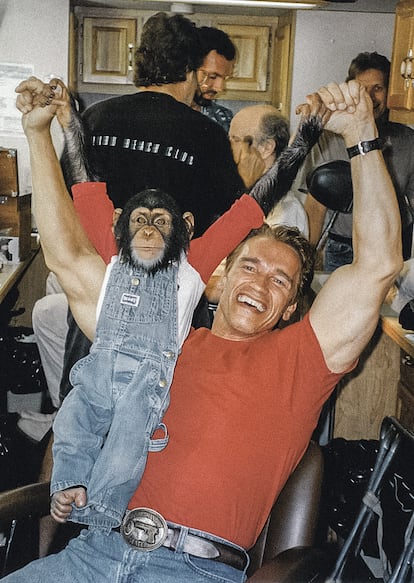
Hanson had coordinated other Taschen books on fantastic art and, in particular, the work of illustrator Frank Frazetta, whose universe, not coincidentally, makes Schwarzenegger read like a character in motion: Frazetta drew the most famous covers of the Conan the Barbarian books, the saga that cemented him as a movie star. But even before defining an era for Hollywood action films, his physical efforts broadened bodybuilding’s horizons. “Joe Weider [the creator of Mr. Olympia] and his brother Ben said Arnold made bodybuilding mainstream. Until then, their magazines were considered for gay men, the only ones who wanted to see guys like that in tight underwear and smeared with oil. But articles about Arnold — who was quite the womanizer — began to emerge that focused on his sex appeal, or about how to look like him to be more attractive. Suddenly it became a trend for picking up women.”
Schwarzenegger’s self-awareness did the rest. Not least, the autobiography he published in 2012, Total Recall: My Unbelievably True Life Story, which was full of homoerotic irony, including descriptions of the bewilderment his particular object of interest caused his family in rural Austria in the 1960s. “I had photographs of muscular men hung all over the wall behind my bed,” Schwarzenegger wrote in the book. “There were boxers, professional wrestlers, weightlifters and powerlifters. But mostly there were bodybuilders posing. I was proud. I arranged them so they looked very good, but that worried my mother a lot.” In 2016, in a different tone, he confessed that his father had beaten him for believing he was gay.
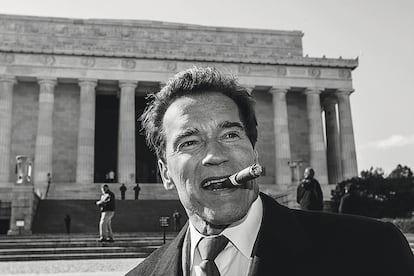
During the video interview with Dian Hanson, one could see in the background a cardboard display for Junior (1994), the comedy in which Schwarzenegger gets pregnant as part of a scientific experiment. Proudly, she says she bought it for $14 on eBay. A steal. “When I asked him about that film, he said he never hesitated to play a pregnant man or to cross-dress. He’s very secure in his masculinity, so he’s comfortable, he knows how to laugh at himself and he supports gay rights. Now there are men in the United States worried that masculinity is disappearing, who think everything is woke, when what they lack is Arnold’s masculinity—the ease and calmness of knowing who you are.”
Body and mind under construction
The book by Taschen was also featured in the Netflix miniseries of the same name, Arnold (2023), where the star reviewed the different phases of his career across three episodes: one about his bodybuilding years, another about his rise in the film industry, and the last devoted to his two terms as governor of California, from 2004 to 2011. Although he continued acting in sequels to his most lucrative franchise, Terminator (1984–2019), Schwarzenegger has not reached the heights of success in his late career that he enjoyed before entering politics. Dian Hanson believes this is due to several factors: on one hand, his age, and on the other, that part of the public possibly turned their backs on him because of his Republican positions.
In recent times, however, his public clashes with Donald Trump and his criticism of the anti-vaccine movement have earned him the enmity of more reactionary sectors. “Arnold is very centrist and over the years he has become more centrist,” says the book’s coordinator. “He’s nothing like the Republican Party that now controls the country. He’s very concerned about climate change and has tried to implement universal healthcare in California, because he came from Austria and that seemed normal to him.” Barack Obama used Schwarzenegger’s environmental policies as a model when he came to the White House. The actor, in turn, applauded the legalization of same-sex marriage in the U.S. under the Democratic president. On social media he has not shied away from displaying the rainbow flag, to the dismay of diehard followers, and his speeches warning young people about the dangers of the far right — recalling the Nazi past of his birth country — have been applauded internationally.
“If Arnold had been born in the United States, with the political stance he has, there is no doubt he would have been elected president by now. He represents exactly what we would all like to see: less division, more solidarity, more empathy, more humanity,” Hanson says. That conciliatory temperament, which made him a maverick within the Republican Party and enabled him to govern a traditionally Democratic state, is rooted in the culture of the Kennedy family, of which he became an illustrious member by marrying Maria Shriver, with whom he has four children; they separated in 2011 and divorced in 2021. She filed for divorce after discovering he had fathered another child as the result of an affair with a housekeeper.
In his autobiography, the actor addressed the matter publicly for the first time, apologizing to his family for the harm he caused. “He handled it as best he could, as anyone might. He has embraced that child and loves him; he has been seen publicly with him and going to the gym together. His other children are not too pleased, but Arnold insisted he had to appear in the book,” his editor and friend says.
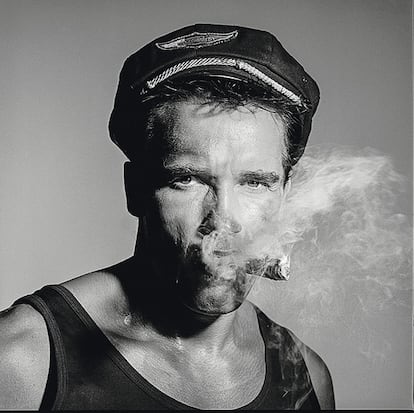
Across the more than four decades since she met him, Dian Hanson says she has seen the star transform and mature significantly. “At first, he was a very selfish person. He left Austria and went to the United States because he saw it as the place to succeed. He was only focused on himself, on achieving his goals, and nothing else mattered,” she recalls. However, since the late eighties, after being asked to run an activity using weightlifting for people with developmental difficulties, he has led a multitude of charitable projects, both personally (he is honorary chair of the Special Olympics) and through the Schwarzenegger Institute. Many he still carries out, the coordinator of Arnold says, “without any publicity.”
“I’ve seen him evolve and change because he has a unique quality of constantly examining everything. He never stayed stuck in any period of time, as happens to many. He genuinely listens to people when they speak, reflects, and that is how he has shifted his views on many things,” Hanson explains. Now approaching 80, the actor and former governor has grown more inclined to talk about his life and legacy in projects such as the book and the documentary. “He’s become more introspective in recent years, after the death of many friends. Lately he has insisted that he is not a self-made man, that all those people who have been part of his life helped make him. He also has a pig, a pony and a miniature donkey, and the first thing he does when he gets up is go out to clean the stables, feed them, groom them and let them into the house. According to him, it’s a return to his roots, as if he has closed the circle and embraced the poor Austrian village boy he once was.”
Another full-circle move scheduled is his return to the role that made him famous with King Conan, the third installment of Conan the Barbarian (1982), now in pre-production and helmed by Christopher McQuarrie, responsible for the latest Mission: Impossible films. Another project Schwarzenegger long dreamed of was a sequel to Twins (1988), in which the brothers played by himself and Danny DeVito would discover they have a third twin: Eddie Murphy. Asked about that film, Hanson does not believe it will move forward due to the death of Ivan Reitman, the original director.
In fact, Hanson has her own ideas about what Schwarzenegger could do next. “Looking at how things are going around here, many of us think that California should secede. We could carry on, have a better life and have Arnold as our president.”
Sign up for our weekly newsletter to get more English-language news coverage from EL PAÍS USA Edition









































