
Eric Clapton’s racist rant that changed British rock
Fifty years ago, Rock Against Racism was formed in reaction to a rising wave of far-right sentiment in the United Kingdom
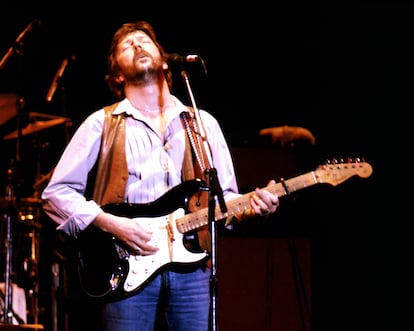
In the summer of 1976, the climate of hatred in the United Kingdom was rising faster than the thermometer. The far-right National Front kept growing — in the town of Blackburn it had just won 40% of the vote — and racist violence was increasingly entrenched on the streets. On August 5, 1976, during a concert in Birmingham, Eric Clapton delivered an infamous speech from the stage in support of the fascist leader Enoch Powell. Many believe alcohol or the substances to which Clapton was addicted (he recounted this in his memoirs and in several interviews) may have played a part.
“Do we have any foreigners in the audience tonight? If so, please put up your hands,” he said into the microphone. “So, where are you? Well, wherever you are, I think you should all just leave. Not just leave the hall, leave our country. I don’t want them here, not in the hall or in my country. Listen to me, man! I think we should vote for Enoch Powell. Enoch’s our man. I think Enoch’s right, I think we should send them all back. Stop Britain from becoming a black colony. Get the foreigners out. Get the wogs out. Get the coons out. Keep Britain white. I used to be into dope, now I’m into racism. It’s much heavier, man [...] Enoch for Prime Minister! Throw the wogs out! Keep Britain white!”
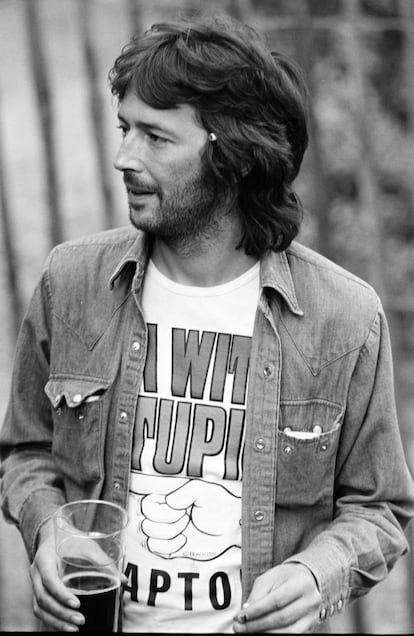
Concern about the rise of racism had led Red Saunders, a photographer and then a member of the theater troupe Kartoon Klowns, together with his friends Roger Huddle, Jo Wreford, and Pete Bruno, to think about forming a musicians’ organization that would be called Rock Against Racism. It was only a nascent idea until they heard Clapton’s speech. “We were sitting around in my photographic studio in Great Windmill Street, Soho, in August 1976. Someone came in all angry with the new issue of Melody Maker and said ‘Have you seen this about Eric Clapton?’ What we read was terrible, but since then I’ve heard a tape of what he said. It was far worse,” Red Saunders recalled in an interview. “I was shocked. I was a fan. I’d bought the albums and I’d seen him play.”
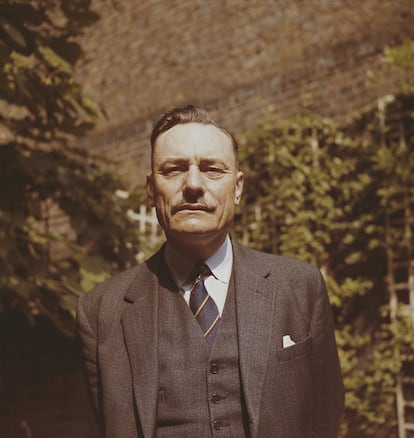
To add to the paradox, Clapton had just had a big hit with I Shot the Sheriff, his appropriation of a song by Jamaican artist Bob Marley. That enraged Saunders so much that he decided to send an open letter to several British music publications. In it he fired this barb: “Half your music is black. You’re rock music’s biggest colonist. You’re a good musician but where would you be without the blues and R&B? You’ve got to fight the racist poison, otherwise you degenerate into the sewer with the rats and all the money men who ripped off rock culture with their check books and plastic crap.” He went on in the letter to announce his intention to create a platform to fight racism in rock music and asked for support, leaving a postal address. Within weeks the appeal received hundreds of responses, and Rock Against Racism (RAR) began operating with groups across the country.
Clapton was not alone
In fact, Clapton’s outburst was not an isolated incident. Fascism seemed fashionable among many musicians of the time, even if often as a more or less frivolous provocation. Sid Vicious or Siouxsie often appeared with swastikas (though she later swapped it for the Star of David), and that aesthetic was also associated with Joy Division — although it’s notable that Ian Curtis’s band performed at a Rock Against Racism concert in Manchester in 1978. It was also in the summer of 1976 that David Bowie made a string of statements that left his fans bewildered. The most obscene came in an interview with Cameron Crowe in Playboy: “I believe very strongly in fascism. The only way we can speed up the sort of liberalism that’s hanging foul in the air at the moment is to speed up the progress of a right-wing, totally dictatorial tyranny and get it over as fast as possible. People have always responded with greater efficiency under a regimental leadership.”
He also opined: “Adolf Hitler was one of the first rock stars. Look at some of the films and see how he moved. I think he was quite as good as Jagger.” Later, a photographer captured him with his arm raised while riding in a convertible, although he always denied he was performing a Nazi salute.
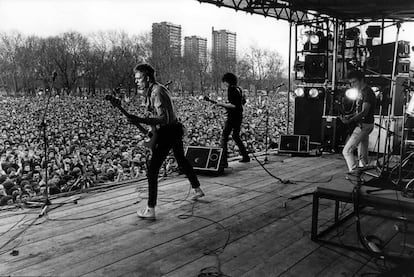
Rock Against Racism began modestly, in November 1976, with a concert at an East London pub headlined by jazz singer Carol Grimes and the reggae band Matumbi, and ended with a jam session featuring members of all the bands — a feature that became a hallmark of its events, which prioritized interracial musical collaboration. Concerts were organized across Britain with many of the best bands of the era, including the aforementioned Joy Division, Elvis Costello, Buzzcocks, Aswad, Gang of Four, The Mekons, Graham Parker, Stiff Little Fingers and Au Pairs. Some did not perform at RAR events but still showed support, such as the Sex Pistols. “I despise [the National Front]. No one should have the right to tell anyone they can’t live here because of the color of their skin or their religion or whatever the size of their nose. How could anyone vote for something so ridiculously inhumane?” said their singer, John Lydon. The movement even spread to other countries, including the U.S., Ireland, France, Belgium, the Netherlands, Sweden, Germany, Norway, Denmark, Australia and South Africa, where small groups were also organized.
The high point came in April 1978, with a march of 100,000 people that walked from Trafalgar Square to Hackney’s Victoria Park. There a free outdoor festival was held headlined by The Clash, X-Ray Spex and the Tom Robinson Band (a then-popular group whose leader was also the first openly gay, politically active punk musician). The event and its context are recounted in the award-winning 2019 documentary White Riot. In a time of disillusionment, that concert gave hope and purpose to the punk movement, then mired in nihilism. It revived the notion that popular music could be an engine of change and, in a sense, laid some of the groundwork for Live Aid, which would take place seven years later, albeit with a different goal. It also made being anti-fascist seem cool and helped precipitate the collapse of the National Front.
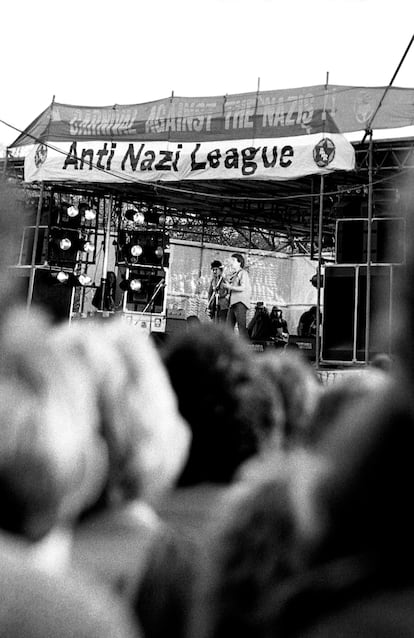
Skeptics of this narrative argue that it was actually Margaret Thatcher who neutralized the far-right party by adopting parts of its political agenda from power, but that does not diminish RAR’s achievements. As filmmaker Gurinder Chadha (Bend It Like Beckham) told The Guardian, the organization also offered hope to Asians and people of African descent who feared the nation was against them. “It was an incredibly emotional moment because for the first time I felt that I was surrounded by people who were on my side. That was the first time I thought that something had changed in Britain forever.”
Clapton apologizes
David Bowie quickly distanced himself from and expressed shame about his 1976 remarks, attributing them to his excessive cocaine use at the time and his then-obsession with Friedrich Nietzsche, and he donated a substantial sum to the Anti-Nazi League, another group that emerged alongside Rock Against Racism. Clapton, by contrast, did not clearly retract his comments until many years later. In fact, he was somewhat persistent in his position. In 2004, for example, he described Enoch Powell as “scandalously brave” in an interview with Uncut magazine, and he asserted that his country “was inviting people to come and work as cheap labor and confine them to ghettos.” In his 2007 autobiography he said he had been “deliberately unconscious” regarding the racial conflict, and evidence of that can be inferred from his interview that same year on the television program The South Bank Show, where he said he was not racist but still believed Powell’s comments remained relevant.
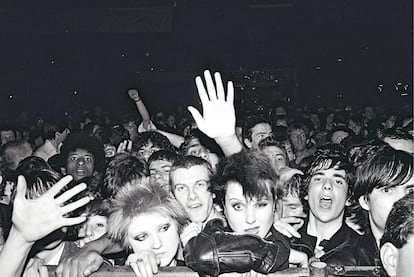
Finally, in 2018, he expressed clearer remorse during a screening of the documentary Eric Clapton: Life In 12 Bars, at which he said he regretted his “fascistic” outburst: “I sabotaged everything I got involved with. I was so ashamed of who I was, a kind of semi-racist, which didn’t make sense. Half of my friends were Black, I dated a Black woman, and I championed Black music.”
In recent years his political stance has drawn attention in other areas. For example, he has performed at benefit concerts for the Countryside Alliance, an association that strongly backs fox hunting. And in 2020 he recorded, with Van Morrison, the song Stand and Deliver, opposing lockdowns and mask mandates during the Covid pandemic. A year later he released the song This Has Gotta Stop, reiterating those themes and taking an anti-vaccine stance, arguing that such measures erode civil liberties. In 2022 he contracted the coronavirus and had to cancel several concerts. In 2023 he recorded the song Voice of a Child opposing the Israeli offensive in Gaza and organized a benefit concert for the children of Palestine.
Sign up for our weekly newsletter to get more English-language news coverage from EL PAÍS USA Edition









































