
José Flores, the 119‑year‑old from Costa Rica that experts are trying to certify as the world’s oldest person
The elderly man lives in poverty but in remarkably good health near a ‘Blue Zone’ that is rich in centenarians
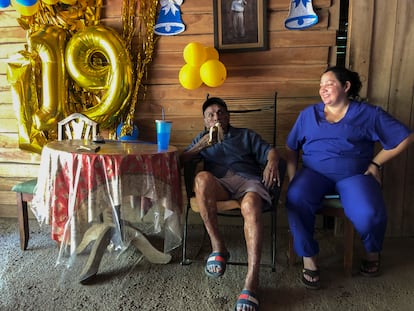
Costa Rica’s Civil Registry says that on July 11, 1907—119 years ago—a woman named Josefa in the province of Guanacaste, on the country’s north Pacific coast, gave birth to a boy who was christened José Flores Flores. Everyone born in that first decade of the 20th century, and many who were born years later, are now deceased. But Mr. José still lives in good health in a rural municipality on the edge of a “blue zone,” a name given to regions with unusually high numbers of centenarians thanks to healthy living conditions.
What the official registry of the Central American country does not report is that Mr. José is strong, that he has a smile on his face and muscles on his arms, that he sleeps well and eats as well as can be expected in a poor, rural household where he is cared for by family. He is, without a doubt, the oldest person in Costa Rica and possibly in the entire world — a potential record that still depends on certifications being processed by relatives with the help of a local organization and a Spanish researcher who does not hesitate to call Flores “an absolutely extraordinary case.”
We found him in his wooden-and-sheet-metal house located on someone else’s estate in the small village of Obandito de Sardinal, in the hot municipality of Carrillo, near the Nicoya Peninsula. It is part of Guanacaste province, where he returned in 2024 nearly a century after leaving to work on banana plantations in the south of the country, when the region was far from being the destination for the thousands of foreign tourists who now arrive each year drawn by its beaches — and by the rural environment that partly explains the abundance of local long-lived people.
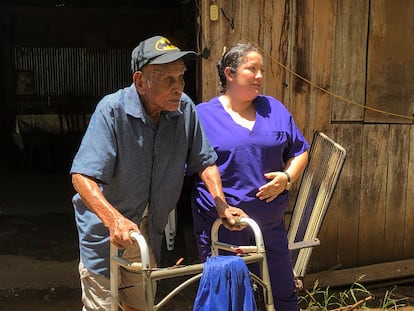
“Con toda la pata (doing great),” Flores replies to the greeting as he rests seated next to some balloons left over from a recent birthday party, after a breakfast of gallo pinto (rice and beans), fresh cheese and slices of fried plantain. Beside the table where he sometimes plays dominoes or cards, he greets visitors with a strong handshake and a slow but genuine smile. He is now famous in the village and beyond; his dark face appears in local media wearing the Batman cap that belonged to a son who has since died. He has trouble hearing and suffers from knee wear; he says he feels “worn and blunt,” comparing himself to a dull machete. He uses a walker to go outside and feel the breeze, listen to the parrots in the trees and greet neighbors, accompanied by his granddaughter Hellen Flores, who divides her time between caring for her grandfather and attending courses for eldercare because she has discovered a calling and a possible employment opportunity.
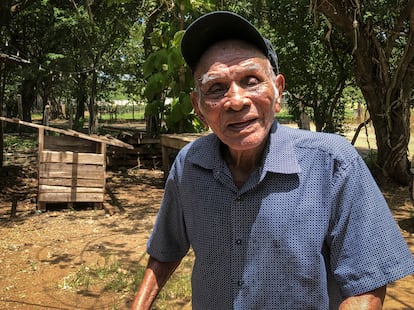
“Many people see grandparents as furniture; they feed them and clean them, but they are not always seen as people with full rights. Here, [José] has the final say over his belongings,” says the granddaughter, who decided to take charge of his care despite not having a fixed income. The family receives only about 150,000 colones a month (about $330), one‑eighth of the average household income in the country. Poverty has accompanied José since he was born in another Guanacaste municipality, where his grandmother raised him after he was abandoned by his mother and lost his father at age seven.
As a child he learned to work in the fields and, barely a teenager, migrated to earn his own money in the banana enclaves in the south of the country, in exchange for brutal workdays in conditions that no one would associate with a long, pleasant or healthy life, except for the advantages of daily physical exercise. Later, married with children, he moved to the country’s north, without ever having the wages to buy his own land. At one point the State was going to allocate him a plot, but he was almost 75 and did not qualify because no one believed he would be able to work it, his granddaughter recalls with a laugh. Now they live in precarious conditions despite various promises of decent housing never being fulfilled, but José always knew how to endure hardship.
“Work a lot, entrust yourself to God and eat healthy.” That is the key José gives. His wife, Ofelia, died at 71. “I can say he reflects that functional lifestyle of the region: family and community networks, organic food, constant physical activity and the calm of a simple life, a routine marked by sunlight, a spirituality tied to religion… it’s a mix of many things,” says Jorge Vindas, founder of the Península de Nicoya Blue Zone Association. This group promotes and protects this part of Guanacaste as a region with a high presence of centenarians, as recorded 20 years ago by U.S. researcher Dan Buettner when he launched an international project that also includes Loma Linda in California, Sardinia in Italy, Ikaria in Greece and the Japanese island of Okinawa. Singapore has recently been added, as a result of large government investments that neither Mr. José nor his granddaughter can possibly imagine.
Flores, however, is not a “product” of Guanacaste’s blue zone. Vindas jokes that “he just left for a century and came back.” The truth is he largely shared the province’s lifestyle, which is now undergoing deep changes accelerated by the tourism industry and an influx of new residents who are altering the environment and influencing locals’ habits. Almost two million travelers arrived directly at Guanacaste Airport in 2025; English-language signs line the roads offering services and properties. Tourism and property developments are displacing vast estates and agricultural plots. Very little remains of the subsistence economy that allowed certain generations to eat without consuming any processed foods, another health factor that specialists often emphasize.
“There are many ingredients in this salad called longevity. Genetics, diet, physical activity… now we have added human relationships and social connection. But there is no definitive answer that explains everything, because other people in similar conditions have died at much younger ages,” says José Antonio Rabadán, PhD in Gerontology from the University of Alicante in Spain and a researcher of the Guanacaste region in Costa Rica, where he has made more than 70 visits to centenarians.
Rabadán met Flores when the latter turned 117 and was impressed by his physical condition. “At 119 years there is no normal. These are cases we are only beginning to understand,” the researcher says of the man who at 113 still walked a kilometer every day to meet other older adults at a daytime center in the town where he then lived. Rabadán is optimistic about obtaining international certification for José. This is because the state registry is reliable, and he also has a copy of the baptismal record signed by Bishop Luis Leipod in 1907.
“There is a very complete file that, to us, gives every credibility to José’s life, with official and verified documents,” adds Rabadán, who is confident of a favorable response from the validating body, the Gerontology Research Group (GRG), a global organization founded in the United States that registers and studies supercentenarians, people older than 110. After that he might become a Guinness World Record holder, but he warns he prefers to take it step by step. So far the oldest living person is the Englishwoman Ethel Caterham, who will turn 117 on August 21, according to GRC data. As far as is known, the record is held by the Frenchwoman Jeanne Calment, who reached 122 years and 164 days and died in 1997.
Rabadán and Vindas know Flores is exceptional as an individual, but he is also part of specific Guanacaste generations with longevity advantages that are disappearing in newer cohorts, as noted since 2023 by the respected demographer Luis Rosero‑Bixby, founder of the Central American Population Center (CCP) at the public University of Costa Rica (UCR). The specialist warned, however, that those born before the 1930s still show exceptionally high longevity in this region of the country, which in any case has a higher life expectancy at birth than the international average (83.7 years for women and 78.6 years for men, according to official figures).
These high ages combine, however, with a national trend of declining fertility to just 1.1 children per woman, which accelerates population aging and strains the economy, the state welfare model and pension systems. The granddaughter Hellen, for example, has only one child, who helps her care for his great‑grandfather. “A nursing home? Over my dead body. Here we care for him between my mother, my son and me; this is his home and this is his family,” the woman adds as José smiles without taking his eyes off the television set, where he enjoys watching the 1960s U.S. series Bonanza. He says he enjoys arm sports and squares up to try a strength test with his left arm, his stronger one.
Sign up for our weekly newsletter to get more English-language news coverage from EL PAÍS USA Edition









































