
The engine of Costa Rica’s welfare system is in intensive care
Overcrowded hospitals, mile-long waiting lists, and warnings from the IMF are putting the Costa Rican Social Security Fund — the pillar that underpins the country’s stability — in jeopardy
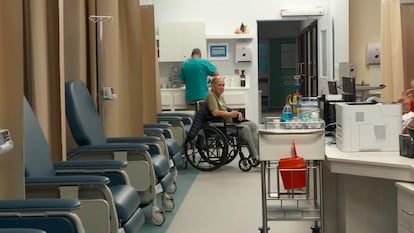
Juan Manuel Naranjo, a pharmaceutical sales representative, was 46 in 2022 when he suffered a heart condition that led to a stroke and a cascade of health problems that would have been enough to kill him — or at least leave him with crippling debt — for any middle-class person in Costa Rica.
“I would have been dead four years ago,” he says after one of his follow-up procedures at Calderón Guardia Hospital in San José, one of the state-run medical centers operating under pressure from overcrowding, complaints from many patients, and the fear of others that they may lose the public healthcare system that has been a pillar of well-being in the Central American country for decades.
“I love the Caja, it’s that simple — I love it,” he says, referring to the Costa Rican Social Security Fund (CCSS), the autonomous public institution in charge of the extensive network of public clinics and hospitals, as well as the main pension system from which Juan Manuel now benefits, as he is on disability retirement.
“It has big budgetary problems that show up in services, and it has a lot to improve, but the Caja is too valuable. Just one of the operations they did on me would cost up to 10 million colones in the private sector [nearly $22,000], impossible for me and for most people,” he says, stressing the importance of an institution that is fundamental to life expectancy in Costa Rica — over 80 years — and that now faces serious threats to its sustainability, as noted in a recent report by the International Monetary Fund (IMF).
A woman named Sandra P. left Oncology with a tired expression; inside, her sister is treated “like a queen.” “We come every week from Limón [on the Caribbean coast, about a four-hour drive] for the treatment they give her. This part is very good, though other things aren’t. Look, I was given an appointment for a scan in 2029; you don’t even know if you’ll still be alive by then.”
Inside, about 50 more people were waiting to visit relatives with cancer; the pharmacy line was long, and frustrated faces crowded the laboratory desk. And so it was in every department. The waiting list for radiological procedures in the country, like the one Sandra needs, exceeds 631,000 cases and, in some instances, the average wait time is 413 days, according to official data. As of May, there were 206,000 surgical procedures on the national waiting list, and at this hospital, the average wait for general surgery is two years.
Juan Manuel’s and Sandra’s concerns are shared by thousands of Costa Ricans who visit public healthcare centers, where more than 35,000 health workers are employed, even as many specialist doctors have chosen to resign in recent years following changes to salary scales. These concerns are also felt by a broad segment of workers — especially among younger and middle-aged people — who fear that the possibility of securing a pension to support them in old age may collapse, as the main retirement system is also under strain.
Both healthcare services and the main pension system (Disability, Old Age, and Death, or IVM) are managed by the Caja, the institution that for decades placed Costa Rica above regional standards. Public debate is rife with disagreements over the causes of the problems and their possible solutions, but there is consensus that the country would be very different without this autonomous body. Even with a budget exceeding 13.3% of GDP (more than $26 billion), funding is not enough, and political debates are intertwined with complex financial pressures that require urgent — and equally complex — measures, as the IMF has pointed out.
“Without additional reforms, the main pension scheme (IVM) is expected to run out of reserves by the mid-2030s,” warned the IMF report, pointing to the weight of the CCSS on the country’s social, fiscal, and economic balances in this nation of 5.2 million people, where more than 85% of the population is covered by its health or pension services.
The problem is that the solutions are not easy. The IMF acknowledges that contribution rates and monthly premiums are already high, leaving very little room for higher payments from both workers and employers, and shifting potential solutions toward benefit cuts.
Options on the table include reducing pension amounts or raising the retirement age (currently 65) to avoid accelerating the projected critical scenario for the IVM, which in December forced the CCSS to draw on its reserves to pay pensions to nearly 400,000 beneficiaries — a measure that had been planned for after 2040.
There are now fewer than five contributing workers for every retiree, a figure that stood at 30 in 1970 and is projected to fall to just 2.5 by 2050, when pensioners are expected to make up 15% of the total population. Fertility has halved this century (to 1.2 children per woman), making demographic trends one of the greatest risks to the sustainability of both pensions and healthcare services, with an increasingly smaller workforce.
Mounting debt with the social security system
But the threat goes beyond demographics. The central government has accumulated a multi-billion-dollar debt with the CCSS over the years; the institution estimates it to be nearly $9.5 billion (8.5% of GDP). Previous administrations at least acknowledged this liability, but President Rodrigo Chaves cast doubt on the figure and refused to pay down a debt to an institution he repeatedly described as “bankrupt.” The stance of his successor, Laura Fernández, has also been reluctant, though she frequently emphasizes the value of the CCSS. Authorities at the institution insist that it is not bankrupt, but do acknowledge that it faces an urgent financial situation.
“The Ministry of Finance and the CCSS continue to work toward a resolution of the disputed claims on the central government,” noted the IMF report. The agency says authorities have agreed to settle “certain past claims” with the CCSS and “are working to resolve the remaining claims.” However, the report warns that broader reforms are needed to ensure the long-term sustainability of the social security system.
The warning carries particular weight because, although it comes from an organization focused on economic objectives, it aligns with concerns voiced by trade unions and social groups that warn of efforts to weaken the CCSS in favor of the booming private healthcare industry — used mainly by wealthier households and, with considerable effort, by middle-class families, especially for less complex services and those most congested in the public system.
Fernández, by contrast, insists that she wants to rescue the institution, arguing that it has been “hijacked” by internal groups, pointing in particular to trade unions. She also laments her limited authority given the CCSS’s legal autonomy and the composition of its board, where nine seats are divided equally among the central government, business organizations, and labor representatives. She argues that this model is outdated because it was established in a very different era.
The CCSS is marking 85 years since its creation as part of a social pact among conservative, Catholic, and communist leaders, with a welfare-oriented approach that even withstood the wave of privatization that swept Latin America in the 1990s — driven by the same IMF that is now recommending cost-saving measures to extend the institution’s lifespan.
The IMF suggests increasing investment in primary care, improving preventive services, and adopting technologies to reduce healthcare costs, as well as refining procurement processes and reviewing coverage for expensive treatments. These recommendations, however, risk getting caught up in the increasingly contentious political debate over the public healthcare model, marked by growing clashes and recriminations, while the CCSS’s problems worsen day by day.
“The Caja will survive, but what kind of Caja and with what funding?” Nogui Acosta, finance minister under Rodrigo Chaves and current head of the ruling party’s bloc, told the local press.
His bloc holds enough votes to push through numerous legal reforms on its own, though many of them have yet to be proposed. “We have to start thinking about what new social contract the state can afford to finance and tell people we need to work toward that,” he added, aware that it is a sensitive — perhaps politically risky — issue, given that a significant portion of the population, like Juan Manuel, say they love the CCSS.
Sign up for our weekly newsletter to get more English-language news coverage from EL PAÍS USA Edition









































