
‘Luis Buñuel: 1.73 meters tall, freckles on his face’: The Spanish exodus to the Americas after the Civil War, told through 100,000 documents
The genealogy website MyHeritage houses a collection on the emigration to countries like Mexico, Argentina and Cuba by Spaniards who found themselves on the losing side of the Civil War
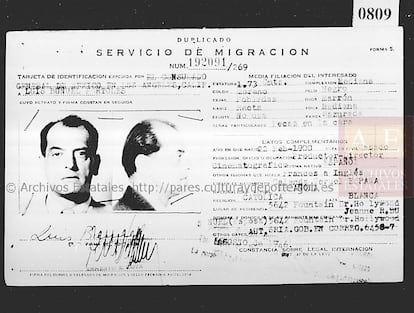

The Spanish filmmaker Luis Buñuel (1900–1983) was 1.73 meters tall, had thick eyebrows, a straight nose and some freckles on his face. At least that is his description on his identification card from the Migration Service of the Mexican Consulate in Los Angeles, issued in September 1946. The document features two passport-style photographs of the director of seminal films such as the surreal Un chien andalou, co-written with Salvador Dalí.
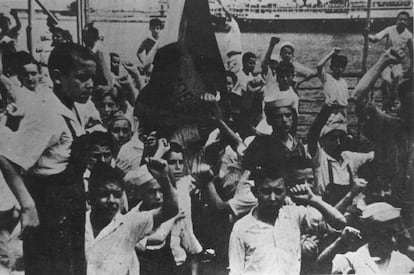
Buñuel had worked for the Government of the Second Republic during the Spanish Civil War on missions in Geneva and Paris. He had also taken part in the propaganda documentary España leal, ¡en armas! (Loyal Spain, up in arms!). After fleeing Francoist Spain and passing through the United States, he settled in Ciudad Juárez, Mexico, in 1946. It was in that country that he developed a key stage of his career, with movies such as The Exterminating Angel. The back of the document specifies that a residence permit was issued to him “for one year,” “renewable” and “as an immigrant to work as a film director” for a Mexican firm.
It is just one example of the documents housed on MyHeritage, a website that allows its users “to build their family tree, research their family past through historical documents and DNA evidence,” says MyHeritage genealogical expert Daniel Horowitz by phone from Israel, where the company is headquartered. Launched in 2003 and available in 50 languages, it has “tens of millions” of users worldwide. It offers other services “thanks to artificial intelligence tools, such as photo restoration and the analysis and transcription of historical documents,” Horowitz adds.
The collection on the Spaniards who emigrated to the Americas — a topic that has returned to the fore as 2026 marks 90 years since the start of the Spanish Civil War — was created in 2023 and comprises documentation with 109,037 records. Although the collection officially covers the period 1880–1930, it also includes later documents. MyHeritage is better known in the United States, “where there is a great interest in genealogy” in a country that welcomed millions of immigrants since its founding. All of its collections combined total “more than 40 billion records from around the world,” the company stresses.
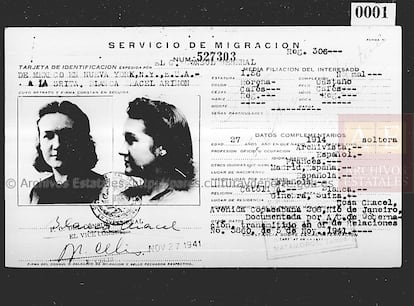
From the Spanish exodus, one can also trace the lives of interesting, though less well-known, people such as Blanca Chacel (1914–2022), an archivist and sister of the poet Rosa Chacel. Blanca belonged to the Board for the Seizure and Protection of the Artistic Treasury, created on July 23, 1936 by Spain’s republican government—just five days after the start of the war— for “the safeguarding of artistic, bibliographic and documentary heritage from the risks inherent to war,” recalls the website of Spain’s Ministry of Culture.
Chacel’s immigration card, from November 1941, describes her as a woman with “brown hair, brown eyes and single.” Another document, from a month earlier, shows her on a passenger list arriving at Ellis Island, in New York. It was there they entered U.S. territory and had their papers and health inspected to determine whether they would be admitted or rejected.
Another woman linked to the arts was the surrealist painter Remedios Varo, who began her exile on a familiar date: Christmas Eve 1941. She was living in Paris when the Nazi invasion forced her to leave for Mexico. Her document listed her profession as “draftswoman” and in the section ‘Name and address in Mexico of persons who can provide references for the applicant’ it cites Diego Rivera, the great Mexican muralist.
Horowitz clarifies that, in the case of the ‘Migration to the Americas from Spain’ collection, these documents come from the Spanish Ministry of Culture, which provided access. “The advantage for our users is that they avoid the bureaucracy and, for example, if the person does not live in Spain it is easier to find these papers through our platform. Also, each time a collection is created we check for any link with already registered records, and if we find one, we notify them.”
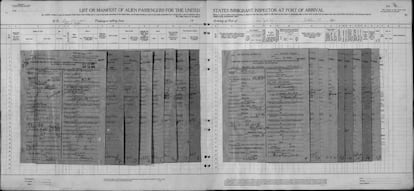
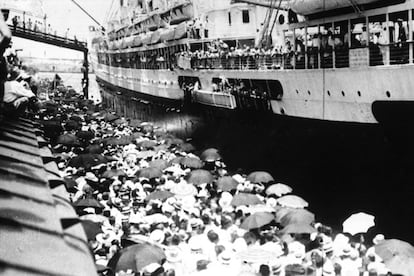
Another well-known cultural figure who had to leave was the writer Max Aub (1903–1972). Born in Paris, he arrived in Mexico in 1942. A member of the Spanish Socialist Workers’ Party (PSOE), he also worked for the Republican Government. He was detained by Francoist forces and sent to a concentration camp in France from which he managed to escape and travel to Mexico. “He entered as a political asylee on the steamship Nyassa,” his immigration card indicates. It also states that he was authorized to “engage in paid activities.” The author of the cycle of novels about the Civil War compiled under the title The Magic Labyrinth died in Mexico City.
But the vast majority of people for whom there are records are anonymous, not celebrities. “Family research is based on documents such as births, marriages and deaths. We even have a collection on tombstones, another one on newspapers... Any scrap of information found can help me learn more about who I am and where I come from,” adds Horowitz, who cites numerous cases of “people in the Americas who discovered through this research that their origins were in Spain.” On the Spanish side it is useful to learn more about ancestors who left to start a new life in Cuba, Argentina, Mexico, Venezuela or the United States.
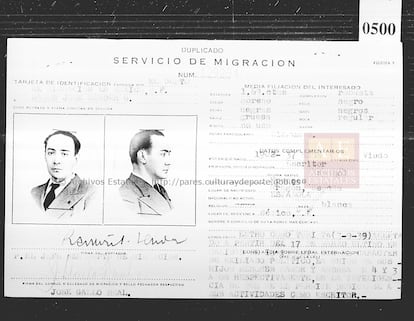
But if there is a literary figure who left behind an iconic novel about the Civil War, it was Ramón J. Sender with Requiem for a Spanish Peasant (1953). Among the data we find about his exile—first in Mexico in 1939 and, from 1942, in the United States, where he died in 1982—we see that he was a man of “robust physical constitution, black hair, thick eyebrows and a prominent chin.” Sender arrived “widowed”—his wife had been shot in the war by the Francoists—“and accompanied by his children Ramón and Andrea, aged 4 and 3 respectively.” These are the cold numbers and facts that tell the great Spanish tragedy of the 20th century.
Sign up for our weekly newsletter to get more English-language news coverage from EL PAÍS USA Edition









































