
Another crisis is driving Cubans to despair: More than three million suffer from water shortages on the island
Government authorities acknowledge that the country is experiencing ‘a very complex situation’ caused by drought and problems with the water system’s infrastructure. Some communities in Eastern Cuba have been without water for about five months

On the afternoon of September 30, the sun was as strong as it had been on previous days. The heat was pretty much the same as always, while the sea remained blue and subdued. And the José Martí Anti-Imperialist Platform, a plaza that hosts public events, was scruffy and almost empty… certainly not like those days in the early 2000s, when Cubans gathered there to shout patriotic slogans. Their chants would bounce off the windows of what was then the U.S. Interests Section in Havana.
Opposite the American office, Fidel Castro ordered the construction of a space that could hold more than 10,000 people, where the crowd loudly demanded the return of Elián González, a child who was the center of a custody dispute between family members in the U.S. and Cuba between 1999 and 2000.
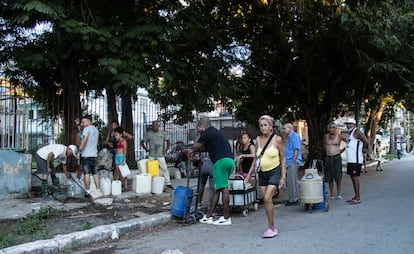
Next to the space named after the national hero and poet José Martí (1853-1895), there’s a cistern. And, on September 30, Alberto showed up, with a lackluster expression on his face and a pushcart in hand. Having gone 42 days without water at home, he arrived at the only place where he could still fill some buckets. The amount of water would last him two days at most.
“Everyone comes here… no one has told us anything yet,” the man sighed, as he filled his containers. To get to the storage tank, he had to walk several blocks from his home, which is located in Havana’s Vedado neighborhood. Three other people were in line with him, ready to carry as much water as they could.
Earlier, people had passed by with plastic bottles, tanks and buckets, finding a temporary solution to a much larger problem, which — according to Cuban authorities — is currently affecting 156,725 residents in the capital and more than three million across the country.
If the blackouts are enraging Cubans, the lack of water — and, therefore, the impossibility of drinking, cooking, washing, bathing (in other words, living life in its most basic form) — has them on the verge of collapse. Water outages as well as power outages mark people’s days. They work, leave home, or eat depending on when service is cut off or restored.
Around the same time as Alberto was filling his containers, a young woman grabbed her son and, holding several buckets, blocked the busy Monte Street in protest. A police officer tried to snatch a bucket away from her, but she forcefully took it back from him. She was angry after 15 days without water at home. She said that she didn’t even have enough water to take a pill.
A local resident told EL PAÍS that water hadn’t reached his tap since the beginning of September. “Sometimes, there’s a trickle of water at three or four in the morning. There are people who wait for it, but there are those who [have to go to] work and can’t. And when we can’t — because we don’t have water — we spend our days like this, until a truck [comes by],” the young man sighs. He asks that his name not be revealed.
On the black market, a tanker truck with water can charge users up to 25,000 Cuban pesos each (more than $55), which most people don’t have. As a result, the young man always waits for a relative who has water in another municipality in Havana to let him go get cleaned up or cook at his home.
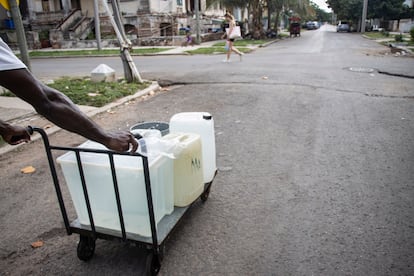
The outlook, which the government has described as “a very complex situation,” is similar across almost the entire country. Santiago de Cuba, the island’s second-largest city, is facing the worst drought reported in 10 years, which is currently affecting more than half-a-million people. Its residents only get running water every 38 days, while some communities in Eastern Cuba have been without it for about five months.
Cuba, a country surrounded by “water everywhere” — in the words of writer Virgilio Piñera — is also one where its people are grappling with extreme scarcity. Today, the island is like a body that’s slowly being dismembered: electricity, medicine, food and water are being cut off, making it difficult to continue moving.
But Cuba didn’t become like this overnight. “It’s a crisis that’s been developing for some time,” Jorge Piñón notes. A Cuban energy expert, he works as a researcher at the Energy Institute at the University of Texas at Austin. “We’ve turned our backs on Cuba’s infrastructure for almost 40 years… and it’s collapsing before our eyes.”
The causes of the crisis
Last year, President Miguel Díaz-Canel asked Antonio Rodríguez Rodríguez, head of the National Institute of Hydraulic Resources (INRH), when the water shortage in Cuba would be resolved. The official was as honest as he could be: “Giving you a date for when we can resolve the problems would be unfair,” he replied. “We aspire, realistically, that, given the pace we’re moving at, we can have a better situation next year… although that doesn’t mean we’ll resolve all the problems [involving] leaks, blockages, [insufficient] water supply and other [issues].”
This year, the situation has only worsened. The government recently claimed that it was investing some five billion pesos in more than 300 water infrastructure projects, but no one is seeing the results.
Helena Solo-Gabriele is a professor at the University of Miami’s College of Engineering and a member of the Association of Cuban-American Engineers (ACAE). She insists that the lack of clean, accessible water on the island has been documented for decades. She points out that some of the main factors contributing to this are “the lack of maintenance of the water treatment system, the lack of electricity, which causes low or no pressure in the pipes, and leaks in the water distribution system.”
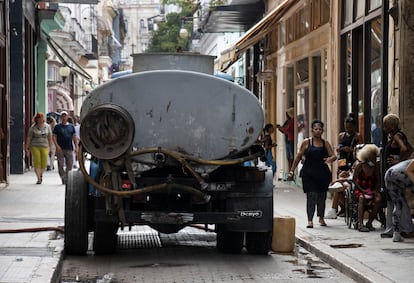
The Cuban government has acknowledged that this crisis has various causes. In addition to the lack of fuel in a sector that’s the second-largest consumer of electricity in the country, there are pumping equipment breakdowns and so-called “salideros” (water leaks). Authorities confirm that, in Havana alone, between 40% and 50% — and sometimes up to 70% of the water pumped — is lost due to the deteriorated water system.
“It’s all due to the lack of investment in hydraulic infrastructure,” Piñón explains. “It’s the same thing we’re experiencing today with thermoelectric plants. The aqueducts and pumping centers haven’t received operational or capital maintenance. Repairs must be massive — it’s not a patch that can be fixed with welding. This is extremely difficult.” The expert details that, in Cuba, the aqueduct system operates with a series of pumping stations. And these stations and motors are currently working almost 24 hours a day. “It’s not necessarily due to high demand, but rather because there are so many leaks… [it’s hard for the] pipeline to maintain pressure. [As a result], the motors are working continuously to maintain that pressure.”
In addition to the deplorable state of the country’s hydraulic infrastructure, there are natural factors that exacerbate the island’s water scarcity, which has been identified as one of Cuba’s main environmental problems. Solo-Gabriele insists that the country is “narrow, with the highest points along the island causing rapid runoff of rainwater toward the coasts.”
“Furthermore,” she adds, “the distribution of rainfall is uneven throughout the year, resulting in water shortages during the dry season.”
Drought is a problem that undoubtedly affects the country, even during these rainy months. The president of the National Institute of Hydraulic Resources (INRH) has stated that reservoirs currently hold 1.79 billion cubic meters below average, affecting a total of 900,000 people across the country. Cuba’s largest reservoir — the Zaza Dam, located in the center of the island — holds 106.4 million cubic meters of water, when it’s designed to store about 1.02 billion cubic meters.
“Cuba has always suffered from periods of severe drought, which is why reservoirs are so important to us,” Piñon notes. He asserts that this is another major challenge facing Cuba. “Reservoirs aren’t just holes in the ground that you dig and leave alone; they also require maintenance. [We’re] short on water because it’s barely raining; you have to have a well-protected and well-maintained reservoir system. Otherwise, the water will leak out naturally. The problem has gone on for so long without a solution that, now, it’s much bigger. And it will take much longer and cost much more money [to resolve].”
Sign up for our weekly newsletter to get more English-language news coverage from EL PAÍS USA Edition









































