
In Cuba, the Revolution has broken its promises: Hunger and homelessness are on the rise
While the official narrative tries to avoid the word ‘poverty,’ the inequality that the revolutionaries promised to eradicate is increasingly evident

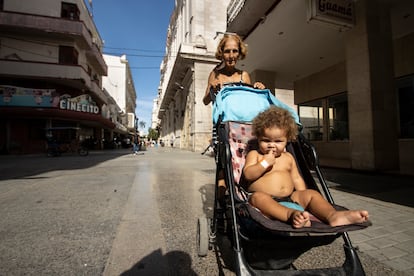
One day, in early-August, just before 5 p.m., Marta Pérez was seen begging for money. She was doing so under the relentless sun that was beating down on San Rafael Boulevard. With her finely-wrinkled skin, striped dress, short hair and very long nails, she was like an apparition on the streets of Havana.
The 70-year-old was pushing her one-year-old granddaughter in a stroller. The little girl with curious eyes — named Cristi, or Crista (Marta can’t quite remember) — accompanies her grandmother on the unpleasant chore of trying to collect one, two, maybe five Cuban pesos.
No matter how unpleasant it is, they have to find a way to eat. “Even if it’s just a little bit of rice and black beans,” Marta sighs. “Because I don’t have any money to buy meat.”
Marta lives with her daughter — a pregnant teaching assistant — her three grandchildren and her 79-year-old husband, who receives a pension. However, “it’s barely enough to buy groceries.” Marta — who, for years, sold croquettes, ice cream and soft drinks at El Viso restaurant in the urban neighborhood of El Vedado — was also entitled to her pension, but her employment record was lost, thus rendering her lifelong job worthless.
Once in a while, neighbors call her: “Come and wash my clothes, I’ll pay you.” Sometimes, she cleans houses. But what she earns isn’t enough — as is the case for almost everyone in Cuba today.
Marta would need approximately 41,735 Cuban pesos (almost $100 on the informal market) to guarantee a month of decent food. This is the equivalent of 20 monthly minimum wages — or two years of pensions — to sit at the table with a plate of rice, beans, meat and some type of root vegetable or salad. These were the calculations obtained by the Food Monitor Program (FMP), which is focused on tracking and reporting food insecurity in Cuba. To come up with these figures, the organization monitored food prices in stores, micro, small and medium-sized businesses, fairs and black market sales for a period of six months.
Today, it’s difficult to survive in Cuba: a country where blackouts stretch up to 18 hours, whole days pass without water, inflation is at 10%, food keeps getting pricier, and the U.S. dollar — which has hit a record of more than 400 pesos on the informal market — is eating away at the local currency.
Some organizations have dedicated themselves to quantifying Cuba’s misfortune. UNICEF asserts that a tenth of children on the island live in conditions of “severe food poverty. The Cuban Ministry of Public Health states that more and more Cubans eat only once a day. And the latest study by the Cuban Observatory of Human Rights (OCDH) reveals that seven in 10 Cubans have skipped breakfast, lunch, or dinner due to lack of money or food shortages, while nearly 89% of the population currently lives in extreme poverty.
However, the official narrative tries to avoid the word “poverty,” just as it has avoided acknowledging the ever-increasing inequality in the country — a problem the Cuban Revolution promised to eradicate or minimize when it put forward its national vision in 1959. Sociologist Elaine Acosta González — an associate researcher at the Cuban Research Institute at Florida International University (FIU) — asserts that, in Cuba, there’s a growing gap between rhetoric and reality, as well as between promises and achievements.
“These phenomena contradict the rhetoric of the Revolution, which specifically promised a better future — with equality and well-being — for its entire population,” she notes. “What we see 60 years later is an increase in poverty and inequality and, what’s worse, a denial by the government of the structural causes that are producing it.”
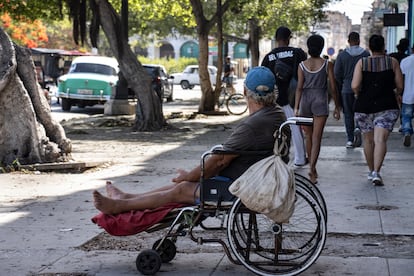
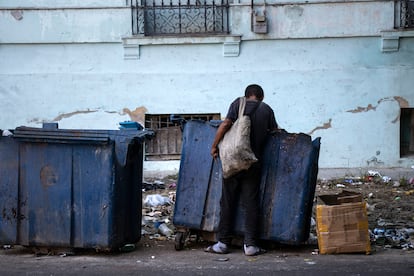
That denial was precisely the reason why, last July, Minister Marta Elena Feitó Cabrera — who led the Ministry of Labor and Social Security — resigned from her post 48 hours after publicly stating that there were no beggars in the country, even though the island’s streets are populated by people experiencing homelessness, clamoring for money or food. Even so, the official insisted that these were only people “who were pretending to be beggars.”
Cuban leaders — accustomed to addressing the issue of begging with all sorts of euphemisms, such as “itinerant behavior,” or people in “vulnerable situations” — had to come forward to acknowledge the magnitude of such statements. President Miguel Díaz-Canel himself immediately acknowledged that the increase in people living in poverty is “a concrete expression of social inequalities and accumulated problems” that have built up over decades, while emphasizing his government’s commitment. But, like never before, the alarm bells of popular anger sounded. Never before had a public official been forced out of office by the contempt of Cubans.
“The minister’s statements caused so much outrage because they came at a time when Cuban society is experiencing one of its worst crises. Particularly during the summer, when the most acute effects of the energy crisis and the lack of water were felt, exacting a very high cost to citizens in terms of how to sustain daily life,” Acosta González explains.
The sociologist insists that this wasn’t the first time that officials or pro-government media addressed “the problem of homelessness from a criminalizing, punitive perspective, transferring responsibility for the widespread impoverishment of the population to individuals, [instead of recognizing it as] a result of social policies that have abandoned the distributive and egalitarian criteria of the past.” According to her, this is being done “in order to shift the responsibilities of well-being to the market or the family.”
Poverty in Cuba, years in the making
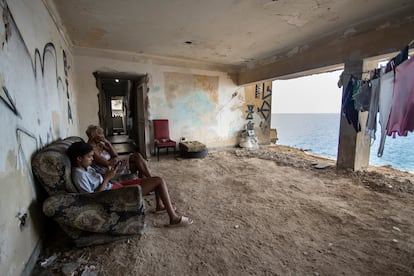
The lack of housing is another reason why many Cubans have ended up on the streets. The residents of the ruins of the Riomar Building — a product of the 1950s real estate boom in Havana’s colorful Miramar neighborhood — have one thing in common: most of them came from the east of the island, have no home of their own, lived in overcrowded conditions, or lost their houses to a hurricane. According to figures from the National Office of Statistics and Information (ONEI), Cuba — which is experiencing a severe housing shortage — has a deficit of 862,000 properties, although the real number is believed to be higher.
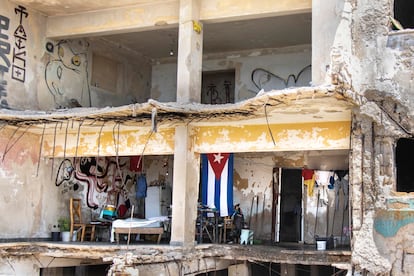
Yuneily Villalón, 44, now occupies a space in an 11-story complex with more than 200 apartments that was once a modern architectural gem of the city — with a lobby, reception area, ballrooms, several elevators, and two swimming pools. Its original owners left the country after the Castros came to power, and the building was later taken over by the government, like so many other properties on the island.
Today, Villalón lives in an apartment that has no windows or doors, facing the northern blue coast of Havana. She doesn’t know who the owners are. She has arranged cooking pots, a mattress and some furniture given to her by neighbors — people like her who also have nowhere else to live and have taken up residence in the building.
In her space, she displays a portrait of Fidel Castro. “This is my boss,” she declares.
She used to live in Santiago de Cuba, in the eastern part of the island. But some time ago, she decided to move to Havana. “There’s nothing there, there’s nowhere to work. I have to get ahead,” she sighs. Unemployment in Cuba remains at 12%.
Villalón arrived in Havana looking for work, hoping to bring her two children to live with her in the future. She earns about 1,500 pesos a month (less than $5) as a housekeeper in a convent. And yet, she says she’s better off than when she lived in the east. Sometimes, she has running water, although she also goes days without seeing it. Sometimes, she has electricity and cooks with the electric stove, and when she doesn’t, she prepares food with firewood by the sea. “I’m not the only one who lives like this,” she points out. “There are a few of us — people trying to get ahead.”
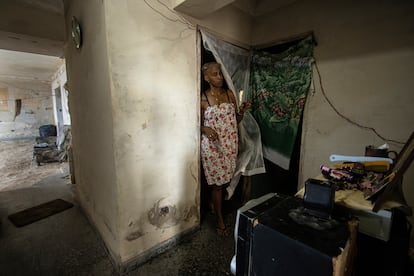
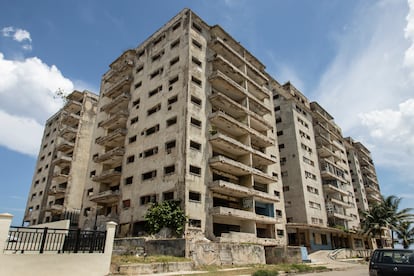
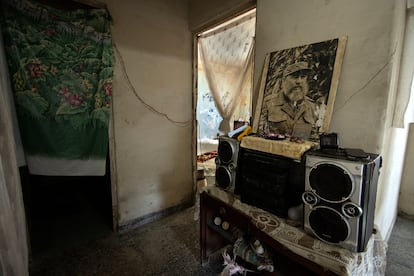
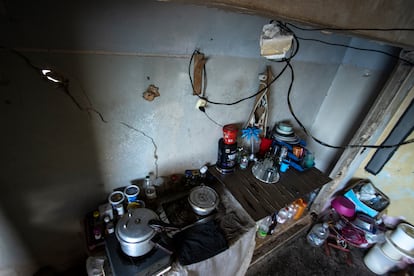
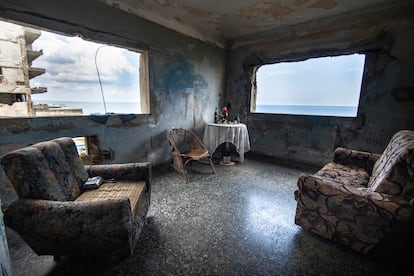
The building is home to people living on the margins, surviving on whatever they can. But it’s the best they’ve been able to find, and they live in fear of being evicted. Though ruined, the building shelters them from the rain and the early-morning cold. Without it, they would only have is the street — and they don’t want to live there. “Let’s see what they’re going to do with us,” Villalón says wearily.
Beyond official figures, it’s impossible to know the extent of the homelessness crisis in Cuba today. The last census on the island — conducted in 2012 — recorded that there were around 1,108 people with “wandering behaviors.” By 2024, the government itself acknowledged that more than 3,700 people were being cared for in “social protection centers.” However, the reality is worse than these numbers reflect.
Although the economic depression of the early-1990s saw more and more Cubans begin to live on the streets for lack of shelter or food, experts agree that the problem has escalated in recent years. The reasons? A country battered by COVID-19 and the resulting shutdown of tourism; the dollarization of the economy, which leaves the population dependent on remittances received from abroad; and economic measures deemed unsuccessful, which have drained the pockets of Cuban families and dragged the country into one of its worst crises.
Ricardo Torres is an economist and a former researcher at the Center for the Study of the Cuban Economy. Currently a professor at American University in Washington, D.C., he believes that other recent changes — such as the expansion of the private sector and the emergence of MSMEs (micro, small and medium-sized enterprises), which “have favored those who own property, capital, or reside in areas like Havana and other urban centers” — may also have exacerbated inequality.
“The unfortunate thing is that this widening gap in income and quality of life hasn’t been accompanied by solid economic growth, as has been the case in China or Vietnam. Instead, the country faces the most adverse combination: a declining economy and a widening social gap. This situation is a direct result of the economic model, its policies and various decisions adopted over the decades,” he maintains.
This past August, the Cuban government announced an increase in the average monthly salary to 6,649 pesos (about $15), or a 16.4% increase (a minimal amount for the average family). And, just one day after the labor minister’s resignation, a 50% increase in pensions was announced. According to Foreign Minister Bruno Rodríguez, this measure fell under the Cuban Revolution’s precept of “leaving no one behind,” benefiting 1,324,599 senior citizens. The minimum pension now stands at 3,000 pesos a month (just over $7.00). But, in the midst of a crisis where the elderly are the hardest hit, this increase still won’t help them make ends meet.
“The average pension has lost more than 60% of its purchasing power between 2021 and 2024,” Torres explains. “And inflation continues, albeit at a slower pace, so I fear [that raising salaries and pensions] offers only slight relief when compared to the sustained loss of purchasing power experienced by households, especially retirees.”
The economist doesn’t see a short-term solution to the Cuban crisis. “As this is a result of economic collapse, there’s no viable strategy to overcome the current crisis. It will require profound changes over several years; we’re not facing a typical recession.”
Sign up for our weekly newsletter to get more English-language news coverage from EL PAÍS USA Edition









































