
Enrique Márquez: ‘I receive more attacks from the opposition than from Chavismo’
The Venezuelan dissident, recently released from prison, defends his strategy of acting within the existing legal framework to push for a political opening based on persuasion and consensus
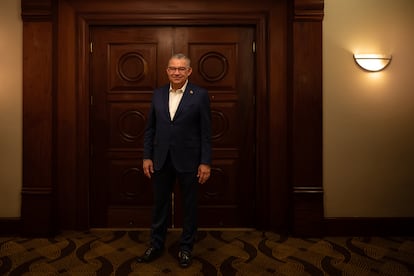
Enrique Márquez, 62, argues that democracy in Venezuela must be restored step by step and from within the institutions of Chavismo, the regime in place since the days of Hugo Chávez (1999-2013), who was succeeded by Nicolás Maduro. This position distances him from some other opposition leaders, but he is convinced that, in the current political situation, it is necessary to act within the existing legal framework to push for a political opening based on persuasion and consensus.
Fresh out of prison, Márquez —a moderate social democratic politician— has taken advantage of the momentum of the amnesty law and the personal invitation from Donald Trump to attend his State of the Union address to expressly criticize the current state of politics and constitutional rights in Venezuela.
His presence in Washington caused a stir and was poorly received by important sectors of the Venezuelan opposition. The leader, who considers the United States’ role in the return to democracy to be fundamental, prefers to avoid the controversy.
Question. How do you see the current situation?
Answer. I believe Venezuela is a different country after January 3. An external factor became an event that dramatically altered the internal landscape. Obviously, there’s a new dynamic: the players have shifted. These events caught the opposition off guard. The U.S. government has made controversial and complicated decisions, but they offer the country an opportunity.
Q. What do you think about Delcy Rodríguez being in power?
A. It will depend on her actions. She is a product of her circumstances. What I do believe is that she is obligated to make the changes that are being proposed in the country. Our role will be to engage in politics and force those changes.
Q. How can that transition be forced?
A. We need a concerted effort from Venezuelan society to pressure the government. Changes must continue in the right direction. Right now, we are in the process of appointing a new attorney general and an ombudsman, given the resignations of both. We should aspire to an attorney general who is independent in office, who is a guarantor of the State, as is their duty, and who keeps his distance from political actors. But if we don’t like the process and simply withdraw from it, we would be making a mistake. We must participate and exert influence from within.
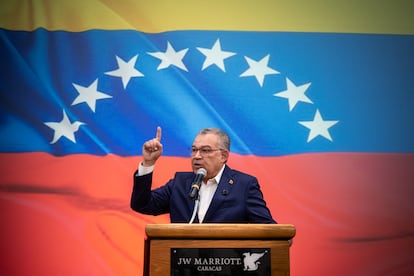
P. The regime’s repressive apparatus remains active.
A. Yes, of course. But the only way to move towards democracy is by challenging this situation. We need to undertake a complete renewal of public institutions. We must restore full freedom of expression, which will lead us to a democracy through transparent elections.
Q. Those who support María Corina Machado argue that, with her clear leadership, the logical thing to do would be to align with her strategy. What is your response to them?
A. I have great respect for María Corina Machado. I think she’s a very brave, persevering, and intelligent woman. She has many virtues as a person, without a doubt. There’s a reason she was awarded the Nobel Peace Prize. She’s one of the most important leaders in the country. But that doesn’t mean we should all stop being involved in politics. There shouldn’t be any devotees in politics. Right now, because I have my own point of view, I’m receiving more attacks from the opposition than from Chavismo. Quite inconsiderate insults, I might add. The paths to achieving democracy don’t have to be mutually exclusive. Besides, there aren’t any elections scheduled in the immediate future.
Q. Your complimentary words for [former Spanish prime minister] José Luis Rodríguez Zapatero have generated criticism in some sectors.
A. I approached this issue from a personal perspective. Mr. Zapatero behaved like a true friend, like a gentleman, with my family while I was imprisoned. I cannot be ungrateful. I also personally thanked President Donald Trump for what he did for my release from prison. And former Dominican President Leonel Fernández, as well as former Panamanian President Martín Torrijos. We are victims of a view of reality governed by the hatred fostered on social media.
Q. Do you share Zapatero’s views on the Venezuelan crisis?
A. I have some points of agreement and some disagreements. I have witnessed his work to free political prisoners. Zapatero has played a crucial role in getting people out of prison in Venezuela. I have the right to thank those who have helped me. Nobility compels me.
Q. How do you see the role of the United States in the Venezuelan crisis?
A. I must say that I would have preferred a different outcome for Venezuela. The international community, not just the United States, gave Nicolás Maduro many opportunities to reflect, to take responsibility, to open spaces for democracy. It wasn’t possible. International organizations had many problems finding a solution. We Venezuelans viewed what was going to happen with great pessimism, because we have already tried everything to regain our freedom.
Q. Are you concerned about the loss of national sovereignty to a foreign power?
A. The first thing we need to recover is popular sovereignty, the capacity to direct our own destiny. The United States is not interested in a permanent occupation. I believe they have a coherent plan for this process.
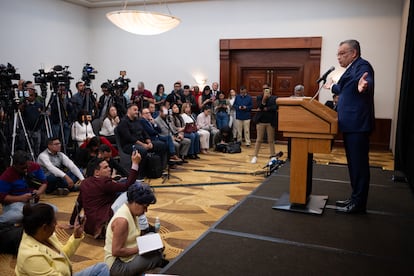
Q. How long might that process take?
A. I think the smallest amount of time possible, but the one necessary to do things right. It’s not so bad to have the world’s leading power as a trading partner. It’s not bad to sell them our oil, to have a close economic relationship with a country with such high purchasing power. We need to overcome poverty, reduce migration, reunite with our families, create quality jobs, and revitalize our oil industry and our private sector. The United States plays an important role in our fight for democracy.
Q. How do you assess the role of the Minister of Defense, Vladimir Padrino López, after what happened on January 3?
A. I have a more technical than political observation regarding his time as minister. The military world is usually based on the rotation of positions. There’s a natural way of filling responsibilities in the Armed Forces. Padrino should make way for new generations. He’s been in the same position for 12 years. I feel that opportunities need to be created. And I’m not saying this as an accusation, but from a professional standpoint.
Q. Should former officials like Miguel Rodríguez Torres be allowed to return to the country?
A. These are individual cases; each one has its own burden. Everyone has their spiritual and political karma. Rodríguez Torres was also persecuted, imprisoned, and his family was subjected to horrible things. I celebrate his return because he deserves to be here in his homeland. Just as I speak of him, I speak of the entire exile community.
Q. Do you see yourself running for president in a possible transition?
A. I ran for president in 2024 to try to develop a policy. My goal now is to ensure a democratic election at the end of a process of defending the Constitution. When we reach that point, we will have to see what conditions we are in.
Sign up for our weekly newsletter to get more English-language news coverage from EL PAÍS USA Edition









































