
Juan Pablo Guanipa’s arrest shows Venezuela’s regime still controls the machinery of repression
The detention of the opposition leader, just hours after his release, is intended to signal that the authorities remain firmly in charge. ‘There are people who think they can do whatever they want,’ warned Diosdado Cabello
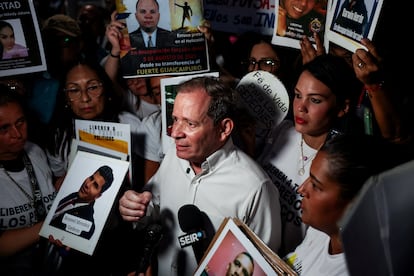
In Venezuela, every gesture of political openness is accompanied by a reminder of who truly holds power. The arrest of opposition leader Juan Pablo Guanipa — just hours after he had been released — served as a warning that contradicts the political opening that acting President Delcy Rodríguez has been projecting since January 3. The sudden arrest — carried out by heavily armed men in civilian clothes — underscores that control of the country remains firmly in the same hands despite recent changes and promises.
The arrest surprised political leaders, human‑rights advocates, and international observers. Many had interpreted the release of political prisoners — especially a large group of people close to opposition leader María Corina Machado, including Guanipa — as a major step forward in this new phase of Chavismo — the ruling movement built around the ideology of Hugo Chávez — without Nicolás Maduro.
Guanipa was released on Sunday after spending eight months in prison along with other political figures from Machado’s party. As soon as he left prison, he toured several avenues in Caracas, accompanied by dozens of supporters and other recently freed opposition leaders such as Jesús Armas. The scene — part of a growing wave of public protest led by families of political prisoners, students, and activists — was not well received by the government.
After Guanipa’s second arrest, the Attorney General’s Office — led by Tarek William Saab — issued a statement confirming that it had asked the Supreme Court to revoke the measure that had allowed him to be released. The request sought to replace his conditional freedom with house arrest. “The precautionary measures ordered by the courts are conditional upon strict compliance with the imposed obligations,” read the statement from the Attorney General’s Office. “Failure to comply empowers the judicial body, at the request of a party, to revoke or replace the previously granted measure.” According to Guanipa’s release document, his obligations were limited to a travel ban and the requirement to report to authorities every 30 days.
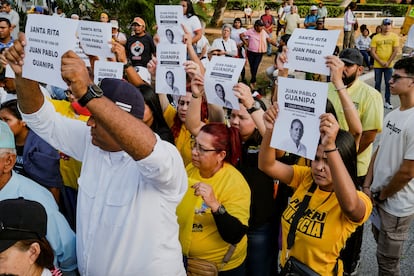
As Guanipa’s relatives demanded proof that he was alive, the government reinforced its message. Diosdado Cabello — Venezuela’s interior minister and the ruling party’s number‑two — publicly celebrated the renewed detention. “There are people who think they’re above the law. They think they’re superior, that they can do whatever they want. They’re not,” he said. Cabello argued that “justice works” and warned that those released were “being given a chance.” His comments carried weight: Cabello personally led the police operation that arrested Guanipa in 2024, when he was accused of conspiring against public order and promoting terrorism.
Guanipa’s arrest comes amid a national debate over a proposed amnesty law. Mediators such as former Spanish prime minister José Luis Rodríguez Zapatero, who visited Caracas last week, describe the bill as “ambitious” and potentially transformative. But human‑rights groups and parts of the opposition question how far it would actually go. The new arrest has only heightened tensions and deepened doubts just as the law is nearing approval.
From exile, Machado described what happened as a “kidnapping,” calling it an example of the government’s “fear of the truth.” In Maracaibo, activists and political leaders gathered in Plaza La República to demand Guanipa’s release. “If we start to see speaking out as a crime and not as a protest, when will the dictatorship end?” asked Ramón Guanipa, the opposition leader’s son, who denounced his father’s “forced disappearance.”
Tomás Guanipa, Juan Pablo’s brother and a leading figure within the more moderate wing of the opposition, described the personal and political impact of the incident. “It’s been a huge blow. We’re making a family effort to speak out about what happened,” he said. In his view, the case reveals “the serious risks we face right now,” even as the government promotes a narrative of reconciliation.
For sociologist and human rights activist Rafael Uzcátegui, the episode confirms that the Venezuelan government is not acting under external pressure. “It is neither a victim nor a hostage. It has its own agenda,” he says. In his view, two logics coexist today: one promoted by the United States, centered on stabilization, recovery, and transition; and another driven by the core of Venezuelan power, which proposes a political opening but with Chavismo still in control. “Citizens perceive that a rift opened up after January 3 and are trying to widen it, regaining trust in the public sphere,” he explains. However, he warns that “the structural foundations of political persecution in Venezuela remain intact.”
Guanipa, a member of the Primero Justicia party, closely aligned with Machado during the 2024 presidential campaign and a member of Edmundo González Urrutia’s electoral team, stood out for his firm and consistent stance against Chavismo’s authoritarian drift. His reputation — even respected by some adversaries — makes him a politically uncomfortable symbol for those in power.
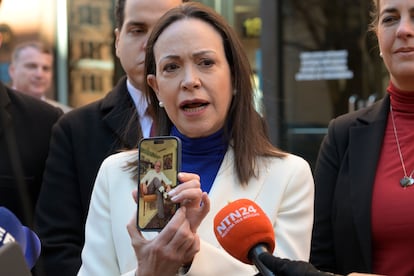
Meanwhile, the situation of political prisoners in Venezuela remains uncertain. The roughly 400 releases confirmed so far have all been conditional, involving precautionary measures and mandatory check‑ins rather than full freedom. “All those released have come out with precautionary measures,” explains Gonzalo Himiob, director of the NGO Foro Penal. “Once the amnesty law was approved, it was assumed that all cases should lead to full freedom. What we don’t know is how many prisoners and those persecuted could be excluded based on certain arguments.”
A broader debate about a potential political transition is permeating the current Venezuelan political landscape. Comparisons are being drawn to historical transitions — from post‑Franco Spain to Venezuela’s own political shifts in 1936 and 1958 — but historian Pedro Benítez warns against overusing analogies. “The history of transitions can only be explained in retrospect, not before,” he says. In his view, the regime may choose to buy time, alleviate external pressures, or address its own internal tensions. “We don’t know how this will end,” he says.
For now, Guanipa’s arrest underscores that any political opening in Venezuela still unfolds under the shadow of the power structure that controls it.
Sign up for our weekly newsletter to get more English-language news coverage from EL PAÍS USA Edition









































