
Human rights activists, opposition members, and a minor: Maduro’s other political prisoners
Venezuelan organizations condemn the continued uncertainty faced by the 900-plus people not included in the 99 Christmas releases
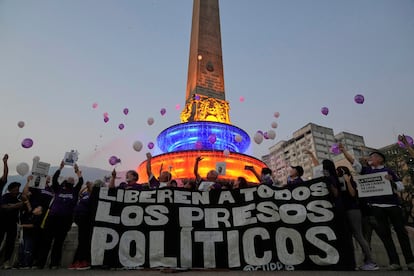

The Venezuelan government’s announcement on Christmas Eve that it would release 99 political prisoners has not yet been fully finalized. Little by little, families and lawyers are compiling lists of names and confirming whether the prisoners have actually been able to leave jail.
Releasing political prisoners is a tactic the Venezuelan government often uses to ease internal pressures or to negotiate agreements with the United States. But this time, the move is noteworthy for who is not being released. More than 900 people (174 of them military personnel) are still imprisoned for political reasons in 90 prisons across Venezuela. Among them are human rights defenders, opposition figures, several cancer patients, and a minor. Since 2014, over 9,000 people remain subject to judicial restrictions, according to Venezuelan human rights organization Foro Penal.
The announcement by the administration of Nicolás Maduro largely applies to prisoners convicted of protesting after the 2024 presidential elections. It also includes people who were jailed for criticizing the government on social media, such as Dr. Marggie Orozco, sentenced to 30 years in prison for sending a WhatsApp audio message. The NGO Justicia, Encuentro y Perdón (Justice, Reconciliation, and Forgiveness), which assists the families of prisoners, noted that “while there is solidarity and genuine shared joy for each release, the selectivity of these decisions is re-victimizing.” Those who remain imprisoned, and their families, are subjected to an indefinite wait, with no clear criteria or guarantees, “as if regaining freedom depended on chance rather than the recognition of a fundamental right.”
Families of political prisoners had hoped for releases in the context of the canonizations of José Gregorio Hernández and Carmen Rendiles, the first Venezuelan saints. They launched an intense campaign for the Church to advocate on their behalf. No releases were secured in October, when the ceremony took place at the Vatican. That month, in contrast, saw more than 50 new arrests. Months earlier, however, through a political negotiation announced by opposition leader Henrique Capriles Radonski, 13 political prisoners were released, including deputy Américo de Grazia and former Maracaibo mayor Rafael Ramírez, along with one of his associates, Pablo Guanipa.
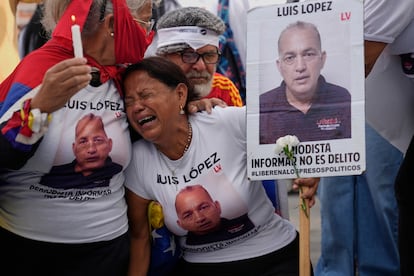
Human rights defenders have reported that 91 of the roughly 1,000 political prisoners suffer from “serious illnesses” and face, according to Justicia, Encuentro y Perdón, “progressive physical deterioration” as a result of what they call a “form of structural violence,” referring to unsanitary prison conditions and the scarcity of food and medicine. Among them are “at least eight patients with advanced cancer.” Nonetheless, these prisoners were not necessarily included in the Christmas releases.
Given the discretionary way in which conditional release measures are granted, Amnesty International again demanded the full freedom of five human rights defenders: Javier Tarazona, Rocío San Miguel, Carlos Julio Rojas, Eduardo Torres and Kennedy Tejeda.
Tarazona is one of the activists who has spent the longest time in prison. Through his NGO, Fundaredes, he documented the presence of irregular armed groups along the Venezuelan border with Colombia and the alleged links of high-ranking government officials to the ELN guerrilla and FARC dissidents. His social media accounts were frozen on July 2, 2021 — the day he was arrested while reporting to the Attorney General’s Office the harassment and persecution he was facing from Venezuelan intelligence agents. Four and a half years later, he remains in El Helicoide prison, and his legal proceedings have stalled.
More than 100 women imprisoned
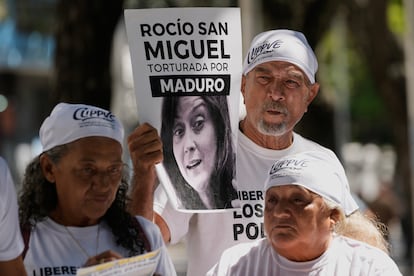
With Rocío San Miguel, detained on February 12, 2024, a line was crossed. The 59-year-old lawyer and internationally recognized defense specialist was arrested while heading to a flight at Maiquetía Airport. She was held in an unknown location for several hours, prompting the U.N. High Commissioner for Human Rights to raise the alarm over her possible enforced disappearance.
The Maduro government responded by expelling the U.N. representatives who had been stationed in Caracas since 2019. Her former partner was also detained under an investigation into an alleged conspiracy against the government. A year ago, it was revealed that San Miguel had suffered a shoulder fracture after a fall in El Helicoide, and months later her family and lawyers were still demanding medical attention. With her case, the number of women imprisoned for political reasons has reached 120, according to Foro Penal.
Carlos Julio Rojas is a journalist and community activist. He has been imprisoned since April 2024, also accused of conspiring. He had been detained three other times for participating in protests, and on one occasion he was sent to the Ramo Verde military prison.
Lawyer Eduardo Torres was arrested in May. He was held in an unknown location for a week and is currently in Yare II prison, on the outskirts of Caracas. He is a member of the NGO Provea, which has received precautionary protection measures from the Inter-American Commission on Human Rights (IACHR). Seven months later, the preliminary hearing in his case has still not taken place.
Kennedy Tejeda, a lawyer with Foro Penal, was arrested while visiting a National Guard (GNB) command in Carabobo State, in the country’s central region, to inquire about protesters detained during the 2024 post-election protests.
Amnesty International also called for the release of political analyst and media director Nicmer Evans, of Punto de Corte, who was detained for the second time a few weeks ago; journalist Rory Branker; and the teenager Gabriel Rodríguez, the only minor still imprisoned for political reasons. He is 17 years old and was arrested during protests against Maduro’s inauguration on January 9 of this year, and sentenced to 10 years in prison for “terrorism.”
The organization also demanded the release of opposition figure Enrique Márquez, 62, a former 2024 presidential candidate who had called on the Supreme Court to require the National Electoral Council (CNE) to publish the official election results. He is a moderate opposition leader who has advocated for a negotiated transition. He served as a deputy and then as a member of the CNE between 2021 and 2023, as part of a political pact aimed at giving the electoral body greater balance. He was arrested in January of this year, and nine months later was finally allowed to see his wife. “Enrique’s freedom, like that of so many men and women behind bars for their ideas or political commitment, should not be a bargaining chip, but a starting point for national reconciliation,” wrote Sonia Lugo de Márquez on social media on December 24.
Other high-profile political prisoners include Freddy Superlano, detained before the 2024 elections. A leader of the Voluntad Popular (Popular Will) party, he had been actively involved in the campaign for Edmundo González Urrutia’s candidacy. He was subjected to isolation and communication restrictions in El Helicoide, and in August he was transferred to another prison where his family has also been unable to see him.
Juan Pablo Guanipa, who has held political positions as a deputy, councilman, and gubernatorial candidate for the Primero Justicia party, was a close ally of opposition leader María Corina Machado. In December, he turned 61 in prison. Guanipa closely followed the 2024 election campaign and later went into hiding. On May 23, 2025, he was captured by security forces in the days leading up to the parliamentary elections in which much of the opposition abstained. His family reported weeks ago that he requires medical attention due to hypertension and insulin-related issues and that they do not know the conditions in which he is being held.
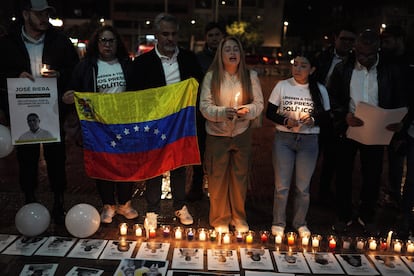
Vente Venezuela (Come Venezuela), Machado’s party, has the largest number of imprisoned leaders and members — around 140. Regarding the recent releases, the opposition leader and Nobel Peace Prize laureate warned on Saturday that they could not be considered true releases, since most remain subject to “unjust judicial processes and continue to be coerced by the regime.” In a statement, she called for an end to the so-called “revolving door” of political prisoners, in which new arrests continue despite releases. She urged the international community to increase pressure on Maduro and to “set as a clear objective the removal of the regime and the complete dismantling of its repressive apparatus.”
Sign up for our weekly newsletter to get more English-language news coverage from EL PAÍS USA Edition









































